
Coexistence of humans and mutants with The Fin, a movie
Director Park Se-young's new film <The Fin> depicts the conflict between the mutant 'Omega' and humans, set in a unified Korea.
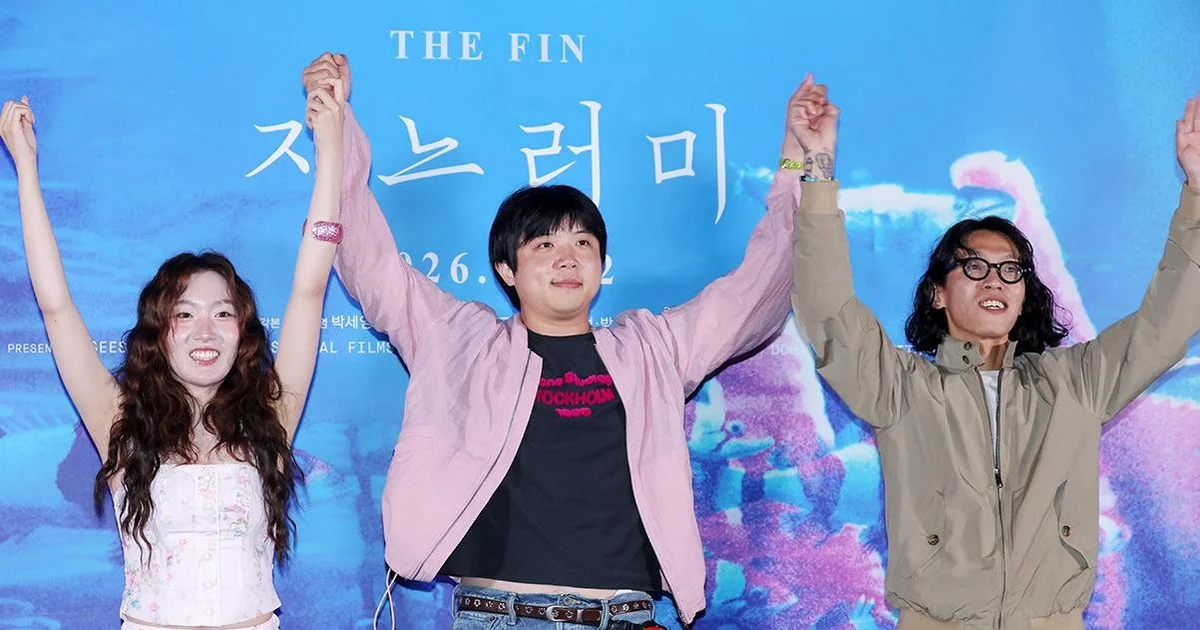
If fish fins were to sprout from a human body, how would society accept them? The film <The Fin>, releasing in theaters nationwide on July 22, poses this question and guides the audience into a near-future dystopia. This work, the second feature film by director Park Se-young, who directed <The Fifth Thoracic Vertebra>, is set in a unified Korea where humans coexist with 'Omegas,' a genetic mutation.
The setting is a near future where a massive wall stretching 4,000km surrounds the entire Korean Peninsula. Inside this wall, built to block the polluted ocean, the Omegas who have undergone physical mutations are pushed to the fringes of society and denied their very existence. They are classified as dangerous beings because they possess toxic fins or can deliver fatal attacks simply by screaming. The government monitors the Omegas and exploits their labor, while those who die or are killed are wrapped in crude bags and thrown into the sea.
A Dystopia Trapped Within a 4,000km Wall
The narrative follows the perspective of a new civil servant, 'Soojin' (played by Kim Pu-reum). Tasked with managing and monitoring Omegas, Soojin begins to tail an Omega named 'Gou' after witnessing them attempting an escape. In the process, Soojin encounters the Omega 'Mia' (played by Yeji Yeon). Mia is a character living an ordinary daily life, working at a fishing tackle shop and playing the piano while blending in among humans.
The film portrays Mia's peaceful daily life where the characteristics of her mutation are not revealed. There are no scenes of her threatening someone with a poisonous fin or bursting human eardrums by screaming. Mia exists simply as an ordinary young woman attending to customers at a fishing tackle shop and stopping by a piano academy. This setting demonstrates that the social stigma defining Omegas as 'threatening monsters' is a fiction.
As Soojin watches Mia, her perception of Omegas changes. She goes as far as telling her mother, who loathes Omegas, "They don't seem that dangerous." However, the moment Mia is finally confirmed to be an Omega during the tailing, Soojin faces a situation that shakes her own perception.
Symbols of Unification and Boundaries Drawn by Director Park Se-young
Director Park Se-young conceived this film from the discrepancy between the expectations of unification she encountered while living abroad during her childhood and the indifference she felt after returning to Korea. The setting of a massive wall encompassing the entire Korean Peninsula, rather than a wall dividing South and North, is a result of the director's imagination.
The title 'The Fin' is a core symbol that determines the characters' fates and drives them forward. The fin, an organ that allows movement forward in water, carries the characters' wishes at the center of the work. Director Park Se-young stated that the true protagonist of this work is not a human, but 'The Fin' itself.
Dichotomous Structure and Social Exclusion
The work omits specific explanations or rationalization processes regarding why the Omegas acquired such physical characteristics or what stories they carry. It presents the audience with the dichotomous situation of Omegas and humans as a given state.
The film focuses on depicting the process by which boundaries established for safety become violence that excludes certain beings over time. It delves into how society handles beings that do not fall into the category of 'normal' as defined by society, and the inhumane acts that occur in that process. The film <The Fin> has been invited to numerous international film festivals, including the Locarno International Film Festival, Seoul Independent Film Festival, and Jeonju International Film Festival, and has a running time of 83 minutes.
0Comments