
The 'Sweet Hell' of a Pension Lottery Winner: Why Unearned Income Ruins Lives and How to Solve It
A video has been released exploring the impact and dangers of unearned income on an individual's economic and mental life…
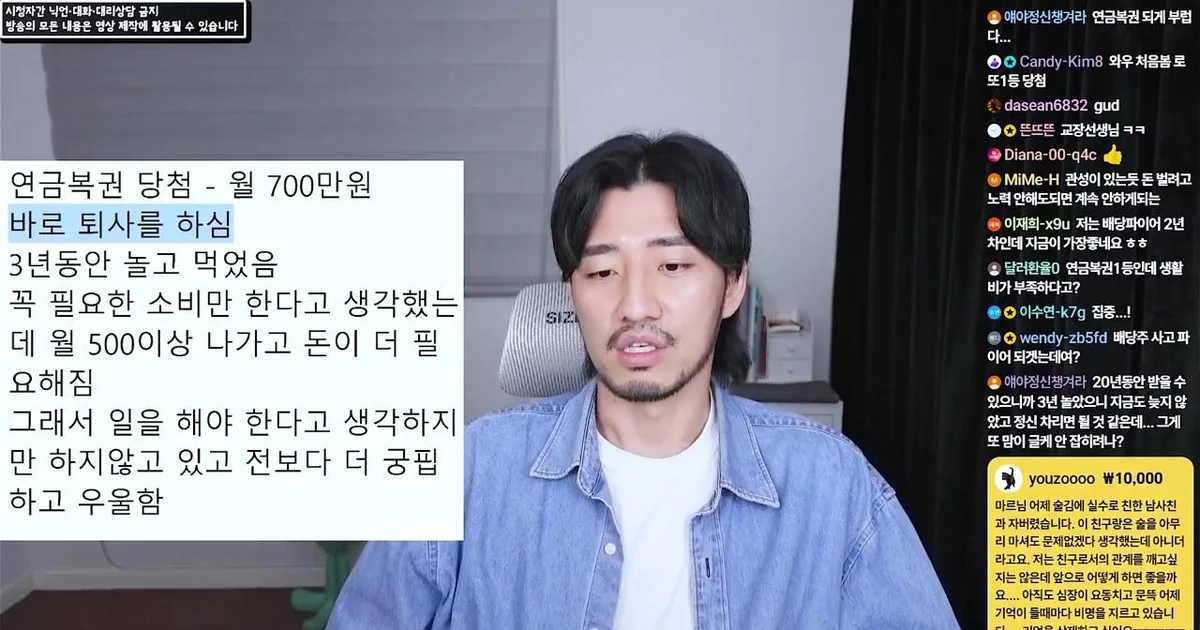
Through the case of a winner who did not work for three years after winning the first prize in the Pension Lottery, a video has been released dealing with the impact and dangers that unearned income has on an individual's economic and mental life.
Structural reasons why unearned income accelerates consumption
The speaker in the video developed the story based on the account of a viewer who began receiving a fixed amount every month after winning the first prize in the Pension Lottery. The viewer stated that after resigning immediately after the win, they took a three-year break, but are currently in a more destitute state than before the win. In a situation where approximately 5.46 million won per month after taxes (based on the Pension Lottery first prize amount) is continuously paid, the speaker analyzed why such unearned income makes it difficult to control consumption.
The speaker explained that the structure of unearned income makes it much easier to spend than earned income. Unlike cases where one must earn a certain amount through labor, unearned income lacks the pressure of physical time and labor that must be invested for consumption. In particular, the speaker emphasized the 'principle of adaptation,' stating, "It is easy to raise consumption, but very difficult to lower it," noting that once one adapts to a certain level of consumption, it is difficult to return to the previous standard of living.
The atrophy of labor capacity fallen into 'Sweet Hell'
The speaker described the environment where continuous unearned income is provided as 'Sweet Hell.' This is because, in a situation where a fixed amount comes in every month, the motivation to continue economic activities drops sharply. The video pointed out that when labor capacity has atrophied due to taking a break for three years, it is psychologically very difficult to start general economic activities, such as a part-time job at a cafe.
Furthermore, the speaker analyzed that unlike the general economically active population who must spend time to earn money, unearned income earners have physically more leisure time to spend money, which becomes a factor that explosively increases spending power. The explanation is that the emptiness that occurs during the time not spent working can lead to consumption.
Proposing 'Systemic Control' to forcibly tie up assets
To overcome this situation, the speaker suggested building a forced 'system' rather than relying on individual willpower. They presented a method of forcibly tying up a certain amount of the prize money (e.g., 4 million won per month) through index investing, dividend stocks, or installment savings. The logic is that if assets are systemically fixed this way, an environment is created where one has no choice but to live within the remaining amount (e.g., 1.46 million won per month), naturally allowing one to engage in economic activities simultaneously.
The speaker concluded by advising, "The joy of winning can be fully enjoyed with the remaining amount," and stated that to ensure the prize money becomes a weapon for retirement rather than a weapon that ruins life, one must create a system to control the flow of assets themselves.
0Comments
Comments are currently disabled.