
Yen Enters 800 Won Range… A Crossroads Between 'Japan Travel' Consumption and 'Yen Investment'
As the Japanese yen exchange rate drops into the 800 won range, interest in both traveling to Japan and investing in the yen is rising simultaneously.
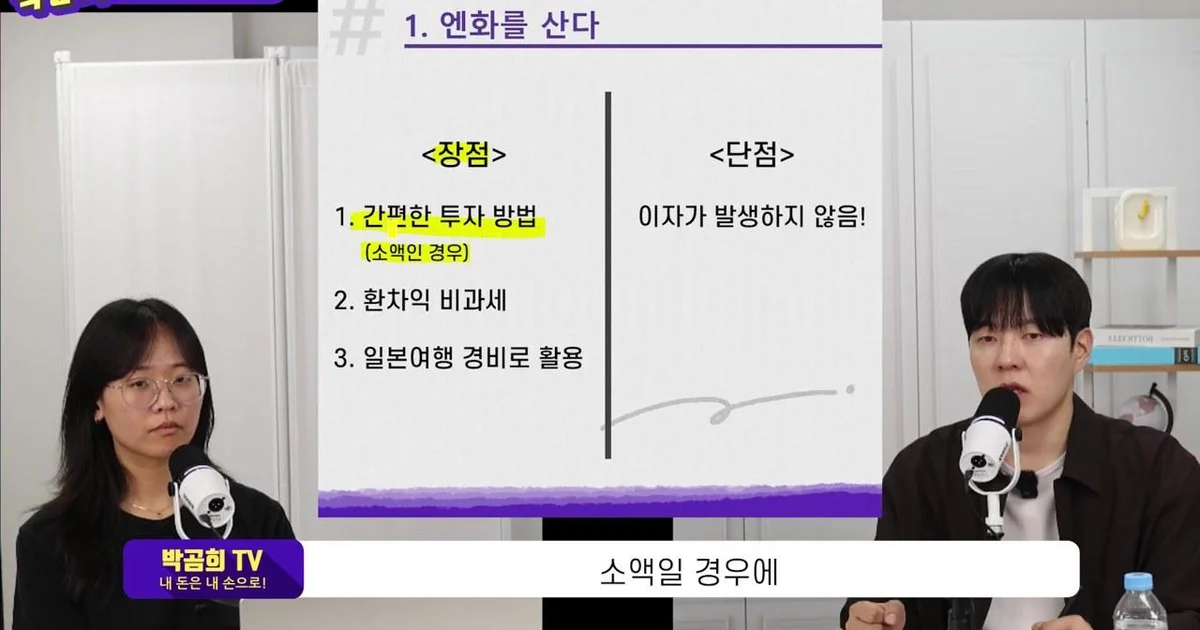
Recently, as the Japanese yen exchange rate has fallen into the 800 won range, interest in both traveling to Japan and investing in the yen is rising simultaneously. At a time when the yen has become cheap, an economic judgment is required on whether to utilize this for simple consumption (travel) or as an opportunity for asset growth (investment).
The Difference in 'Scale' Between Consumption and Investment… The Real Value of the Exchange Rate Effect
According to a Park Gom-hee TV video, 'consumption' through traveling when the yen is cheap and 'investment' by purchasing yen show a large difference in the expected economic scale. This is because consumption through travel ends as a one-time expenditure, whereas in investment, the absolute amount of expected profit varies depending on the size of the assets.
For example, if a 4-day, 3-night trip to Okinawa for two people is planned at a 'luxurious level,' it is assumed that fixed costs of approximately 1.5 million won will occur, including airfare, accommodation, and car rental costs. In the case of Okinawa, themes are divided by region: Naha, which is centered on shopping; Chatan, which has sunsets and street culture; Onna, which has marine activities; and the northern region, which has nature activities. In the video, if accommodation for two people is chosen at a level of about 500,000 won per night, 750,000 won (375,000 won per person) will be spent on 3 nights of accommodation, and when airfare and car rental costs are added, a total cost of 1.5 million won is calculated.
If the past exchange rate was in the 1,000 won range and has now fallen to the mid-800 won range, the cost reduction effect due to the falling exchange rate is limited to about 150,000 to 200,000 won. The analysis suggests that excluding the qualitative value of the joy of travel, this may not be significant in terms of economic benefit. On the other hand, in the case of investment, the scale is different. In the video, assuming 15 million won is invested in yen, if it is assumed to recover to the level of 950 won, which is the average exchange rate of the yen over the past 5 years, an expected return of approximately 10% can be expected. In this case, the expected profit reaches about 1.5 million won, which is a scale that can cover the entire aforementioned travel cost (1.5 million won) with the profit. In other words, the logic is that because the scale of investment is larger than the scale of consumption, generating profit using exchange rate fluctuations can have greater economic meaning.
The Impossibility of Predicting Exchange Rates… A Probabilistic Approach Based on Data
Predicting the future direction of the yen is a very difficult area. This is because the exchange rate is determined by a complex combination of various macroeconomic variables such as the interest rate differentials of each country's central bank, monetary policy, bond yields, and foreign exchange reserves. The participant emphasized that "predicting the exchange rate is a waste of time," stating that it is impossible to hit the exchange rate at a specific point in time.
However, a probabilistic approach is possible through past data. The video mentioned a case where the yen hit a low point in the 850 won range in the past and rebounded to the 1,000 won range, suggesting that the current low yen situation is similar to the low point in the past. In particular, the yen exchange rate against the Korean won has exceeded 1,000 won after hitting a low point in the 850 won range in the past, and the recent trend is also viewed as touching the low-point zone of the past. Of course, the possibility of further declines cannot be ruled out, but the opinion is that if a judgment is made that 'the current yen is sufficiently cheap' based on past data, one could consider purchasing. The fact that Japan's 10-year government bond yield has recorded 3%, meaning Japan's interest rate situation has changed from the past, can also act as a variable.
The Psychology of Consumption and the Psychology of Investment… Differences in Decision Making
The decision-making methods in travel (consumption) and investment are clearly distinguished psychologically as well. Consumption is based on a one-time judgment that 'it's cheap, so I must go now.' Even if the exchange rate falls further, if the trip has already been taken, the psychological impact of additional losses is small. On the other hand, investment is accompanied by the fear of a decline (Downside Risk), such as 'it's cheap now, but what if it falls further?' This is an inherent psychological challenge that investors must face.
In conclusion, enjoying low prices through travel to Japan to obtain qualitative satisfaction is the realm of consumption, and aiming for the increase in the value of the yen to grow assets is the realm of investment. The video suggested that under the judgment that the yen has entered a sufficiently low range, increasing the investment scale to cover consumption with the profit generated from the rise in the exchange rate may be advantageous in terms of economic scale. The logic is that if one goes on a trip after the exchange rate rises, even if the travel cost has increased, it could be like 'going on a trip for free' by offsetting it through investment profits.
0Comments
Comments are currently disabled.