
"2 million won became 200 million won"... Author Kim Un-a's secret to long-term investment success is 'separating accounts'
Author Kim Un-a shared her experience of turning a 2 million won investment into 200 million won through her children's accounts and suggested separating…
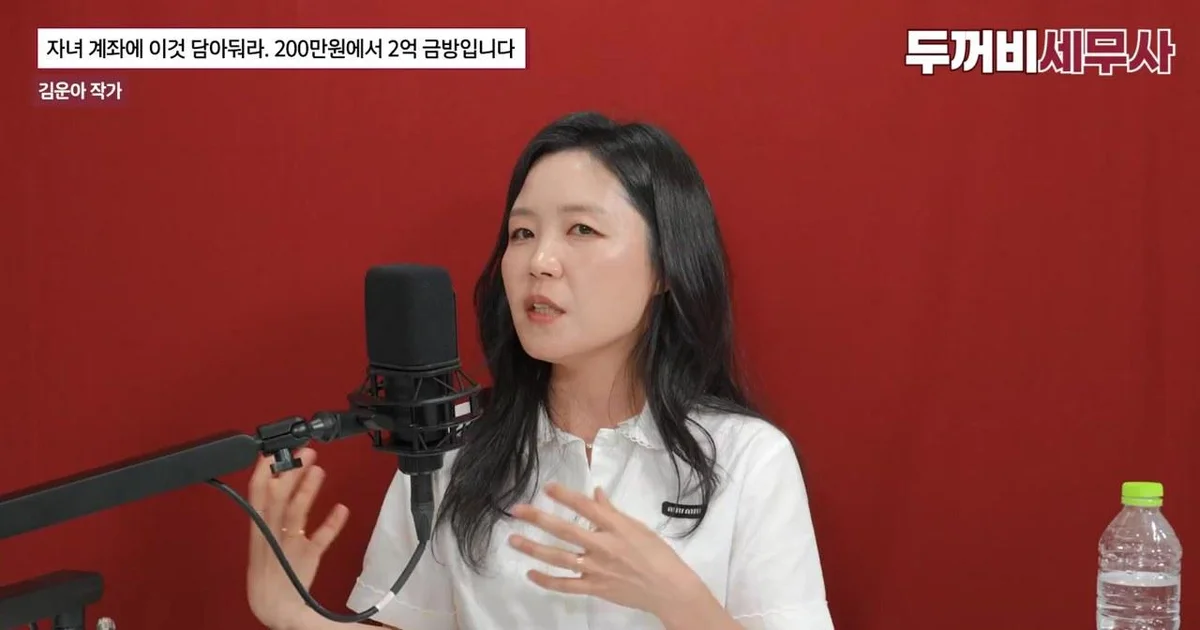
Maintaining long-term investment amidst stock market volatility is by no means easy. Many investors repeatedly engage in frequent trading, aiming for opportunities to buy low and sell high, but often fail because they cannot utilize the 'power of time' that actually brings large profits. Author Kim Un-a, who recently appeared on the YouTube channel 'Finance with Toad Tax Accountant', presented specific methodologies to control investment habits by citing a dramatic profit case experienced through her children's accounts.
"2 million won became 200 million won"... The power of long-term investment proven by children's accounts
Author Kim Un-a stated that the accounts she created for her children are representative examples showing the power of long-term investment. Kim deposited 2 million won into each of her two children's accounts, purchased the same stocks she held, and left them untouched for a long period. As a result, the return on those accounts exceeded 10,000% at its peak, and the initial investment of 2 million won grew to approximately 200 million won.
Kim said, "Seeing an amount that was only 2 million won turn into hundreds of millions in profit made me realize that long-term investment is the best secret." She pointed out the realistic limitation that as the investment amount grows, it becomes harder to maintain patience, noting that if the investment at that time had been 20 million won, she likely would not have been able to maintain patience and would have sold while the returns were increasing. She emphasized, "It is not that we lack patience, but that the money lacks patience," adding, "Since you cannot make money wait if there is not enough of it, it is important to start investing with small amounts to experience the power of time."
Based on the conviction gained through this experience, Kim suggested a strategy of laying index-tracking ETFs such as S&P 500 or QQQ as the foundation of a portfolio. However, since index tracking alone can be boring, she advised including individual stocks in the portfolio. She stated, "Because I started with individual stocks, my fear of them is lower than others," expressing the view that in the case of blue-chip companies, it is actually correct to buy when the stock price falls.
How to control trading habits, "Separate your accounts into two"
One of the difficulties many investors face is being unable to resist the 'temptation to buy and sell.' In particular, investors accustomed to the volatility of the domestic stock market are prone to repeating the trading habit of wanting to sell when profits are made and wanting to buy again when prices fall. Kim diagnosed that it is impossible to control these instinctive human habits through willpower alone.
As a solution, Kim suggested the 'dualization of accounts.' That is, one account is operated as a 'trading account' to respond flexibly to market conditions by buying and selling, while the other is separated as an 'accumulation/holding account' that holds stocks for the long term without selling, even if the amount is very small. Kim advised, "I myself conducted trades through my own account while simultaneously gaining experience in long-term holding through my children's accounts," and "If you are an investor without conviction, you must experience holding without selling, even with a small amount."
Furthermore, she added that to stick to investment principles, one must clearly recognize 'ways to fail.' Citing the case of Charlie Munger, Kim explained, "If you know exactly the certain ways to fail (leveraged investment using loans, blind investment following others' recommendations, etc.), paradoxically, you can avoid failing by avoiding those actions." She warned of the dangers of liquidation using leverage or buying just by listening to others, saying, "If you do not do exactly what leads to failure, you will never fail."
Children's economic education, "Need for balance between the value of labor and capital income"
As stock investment for children increases, parents' concerns regarding economic education are also deepening. Kim expressed concern about teaching only the principles of capital income to children at too early an age. This is because if children are given the perception that capital income can earn money more easily than labor income, they may disregard the value of labor or develop speculative tendencies before preparing for economic independence. In particular, regarding the profit-centered mock investment education currently conducted in schools, she expressed opposition, saying, "It is a competitive method that requires achieving maximum performance within a specific period, which is different from what I aim for."
Kim said, "It is desirable to naturally have conversations about investment and hand over the account when the child is socially prepared and able to prove their own abilities." She noted that while she is actually buying stocks for her children's future, the process of the child building 'economic muscles' by gathering seed money themselves (e.g., gathering 100 million won) must come first. She stated that she does not plan to hand over the accounts immediately until the children possess the ability to achieve economic independence.
In fact, Kim mentioned that she plans to use the stock assets prepared for her children's future for expenses such as studying abroad at an overseas culinary school in the future. She advised experiencing the entire flow of the market and establishing one's own principles, saying, "You can only say you have truly invested after experiencing not only the good times but also the bad times in the stock market."
0Comments
Comments are currently disabled.