
Financial Services Commission to Launch Second Public Participation National Growth Fund Worth 600 Billion Won; Sales Begin September 30
The Financial Services Commission has confirmed the second launch of the "Public Participation National Growth Fund…
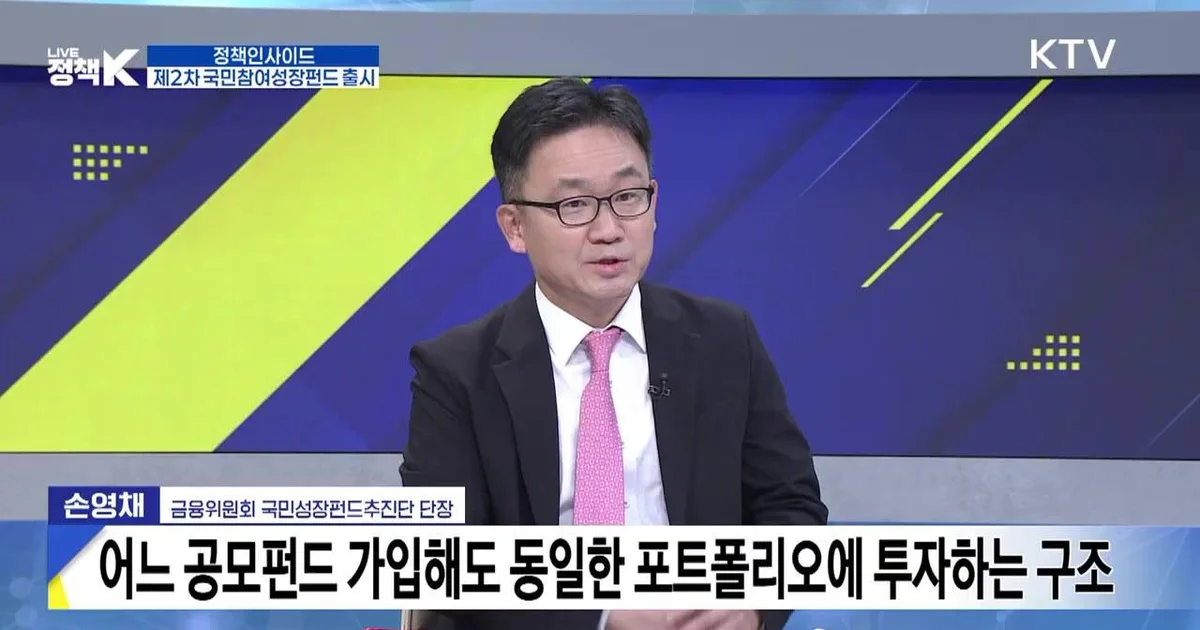
The Financial Services Commission has confirmed the second launch of the 'Public Participation National Growth Fund,' which was successful during its first launch, and will conduct sales for two weeks (10 business days) starting from September 30. Based on the performance of the first round, the scale of this second fund has been determined to be 600 billion won, with supplemented sales methods and support details.
Increasing 'Pre-allocation' Proportion to 50% to Expand Opportunities for Ordinary Citizens and Youth
According to a Financial Services Commission video, this second Public Participation National Growth Fund focuses on expanding participation opportunities for ordinary citizens and the youth. During the first sale, 87.1% of the target amount, 522.4 billion won out of the 600 billion won target, was sold on the very first day, recording a virtual sell-out. Even though online volume was limited to below 50% of the total at that time, the limit for non-institutional investors was completely exhausted, showing a heated response as limits were depleted in less than 10 minutes at some securities firms.
During the first sale, 20% of the total sales amount was pre-allocated to ordinary citizens in the first week, but in reality, the proportion of ordinary citizen subscribers soared to 35%, showing high demand. Accordingly, for the second launch, it has been decided to boldly expand the proportion of ordinary citizens to 50% during the first week of the two-week sales period. Son Yeong-chae, head of the Financial Services Commission National Growth Fund Task Force, explained, "If we only aimed for the success of this product, there would be no need to increase the pre-allocation for ordinary citizens like this," and added, "To provide opportunities to many people in accordance with the purpose, we have confidently raised the sales standards for ordinary citizens significantly."
The standard for ordinary citizens is set at 50 million won or less for those with only earned income, and 38 million won or less for those with comprehensive income. Son added, "Since the youth category, which falls under ordinary citizens, accounted for more than 60% during the first round, we expect that increasing the pre-allocation ratio for ordinary citizens will also benefit the youth." Considering the difficulty of meticulously examining individual incomes on-site, immediate judgment is possible through the National Tax Service by utilizing the ISA ordinary citizen product standard.
The subscription limit is 100 million won per person per year. Although the limit for receiving tax benefits under tax law is 200 million won, it has been limited to 100 million won to provide opportunities to more citizens. Sales will be conducted through a total of 24 financial institutions, including commercial banks, local banks, and 14 securities firms, and online subscription is also possible. However, internet-only banks were not included in this group of sellers.
Maximum 40% Income Deduction... Aiming for Stable Management through 'Non-redemption Type' Structure
Tax benefits for subscribers are designed at an unprecedented level. Differential income deductions will be applied according to certain intervals of the subscription amount. For up to 30 million won, a 40% deduction is given; from over 30 million won to 50 million won, a 20% deduction; and up to 70 million won, a 10% deduction benefit is provided. If 70 million won is subscribed, a total of 18 million won in income deduction can be received in that year. Son stated, "Since the investment period of five years can be a psychological burden, we decided to provide significant tax benefits as well."
The product structure involves distributing a total of 720 billion won—consisting of 600 billion won collected from citizens plus 120 billion won in government finances—to 10 asset management companies for operation. Each management company will operate the fund for 15 years, and after 5 years, the returns of the 10 funds will be aggregated and distributed fairly to the subscribers. Through this, it is designed so that subscribers can enjoy the same portfolio and returns regardless of which financial institution they subscribe through.
A point to note is that this product is a 'non-redemption type.' Because it is difficult to select promising investment targets if the managed funds fluctuate, redemption has been restricted to ensure stable management. However, Son emphasized, "Since it is a financial investment product, the principal is not guaranteed," and explained that if the product is sold within 3 years after receiving tax benefits, the deducted benefits must be returned. He also mentioned measures related to the exchange in case urgent funds are needed.
Investing in High-tech Industries and Unlisted Companies... Entrusted to 10 Management Companies
The investment targets will be selected centered on 12 major industries supported by the government. It will focus on investing in industrial sectors where our country possesses competitiveness amidst the global technology war. For asset allocation, the primary purpose investment proportion is set at 60% to secure stable returns, and the remaining 40% is left to the capabilities of the management companies as discretionary investment areas, such as listed stocks. In particular, more than half of the primary purpose investment proportion will be managed in a form where new funds are injected into promising unlisted companies or KOSDAQ technology-specialty listed companies. This is to live up to the purpose of the fund by taking the form of injecting new funds rather than purchasing existing stocks.
The 10 asset management companies that will operate the fund consist of 2 large-scale, 4 medium-scale, and 4 small-scale companies. The management scale is largest for the large-scale management companies, while medium-scale companies handle 80 billion won each, and small-scale companies handle 40 billion won each. In this second selection process for management companies, while re-evaluating the capabilities of existing management companies, a new recruitment was conducted to give opportunities to new management companies as well. Three of the management companies selected in the first round were selected again for this second round.
The Financial Services Commission stated that it will proceed with entrustment considering the unique strengths of each management company (such as specialization in listed stocks or unlisted stocks, etc.), and plans to increase the reliability of the public offering fund by having the government and industrial sectors conduct continuous monitoring. Son said, "The purpose is to share the achievements of the Public Participation National Growth Fund project promoted by the government with many citizens," and added, "We have prepared various devices, such as monitoring and providing incentives, so that management companies operate it well as if it were their own money."
0Comments
Comments are currently disabled.