
Hyundai Motor Company develops data recipes to deploy Atlas humanoid robots
Hyundai Motor Company is developing a data-driven learning system to convert the expertise of skilled workers into digital "recipes" to prepare the Boston Dynamics humanoid robot Atlas for manufacturing environments.

Hyundai Motor Company is building data recipes to prepare the Boston Dynamics Atlas humanoid robot for deployment at the HMGMA plant in Savannah, Georgia. The Robot Application Solution team aims to first utilize the robots for repetitive logistics and material handling tasks before expanding into assembly.
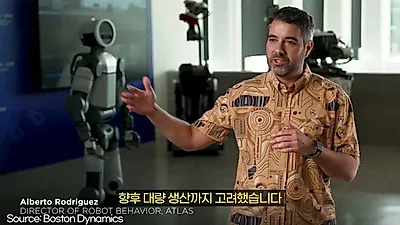
For the humanoid robot 'Atlas' from Boston Dynamics to operate in actual automobile manufacturing sites, the process of converting the skilled techniques of humans into data is essential. A job interview released by HYUNDAI details the role of the 'Robot Application Solution' position, which designs and verifies data recipes to ensure humanoid robots can settle into production lines.
Capturing skilled workers' gaze and hand positions to respond to site variables
Kim Gi-beom, a senior manager on the Hyundai Motor Company Robot Application Solution team, is responsible for discovering, collecting, and verifying data so that Atlas can perform practical roles at manufacturing sites. In particular, to enhance the working capabilities of humanoids, the team is focusing on building 'data recipes' that sense and process manufacturing know-how into raw data that robots can follow.
The greatest challenge in the data collection process is the high volatility of manufacturing sites. While humans can respond flexibly even if the environment changes minutely, robots must learn all changed environments as data. Even for the same vehicle model, the vehicle version or shape may differ between the time of data collection and the actual work time, and issues arise where the environment itself changes as robot-friendly work environments are implemented.
To solve this, a system is needed to precisely collect vast amounts of information—including the movements, gaze, hand positions, and work sequences of skilled workers—beyond mere quantitative expansion. "The key is to set acquisition priorities based on technical maturity and to acquire data precisely without interfering with the actual work site," Kim stated. "We are continuously conducting experiments in collaboration with related departments, such as Boston Dynamics, to find the balance between data quality and field application."
From logistics transfer to assembly: Roadmap for deployment at HMGMA in the United States
The initial role humanoid robots will undertake when first deployed to manufacturing sites is not high-difficulty assembly work. Initially, they are likely to start with repetitive and relatively monotonous tasks (sequencing tasks), such as logistics transfer, material handling, and part transport. Once stable work performance is verified, the plan is to expand the scope of application to inspection or simple assembly tasks.
Hyundai Motor Company is establishing a roadmap to deploy Atlas at HMGMA, a new plant located in Savannah, Georgia, United States, and is working to make this a reality. A major mission of the team is to review which processes to apply the robots to and to design 'robot-friendly environments' that make it easy for robots to work.
Due to the nature of the job, frequent overseas business trips for global collaboration occur. This includes visiting Boston, United States, for detailed cooperation with Boston Dynamics, or visiting the HMGMA site in Georgia, United States, to confirm the requirements of actual manufacturing sites and refine the data collection system. "It is a role that performs the work of turning technology into reality at the forefront, moving beyond laboratory-level research," Kim explained.
Source: original video (YouTube)

0Comments
Comments are currently disabled.