
Boston Dynamics Unveils New Atlas Hand… The Core of the '4-Finger, 13 DoF' Design
Boston Dynamics has revealed a new hand structure for its next-generation humanoid robot, Atlas, featuring a four-finger design with 13 degrees of freedom. The design focuses on bridging the gap between virtual AI training and real-world physical execution through mechanical compliance.
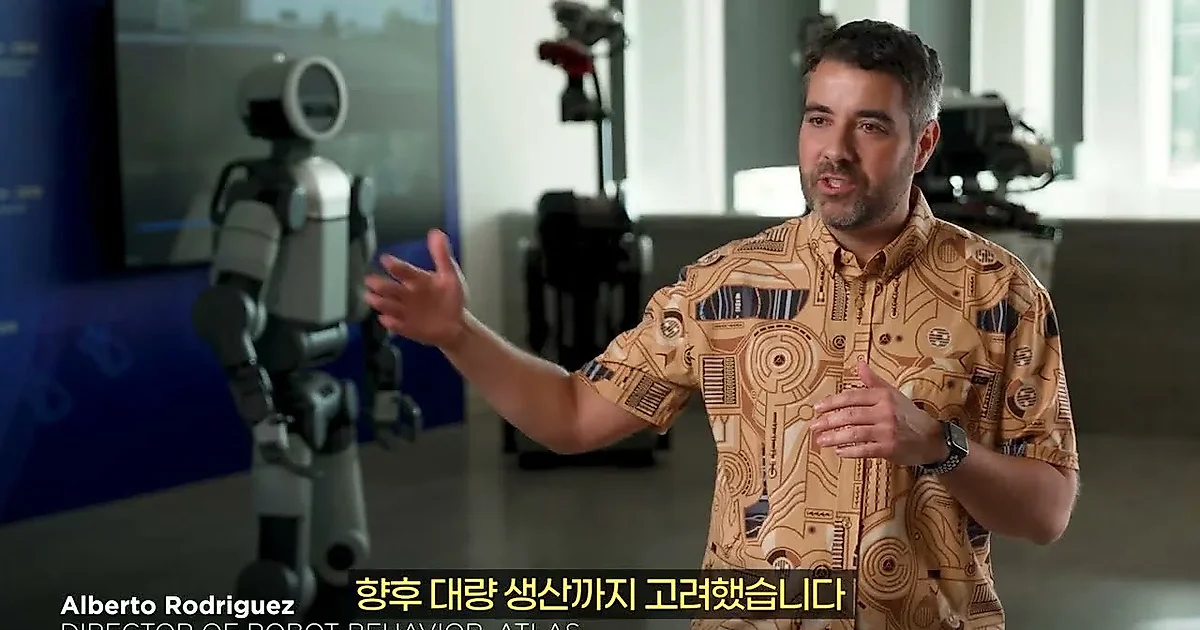
Boston Dynamics has revealed a new hand structure for its next-generation humanoid robot, 'Atlas'. The core of this design goes beyond simple movement, focusing on how precisely the motions of an AI trained in a virtual environment can be reproduced in the actual physical world.
Precision increased with 13 degrees of freedom… "The fifth finger is excluded"
According to a video from the YouTube channel Impossible Engineering - New IT Technologies, the new Atlas hand revealed by Boston Dynamics features four fingers and 13 degrees of freedom (DoF). By arranging 4 degrees of freedom in the thumb and 3 degrees of freedom in each of the remaining fingers, it is designed to enable complex manipulations, such as changing the orientation of an object while holding it or gripping a tool and pulling a trigger.
The unique point is that, unlike humans, it consists of four fingers instead of five. The video reported that during the development process, engineers even conducted experiments where they spent a day with their ring and pinky fingers taped together to review the necessity of a fifth finger. This is because adding a fifth finger would increase the burden of occupying internal hand space, rising costs, and increasing the possibility of failure due to three additional actuators. Boston Dynamics strategically adopted the 4-finger design, judging that the utility of a fifth finger for the target tasks was not large enough to bear these costs and risks.
Mechanical design and control to reduce the 'Sim-to-Real' gap
The technical topic of this design is 'Sim-to-Real' matching, where the results of reinforcement learning in a virtual environment lead smoothly to the actual movements of the robot. This is because when a robot transfers motions learned in a virtual environment to a real hand, if friction in the mechanical structure or stiffness in the joints occurs, the control timing may be misaligned, causing it to drop or crush objects.
To solve this, Boston Dynamics focused on 'compliance'. When a finger touches an object, the reaction force generated must be well-transmitted to the actuator to accurately identify the contact situation. If internal friction is high, it is difficult to distinguish whether it is resistance coming from the object or internal mechanical resistance. Boston Dynamics applied technology to compensate for the imbalance of force caused by the motor's rotation position and friction. Furthermore, when creating the hand model in the virtual environment, they did not simply mimic the shape, but increased the accuracy of learning by reflecting force transmission characteristics and ease of movement similar to a real hand.
Different driving methods from Tesla and Figure… The evaluation standard is 'tasks completed per hour'
The video also analyzed the differences in design between the methods of Boston Dynamics and those of Tesla and Figure. According to Tesla's published patents, Tesla uses a 'Tendon-driven' method where actuators are placed on the forearm and finger joints are pulled by strings. While this is advantageous for securing space in the palm, managing string tension and friction control is a key challenge. On the other hand, Figure (Figure 03) features placing cameras in the palm to overcome the field-of-view limitations of cameras on top of the head, and performs precise manipulation by combining tactile sensors and joint information.
Ultimately, the performance of a robot hand depends on how efficiently the design method and AI learning are combined. The video suggested 'number of tasks completed per hour' as a criterion to judge the practical competitiveness of robot hands in the future. The analysis suggests that rather than simply measuring the speed of movement, the actual work efficiency of a robot can be accurately understood by calculating the number of retries occurring during work, the frequency of human intervention (help), and the maintenance time for repairs.



0Comments
Comments are currently disabled.