
Differential Basic Pension Payments by Income Bracket... Amount for Bottom 30% Increased to 380,000 Won
The government has announced a reform plan to differentiate Basic Pension payments by subdividing income brackets for recipients.
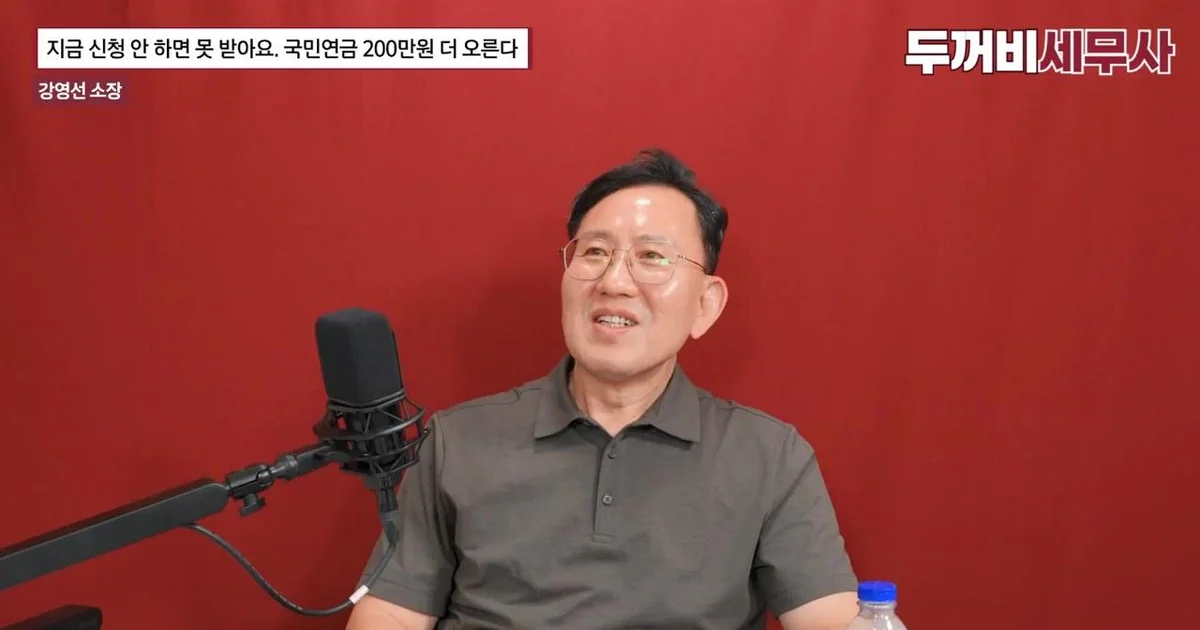
The government has announced a reform plan to differentiate payment amounts by subdividing the income brackets of Basic Pension recipients. Previously, the same amount was paid to the bottom 70% of income earners, but the structure will change so that payment amounts vary depending on income levels. According to Director Kang Young-sun, who appeared on the YouTube channel 'Finance with Toad Tax Accountant', this reform plan has been reflected in the budget and awaits future legislative procedures.
Differential Basic Pension Payments by Income Bracket and Mitigation of Couple Reduction
The core of this reform plan is to divide the income brackets into three stages within the bottom 70% of income earners who are eligible for the Basic Pension. Director Kang explained, "The government plan aims to push for a reform in 2027 by dividing the brackets into the bottom 30%, 30–45%, and 45–70% segments," adding, "The bottom 30% bracket will receive 380,000 won, the 30–45% bracket will receive 359,000 won, and the 45–70% bracket will receive a level similar to the current 350,000 won." Previously, those in the bottom 70% were paid the same amount, such as 349,700 won per person, but the new method introduces differences based on income brackets.
Furthermore, the 'couple reduction' system, which was applied when a couple receives the Basic Pension simultaneously, will also be partially mitigated. Previously, a 20% reduction was applied when a couple received benefits, but in the reform plan, the reduction rate will be lowered to 10% only for couples in the bottom 45% or lower. Director Kang stated, "In the case of couples in the bottom 30% bracket, there is an effect of increasing the received amount, such as increasing from the existing level of 560,000 won per month to 684,000 won." Couples in the 30–45% bracket will receive approximately 646,000 won per month. This reform plan aims for implementation next April, and from July 2027, it is expected to be applied in stages depending on whether recipients of occupational pensions are included. The budget for this reform is approximately 25.7 trillion won, and it is characterized by the fact that the Basic Pension is fully funded by taxes rather than insurance premiums paid by citizens.
Prevention of Fraudulent National Pension Claims by Foreigners and System Supplementation
Institutional supplementary measures are also being prepared to block the possibility of fraudulent National Pension claims by foreigners, which has recently become a controversy. In the past, it was possible to meet the National Pension eligibility requirements as long as foreign registration and stay status were maintained, but the government has decided to strengthen this based on 'actual residence period'. According to the supplementary measures effective as of August 31, in order for a foreigner to receive a pension, they must actually reside in the country for 15 days or more per month. While previously only the maintenance of stay status was verified, the new method will verify actual residence more closely through immigration records and other means.
In addition, the principle of 'reciprocity' will be adopted, and measures to limit pension payments to citizens of countries that do not recognize pension eligibility for our citizens are being considered. For example, this is a measure considering that in the case of China, the minimum National Pension contribution period is 15 years. Furthermore, to prevent cases where foreigners with no history of entering the country register dependents (spouse, children, parents, etc.) to receive a pension, the management system will be strengthened to pay only when they are actually residing in and supporting them in the country. Dependent pensions allowed for an additional annual receipt of over 700,000 to 800,000 won depending on the number of registered persons, such as a spouse (approx. 306,000 won per year) or children and parents (204,360 won each per year), but in the future, actual support will be strictly managed. Director Kang emphasized, "Active management is necessary to block tax loopholes so that pensions can go to those who truly need them."
Changes in the National Pension System and Plans to Expand Receipt Amounts
The National Pension system is also undergoing changes. The insurance premium rate will be increased in stages to a final 13%, and from January 2026, the income replacement rate will be raised to 43%. In particular, the criteria have been relaxed so that the pension amount is not reduced if the recipient's income is below a certain level (5.19 million won per month) while receiving the National Pension. Additionally, for low-income contributors, the state provides up to approximately 37,950 won per month to local subscribers with a monthly income of less than 800,000 won. Measures have also been taken to increase trust in the system by specifying that the state is legally responsible for the payment of the National Pension.
Director Kang suggested the 'Voluntary Enrollment Scheme' and the 'Retroactive Payment (Chunap) System' as alternatives for those worried about low National Pension receipt amounts. Since the National Pension is more advantageous the longer the contribution period, those with insufficient contribution periods due to career breaks in the past can fulfill the 10-year requirement through retroactive payments. In particular, military service experience or childbirth-related credit systems can also be utilized. Furthermore, she explained that full-time housewives, etc., can secure pension eligibility by paying insurance premiums for more than 10 years through voluntary enrollment, and due to the nature of the National Pension reflecting the inflation rate, it can be an advantageous means for old age in the long term. If the 10-year requirement is not met even after age 60, a lump-sum refund is received, but if they continue to enroll and meet the requirement, they can increase the amount received.
0Comments
Comments are currently disabled.