
Google AI integration sparks conflict with US schools over student learning
Google's integration of AI features into its search engine and educational tools is facing intense backlash from U.S. schools as students use AI-generated answers to bypass critical thinking. While educators demand the removal of AI features, Google argues that disabling them would require blocking its core search functionality.
US schools are clashing with Google as the company's AI features allow students to copy answers instead of solving problems. While New York City has deferred generative AI use for students up to 8th grade, Google maintains it is impossible to block AI Overviews without disabling the search function entirely.
When a math problem is entered into the Google search bar, AI provides an immediate answer. A student doing homework can obtain a completed solution without needing to struggle. While this is a convenient feature, the educational field is perceiving it as the "end of learning."
Recently, Google's AI integration strategy has faced intense backlash, centered around elementary, middle, and high schools in the United States. As Google integrates "AI Overviews" and "AI Mode" into its search engine, problems are arising where students, using laptops provided by their schools, copy AI-generated answers instead of solving assignments themselves. A video reported by T Times TV details how Google's powerful market share in the education market is clashing with schools as it combines with AI technology.
"It was hard to think during exams"... The temptation of AI leading to falling grades
The accessibility of AI is a powerful temptation for students. Richard Scott, a middle school student in Pennsylvania, United States, realized that the Google search bar on his school-issued laptop provided answers like an AI chatbot. He used AI to quickly finish assignments ranging from math problems to essay writing. However, the result was failing. "Since I couldn't use AI during exams, it was hard to think for myself," Scott confessed. While AI solved the problems for him, he missed the opportunity for the cognitive training necessary to solve problems independently.
Another student, Sophia Chachijia, also experienced a decline in grades after relying on AI summaries and AI Mode in Google Search. The biggest issue identified was that as the familiar search bar—which she always accessed when stuck while studying—transformed into a tool that immediately provided answers, she encountered AI's conclusions before she could develop the ability to read and judge information.
The Google "educational ecosystem" created by Chromebook and Google Classroom
The reason this controversy is particularly serious in the U.S. educational field is due to Google's overwhelming market share. Currently, 88% of public schools in the United States provide learning devices such as laptops or tablets to students, and the core of this market is Google's "Chromebook." Students check assignments in Google Classroom through Google accounts assigned by their schools and continue their learning with Google Docs and Google Drive.
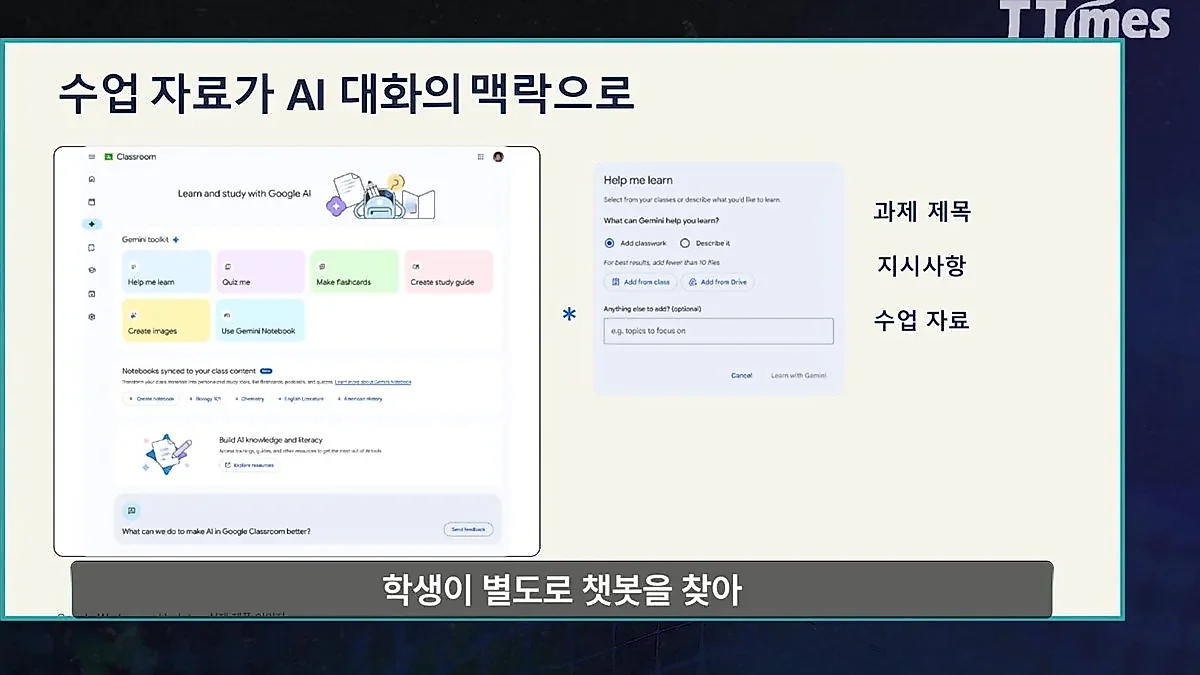
Google has rapidly expanded its AI services based on this ecosystem. When the Gemini app was released for educational accounts in May 2024, it was only available to those aged 18 and older, but the user base was subsequently expanded to those aged 13 and older, and in 2025, it will expand to all ages, including elementary school students. In particular, in 2026, Google plans to fully integrate Gemini features into Google Classroom, providing a path for students to receive AI assistance directly alongside their assignment screens.
Globally, Google Classroom users have exceeded 150 million, and the number of students and teachers using Chromebook has surpassed 50 million. This robust infrastructure built by Google has essentially become a powerful gateway for AI technology.
Schools demanding "keep search, block AI" vs. Google claiming "it is impossible"
The demands from the educational community and parent groups are clear: maintain the "search" function for finding materials, but block the "AI" functions that generate answers. New York City has introduced a policy to defer the use of generative AI in the curriculum up to the 8th grade in middle school, and U.S. Senators are also pressuring Google by demanding the blocking of AI features on school devices.
In response, Google has offered a countermeasure to keep Gemini and AI features within Google Classroom turned off by default for elementary, middle, and high school student accounts. However, the fundamental problem remains with "Google Search." Google argues that it is impossible to separately turn off only the AI Overviews and AI Mode functions integrated into the search engine, and that to completely block AI, the Google Search function itself must be blocked.
Google's firm stance is driven by business interests. According to announcements from OpenAI, the volume of search-like questions processed by ChatGPT reaches approximately 20% of Google Search volume. To prevent users from leaving for ChatGPT chat windows instead of the search bar, Google must provide faster and more direct answers within Google Search to keep users. Ultimately, Google's strategy to keep users within the Google ecosystem is in direct conflict with the demands of schools seeking to protect students' right to learn.
Source: original video (YouTube)



0Comments
Comments are currently disabled.