
Top 20% of restaurants use three key settings to boost orders
Baemin Oesigeop Gwangjang has revealed operational know-how from the top 20% of restaurants to help new food service partners struggling with low order volumes. The data suggests that optimizing basic store settings can significantly increase orders without extra marketing expenses.
Baemin Oesigeop Gwangjang has released operational strategies to help new food service partners increase order volumes. By optimizing peak-time operating hours, menu images, and minimum order amounts, top-performing stores achieved monthly average order rates up to five times higher than those that do not overlap with peak times.
Baemin Oesigeop Gwangjang has released operational know-how from the top 20% of stores to assist food service partners who are concerned about lower-than-expected order volumes during their initial entry into delivery platforms. According to the information provided by Baemin Oesigeop Gwangjang, stores can significantly increase their number of orders by simply optimizing basic settings without spending additional marketing costs.
The power of peak-time operating hours and menu images
A decisive difference between the top 20% of stores and the bottom 20% was found in the setting of operating hours. The key is not simply how long a store operates, but "when" it operates. In most categories, more than 50% of orders are concentrated during peak times; in the bossam category specifically, the proportion of peak-time orders exceeded 60%. Data shows that stores whose operating hours overlap with peak times have a monthly average order rate up to approximately five times higher than those that do not.
A clear gap also appeared in how menus are composed. The registration rate for main menu images among the top 20% of stores reached 91.5%. This reflects the fact that nine out of ten customers consider main menu images important when deciding to order, and they prefer images that look similar to the actual food being sold rather than exaggeratedly staged shots. In fact, menus with registered images showed a click-through rate approximately four times higher than those without.
The thoroughness of menu descriptions is another factor that determines order volume. The registration rate for main menu descriptions among the top 20% of stores was 76.1%, whereas the bottom 20% stood at only 35.4%. For effective menu descriptions, instead of simply using expressions like "delicious," it is better to describe specific tastes and textures, such as "nutty" or "crispy." Additionally, it is advantageous to make customers imagine the taste by explaining the cooking process or to gain customer trust by specifying ingredients, such as "100% domestic beef patty."
Lower minimum order amounts are more advantageous
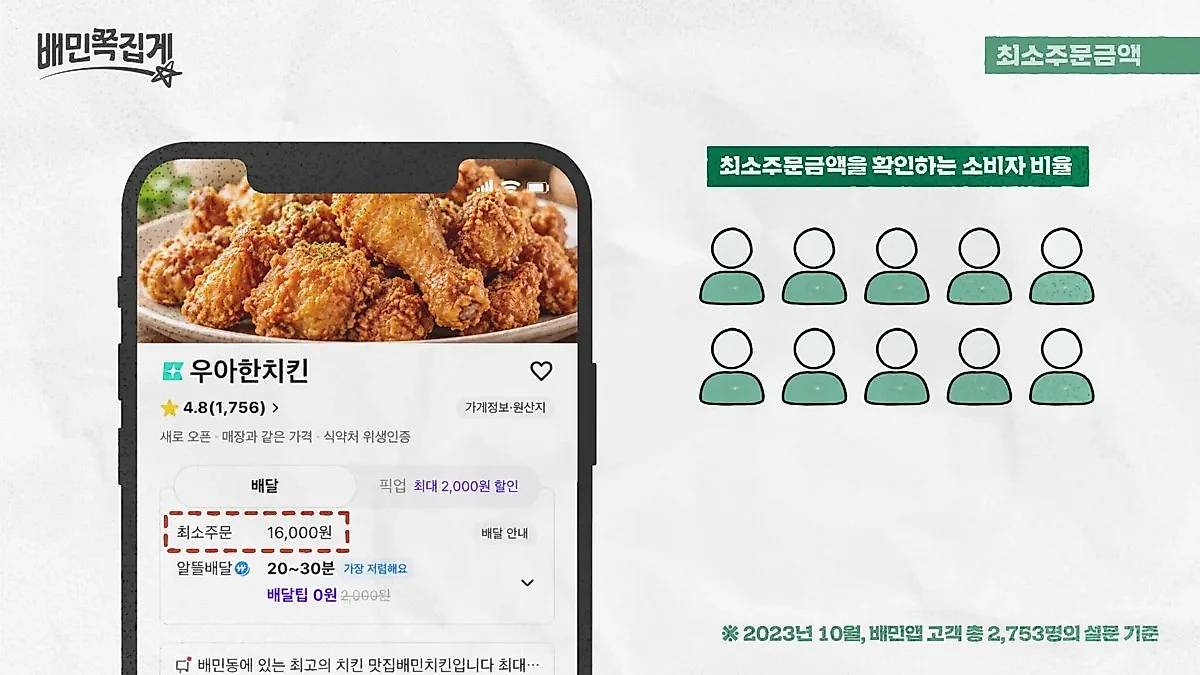
The final gateway to winning a customer's choice is the minimum order amount. As data shows that seven out of ten delivery users check the minimum order amount, this figure directly affects order conversion. According to Baemin data, stores with lower minimum order amounts showed higher figures in all metrics, including exposure, clicks, and orders.
Actual survey results showed that the top 20% of stores operated with lower minimum order amounts than the bottom 20% of stores. If setting an appropriate amount is difficult, it is recommended to set it no higher than the price of the signature menu item. For example, if the price of a signature menu is 12,000 won, the minimum order amount should also be set to 12,000 won. This setting serves to lower the psychological barrier for customers, increasing the probability of an order.
Baemin Oesigeop Gwangjang advised that partners in their initial entry stage can seek to increase sales by checking three basic items: adhering to peak-time operating hours, registering specific menu images and descriptions, and setting minimum order amounts in consideration of signature menu prices.
Source: original video (YouTube)

0Comments
Comments are currently disabled.