
Companies creating social value see 34.4% higher revenue
Data revealed at the 2026 IIAS Seoul Conference shows that companies participating in SK Group's Social Progress Credit (SPC) program created three times more social value and achieved significantly higher revenues than non-participants.
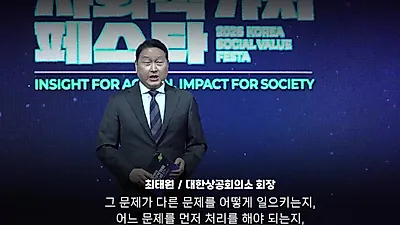
Can solving social problems lead to economic profits for a company? To answer this, SK Group has spent the last 10 years experimenting with the 'SPC, Social Progress Credit' system, which measures the social value created by social enterprises and provides economic rewards based on those results. According to data from the Korea Chamber of Commerce and Industry, released during a keynote speech at the 2026 IIAS Seoul Conference held at Seoul National University on November 18, 2026, data has confirmed that social value is no longer a cost but a core asset for corporate growth.
Incentivized companies create 3 times more social value and see rising revenue
The SPC, which SK Group has been promoting since 2015, is a performance-based financial mechanism that provides cash incentives for measurable social achievements. To date, 468 companies in Korea have participated in this program. To verify whether social value actually changes corporate behavior, researchers conducted the first large-scale Randomized Controlled Trial among private companies in Korea.
Researchers divided companies with similar characteristics into two groups: one group received only social value measurements, while the other received both measurements and cash incentives simultaneously. The results showed that companies receiving incentives created approximately three times more social value than those that did not. This difference was consistently observed across various fields, including the environment, employment, and social services.
The creation of social value also led to tangible financial performance. Companies participating in the SPC recorded an average of 34.4% higher revenue than non-participating companies. This growth gap was even more pronounced in early-stage companies established for less than seven years. Furthermore, participation in the SPC acted as a positive signal to financial institutions regarding a company's financial stability and long-term performance, which was analyzed to have helped participating companies secure external capital.
From private experiment to public policy: the economic multiplier effect of social value
The achievements of the SPC have influenced the entire social ecosystem beyond individual companies. The Stanford Social Innovation Review highlighted the SPC as the world's first private-sector-led performance-based incentive experiment, evaluating it as having contributed to building an ecosystem to solve social problems. Companies became able to manage social value through data, and investors gained a basis to allocate resources based on verified data rather than reputation. For social enterprise workers, rewards for performance became a factor that increased pride in their work and organizational commitment.
Efficiency in the public sector was also proven. Compared to existing proactive subsidy payment methods, the performance-based incentives of the SPC created a multiplier effect that was 1.5 to 2 times higher in terms of employment and production. These experimental results have spread to the international community, including the WEF. CSCE, a foundation specializing in social value creation by SK Group, has released three joint reports with the WEF, presenting evidence that measuring social value and providing incentives can change corporate behavior and expand the resolution of social problems.
The private experiment is now leading to government policy. Local governments, including Seoul Metropolitan Government, Jeju Special Self-Governing Province, and North Jeolla, have enacted relevant ordinances to institutionalize the SPC method. In 2026, a nationwide SPC pilot project targeting more than 400 social economy organizations began at the central government level with an investment of more than 7 million dollars. The expansion of corporate experiments into public policy is presenting a new model for resource allocation to solve social problems.
Expanding into a 'New Entrepreneurship' ecosystem with 1,800 participating companies
Efforts to create social value are evolving beyond the corporate realm into a cooperation model for society as a whole. The ERT, launched by the Korea Chamber of Commerce and Industry in 2022, is an initiative that encourages companies to solve social problems by utilizing their technology and capabilities. The number of participating companies, which was 76 at the time of launch, has now grown to more than 1,800.
The 'Korea Social Value Festa,' which began in 2024, expanded this platform for participation from companies to society at large. At the 2026 event, approximately 15,000 participants, including companies, government, civil society, academia, and citizens, gathered to share ideas, technology, and resources. To date, the total social value created by SPC participating companies has reached 370 million dollars, and more than 55 million dollars in post-performance incentives linked to achievements have been paid out.
The Korea Chamber of Commerce and Industry is focusing on building a sustainable system where more companies and individuals can participate and connect their respective capabilities, rather than relying solely on the goodwill of a few. This is a process in which solving social problems moves beyond simple charitable activities to become a new economic driver and opportunity for growth.
Source: original video (YouTube)
0Comments
Comments are currently disabled.