
High robot costs hinder food-tech adoption for small restaurants
Bae Mun-jin, CEO of JD Branding, suggests that small food service businesses should pivot from expensive physical AI robots to strategic AI data and branding tools to remain competitive.
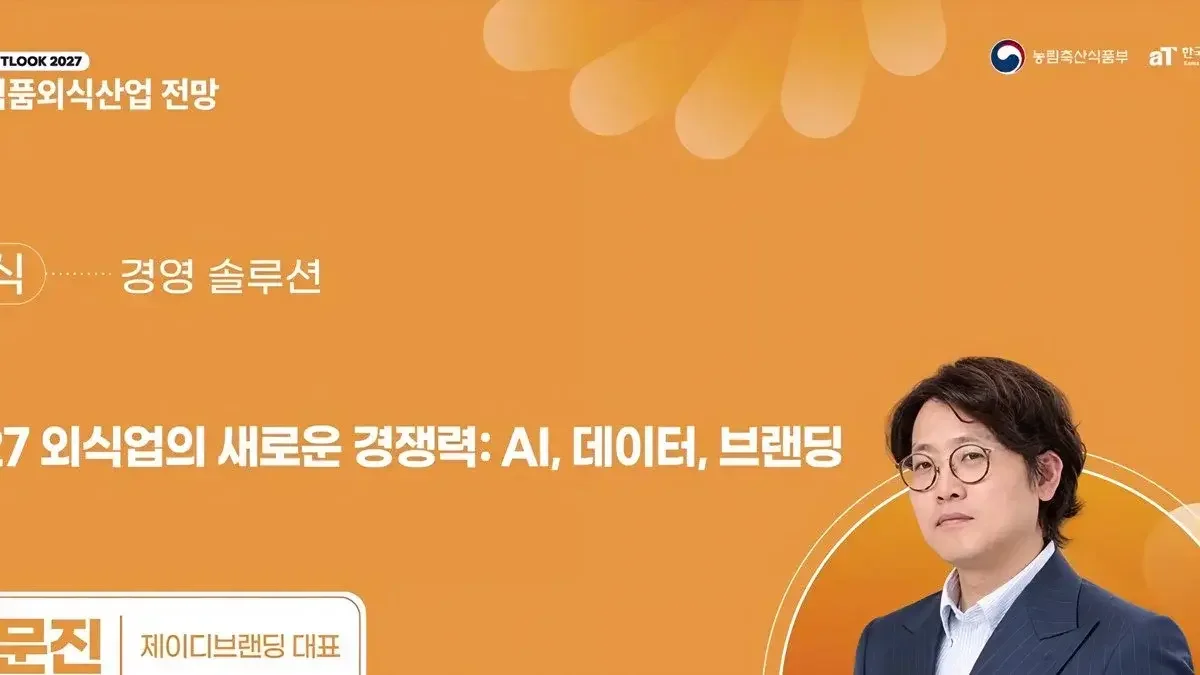
At a lecture in Seoul on the 5th, JD Branding CEO Bae Mun-jin proposed using AI for data-driven branding to help small businesses overcome the 70 million won barrier for robot systems. While robot adoption stands at just 0.2%, Bae suggested that AI could serve as a practical tool for menu development and marketing.
While food-tech is advancing rapidly, it often remains out of reach for small business owners on the ground. The high cost of implementing robot systems frequently exceeds the profit structures of small-scale establishments. To bridge this gap, suggestions have been made to utilize AI not merely as an automation tool, but as a strategic instrument to read data and strengthen branding.
During a lecture titled "2027 Foodservice Industry Outlook" held on the 5th at COEX Conference Room 401 in Seoul, JD Branding CEO Bae Mun-jin presented a combination of AI, data, and branding as the new competitive edge for the food service industry. Bae pointed out that the current AI trend in the industry is excessively focused on "physical AI," such as robots or smart factories, and emphasized the need for AI strategies that small business owners can actually utilize.
Food-tech stalled by 70 million won barrier; adoption rate at 0.2%
Current AI discourse in the food service industry is primarily concentrated on hardware-centric food-tech, such as cooking or serving robots. Technologies where barista robots make coffee to hand over to hall robots, or frying robots perform tasks from measuring to packaging, have already reached the commercialization stage. We have entered an era where robots can perform delicate cooking processes, such as flipping burger patties at the right time to cook them evenly, or removing fried items at the optimal temperature and placing them in packaging.
However, Bae diagnosed that these technological advances remain a distant reality for field managers. As of 2023, the proportion of food-tech establishments purely utilizing robots—excluding unmanned ordering machines or serving robots—is only about 0.2%. Even large franchises are hesitant to adopt robots. BHC, the top chicken brand in Korea, has applied robot systems to only 30 stores, while Kyochon Chicken has applied them to only 20 stores. This is due to economic realities rather than technological limitations.
Bae explained, "The cost to build a single robot system reaches 70 million to 80 million won, and even with rentals, costs of 1.2 million to 1.5 million won per month occur." He added, "A standard automatic fryer approaches about 40 million won, and a new model of a serving robot costs more than 10 million won upon purchase." He further noted, "For a small store owner recording an annual revenue of 250 million won and an operating profit margin of 8.7%, making about 1.8 million won in monthly profit, it is structurally impossible to introduce robots at a cost equivalent to opening a new store."
Practical utility of AI seen through the Starbucks case
Instead of hardware-centric food-tech, Bae recommended focusing on operational efficiency through data analysis. He proved through the case of Starbucks that AI can be a tool that assists field personnel rather than interfering with their work.
Starbucks introduced an AI program called "Green Dot Assist" to resolve bottlenecks at drive-thru (DT) locations. This program analyzes problems in the menu response process or process errors in real time to find improvements. As a result, Starbucks generated an additional 600 billion won in revenue over nine months, and 83% of field baristas responded that the program was helpful to their work. This serves as an indicator that AI can be a practical helper to field staff who feel resistance toward introducing new systems.
'AI Branding' as a survival strategy from menu development to marketing
What, then, are the AI applications that small food service operators can implement immediately? Bae identified menu development, building brand identity (BI), and creating marketing content as the core areas. Currently, only 30% of food service workers use ChatGPT to get new menu ideas, and the proportion of those utilizing kiosks, delivery apps, and social media (such as Instagram and Threads) does not exceed 50%. Bae diagnosed that "more than half of food service workers are still unskilled in utilizing digital tools."
Bae suggested specific ways to use AI, stating, "The branding processes used by corporations must be transplanted into small stores using AI." He noted that it is possible to analyze customer data via AI to develop customized recipes and review costs, as well as to design a store's story and visualize it into marketing content such as menus, interiors, and online flyers.
He emphasized, "To turn the current crisis into an opportunity, one must not dismiss AI as someone else's business, but use it as a tool to firmly build a store's competitiveness through data-based branding." In particular, he offered the outlook that if one can rise to the 15% level, they can sufficiently secure store competitiveness, moving beyond the top 1.5% tier of those possessing AI utilization skills.
Source: original video (YouTube)



0Comments
Comments are currently disabled.