
"Non-homeowners should hurry"... Real estate strategies by number of houses suggested by CEO Song Seung-hyeon
CEO Song Seung-hyeon provides tailored real estate strategies for various groups, including non-homeowners, single-homeowners, and multi-homeowners…
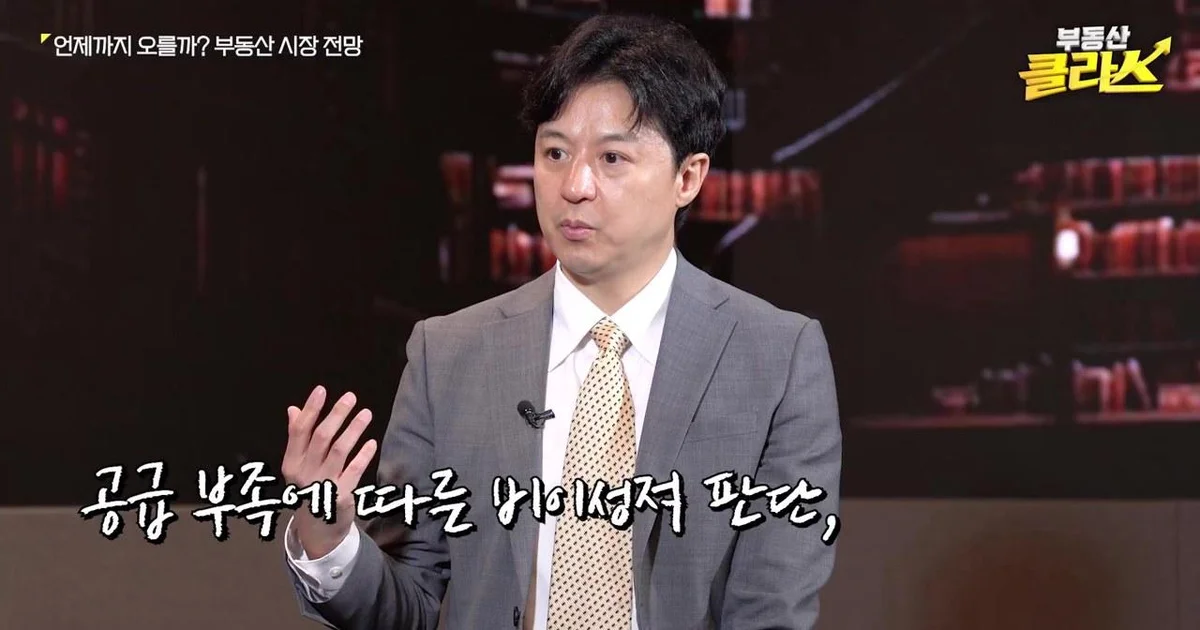
As volatility in the real estate market increases, an analysis has been released regarding what strategies should be established depending on the number of houses owned. According to a KB Real Estate TV video, CEO Song Seung-hyeon presented response plans for non-homeowners and single-homeowners based on their specific situations amidst the recent trend of both house prices and Jeonse/monthly rent prices rising together.
Non-homeowners and Single-homeowners: "Pay attention to decreasing move-in volumes and the national standard size"
In the case of non-homeowners, CEO Song divided them into those with asset capacity and newlyweds/youth. For those with asset capacity, he noted they may aim for subscriptions in desired areas and live in Jeonse ranging from 2 billion to 3 billion won, but for the general demand group of newlyweds and youth, he analyzed that "buying a house could be advantageous." Although there is a trend of rising interest rates, his judgment is that securing a home could be more beneficial compared to the burden of monthly rent. In particular, he cited the supply shortage as a major cause, stating, "Currently, move-in volumes are decreasing sharply, and in most areas, volumes have decreased by 60–70%." However, he suggested approaching this from the perspective of securing a home rather than from an investment perspective.
For single-homeowners considering moving to a higher-tier area, he recommended 'expanding the area.' CEO Song stated, "If you are moving up, it is necessary to expand the area," and recommended the 84㎡ (national standard size) which has the thickest demand. This is because 84㎡ has high liquidity when selling in the future and there is a relatively large volume of units to choose from. He explained that although smaller sizes like 59㎡ have been supplied recently, demand for moving up still prefers 84㎡ considering children's growth or increased income, and it is also advantageous in terms of securing supply. Regarding the timing of moving up, he advised that "policy design is moving toward a long-term holding perspective and prices are already significantly attached," so if considering moving up, it is good to take action as there may not be many similar opportunities in the future.
Regarding the order of buying and selling, he mentioned, "These days, it is correct to buy first and then sell." He explained that it could be advantageous to first purchase a new 84㎡ unit (such as 79㎡, etc.) because the range of demand is wide and negotiating power is high when selling in the future. He added that if one wants to sell after buying, such strategic design is necessary.
Non-resident single-homeowners and multi-homeowners: "Need to design structures considering tax burden"
In the case of non-resident single-homeowners with tenants, a strategy considering the obligation to reside and capital gains is required. CEO Song advised, "You should enter areas with large profit margins and reside there as much as possible." For example, it is more effective to reside in an area with a large profit margin, such as an apartment bought for 1 billion won that becomes 2.5 billion won, rather than one bought for 300 million won that becomes 400 million won, to effectively reduce the tax burden through benefits such as capital gains tax deductions.
He expressed a positive opinion regarding the strategy of high-priced single-homeowners moving to mid-to-low priced two-homeownership to reduce the tax burden. For those holding high-priced houses of 3.5 billion won or more in areas like Gangnam, the burden of Comprehensive Real Estate Tax is high; in this case, dividing into two houses in the 1.5 billion to 2 billion won range—where one is for residence and the other is for monthly rent—could be an alternative. CEO Song analyzed, "Since the current market favors landlords, you can receive the desired amount," and "You can create a structure where you can pay the Comprehensive Real Estate Tax and still have some income left through monthly rent." In the video, he used an example of receiving about 7 million won in monthly rent from an apartment in Banpo, explaining that assuming the Comprehensive Real Estate Tax is about 50 million won, it is possible to design a structure where income is generated even after paying the tax through monthly rent (based on a simulation of 7 million won per month, resulting in a monthly income structure of about 84 million won). He also mentioned that it is possible to lower the barriers of acquisition tax or Comprehensive Real Estate Tax by utilizing non-apartment products that are recently excluded from the count of houses owned.
Conversely, he evaluated the strategy of mid-to-low priced multi-homeowners moving to high-priced single-homeownership as a "good strategy." This is because it can be seen as a natural flow according to life cycles, such as asset movement of the retired generation or the movement of investors to higher-tier areas. However, he cautioned that it is not a good strategy for generations whose income has ceased to proceed excessively. He also presented the view that deregulation of areas such as Land Transaction Permit Zones is necessary for such asset movement to become smooth.
Real estate market outlook: "Pay attention to complexes with price volatility"
Regarding the future real estate market outlook, CEO Song diagnosed it as "a structure that goes up through repeated rises and falls." He viewed that price volatility is determined by interest rates, supply, and price resistance. In particular, he emphasized that choosing complexes with price volatility, such as reconstruction complexes or new complexes, is strategically effective. CEO Song said, "I do not judge places with no transactions and no volatility, such as isolated complexes, to be good complexes," and recommended paying attention to the price increase rate. He suggested that choosing complexes with volatility by checking the increase rate, such as prices doubling compared to existing actual transaction prices, could be a good strategy.
However, he expressed caution regarding short-term surges in specific areas. He stated, "A surge exceeding twice the average can be seen as overshooting," and predicted that in some areas such as Gwacheon, an adjustment could occur around next year as policy noise and an overvaluation phase overlap. He also mentioned that it is necessary to look cautiously at areas such as Dongtan or Yongin in the southern Gyeonggi belt.
0Comments
Comments are currently disabled.