
"Missed the timing for US rate hikes"... September FOMC hike possibility alongside Japan's interest rate normalization variable
Economist Park Hyeong-jung predicts a high probability of a US interest rate hike in September due to inflation and oil prices…
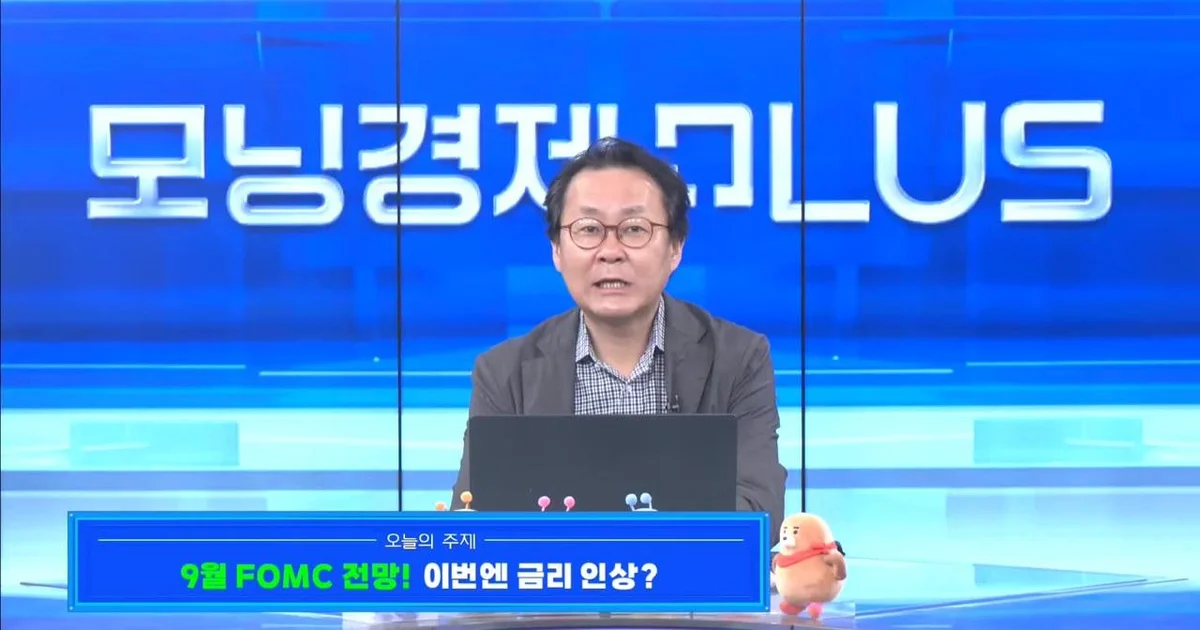
As the Federal Reserve System's (Fed) decision on the September base interest rate approaches, the market is predicting a very high possibility of a rate hike. Analysis suggests that macroeconomic indicators, such as rising oil prices and persistent inflationary pressure, are pushing for an interest rate hike.
"Fed missed the timing for rate hikes"... September FOMC hike outlook dominant
Economist Park Hyeong-jung, appearing on the Woori Bank YouTube channel 'Morning Economy Plus', diagnosed ahead of the September FOMC (Federal Open Market Committee), "The market is looking at a probability of more than 90% for a base interest rate hike," and "The atmosphere is such that the probability of raising rates more than twice this year has exceeded 60%."
Park analyzed that the Fed lacks justification for not raising interest rates. He explained, "Oil prices are soaring due to news such as the continuation of the war in Iran and Saudi Arabia's suspension of oil supply," and "Prices have exceeded the Fed's target of 2% for 66 consecutive months, and Treasury yields have also exceeded 5% due to concerns over inflation and fiscal instability." He added, "Personally, I think the Fed missed the timing for a rate hike," and "It is desirable to raise interest rates even now."
However, attention must be paid to the Fed's rhetoric to mitigate market shock. Park forecasted, "The best scenario is to raise interest rates while making 'dovish' remarks that they will increase moderately in the future," and "As the Fed may be cautious because excessively hawkish remarks ahead of the November US midterm elections could lead to unfavorable results for the Republican Party, especially former President Trump."
Japan's interest rate normalization and concerns over the persistence of 'Yen-carry trade unwind'
Not only US monetary policy but also the moves of the BOJ (Bank of Japan) have emerged as a key variable in global financial markets. There is a possibility that Japan's base interest rate, currently at the 1.0% level, will be raised through this week's monetary policy meeting.
Park emphasized, "There is a high possibility that Japan's base interest rate will be raised to 1.5%," and "It is important that for more than the last 30 years, the world has never experienced Japan's interest rate normalization process." In particular, he warned about the 'Yen-carry trade unwind' (a method of borrowing low-interest Yen to invest in high-interest assets) that may occur as Japan's interest rate hike coincides with a stronger Yen.
He analyzed, "In the past, the reduction of the Yen-carry trade was either not an internal issue for Japan or ended shortly even if it occurred," and "However, if the BOJ steadily raises the base interest rate and maintains market interest rates at a high level, the pressure for an unwind driven by internal Japanese dynamics could have considerable persistence, unlike in the past."
Rise in Japanese government bond yields and possibility of changes in US Treasury holdings
Japan's interest rate normalization could also affect the US Treasury market. This is because uncertainty is growing regarding whether Japanese financial institutions, currently the largest holders of US Treasuries, will continue to hold them.
Park said, "In a situation where Japanese government bond yields exceed 3%, Japanese financial institutions may no longer feel the need to hold US Treasuries." He explained that from the perspective of Japanese policy authorities, there is a possibility they may induce financial institutions to buy Japanese government bonds instead of US Treasuries to reduce the burden of interest costs resulting from the rise in Japanese government bond yields.
In conclusion, the analysis is that the US monetary policy and Japan's interest rate movements could simultaneously affect South Korea's Won-Dollar exchange rate, government bond yields, and stock prices. Park concluded, "As the US FOMC results and the BOJ's decision are important issues this week, it is a situation that is difficult to interpret only optimistically."
0Comments
Comments are currently disabled.