
"For a Self-Employed Person with 160 Million Won in Assets, This Should Come Before Buying a Home"
Money trainer Kim Gyeong-pil advises a self-employed individual with 160 million won in assets to focus on business success and securing 300 million won…
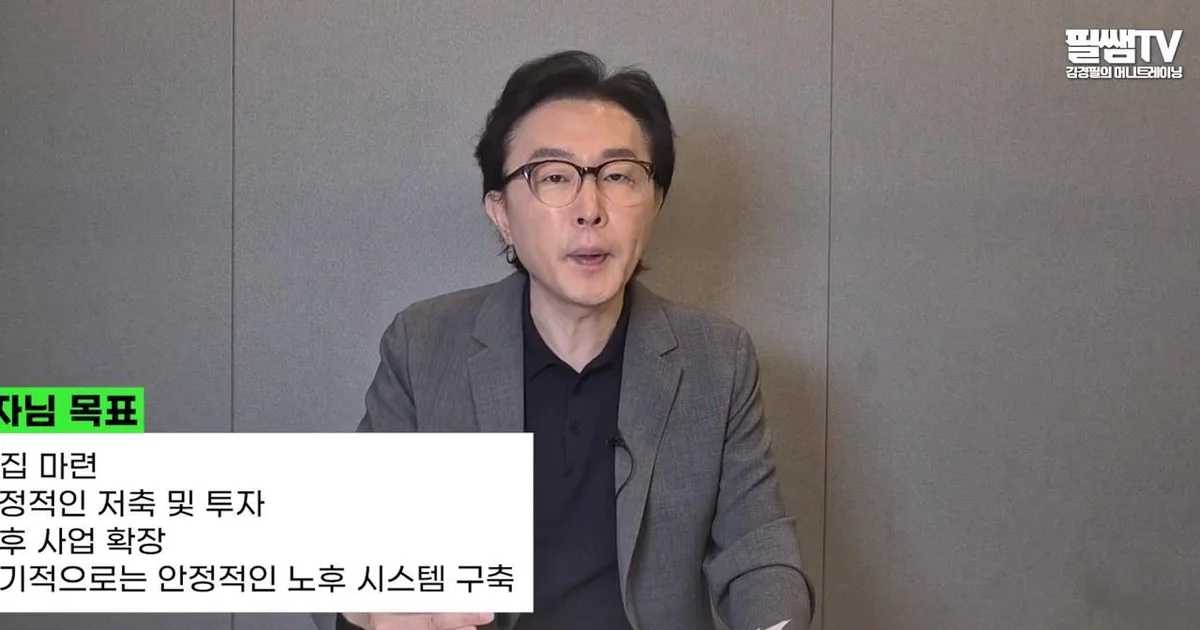
An analysis has revealed that for self-employed individuals preparing for retirement, the first task to precede buying a home or aggressive financial technology is 'the success of one's main business.' It is pointed out that because income volatility is high due to the nature of self-employment, making business income solid is the starting point for retirement preparation.
"Business success before buying a home... recommendation to secure 300 million won in seed money"
According to a recent video on the YouTube channel 'Teacher Pil TV - Kim Gyeong-pil's Money Training', a 37-year-old single self-employed individual currently holds 160 million won in assets and has making buying a home their top priority. The individual experienced having saved 36 million won in their early 20s but used it all for study abroad funds, and has been accumulating assets again since their late 20s, having started a restaurant with relatively low investment after being selected for a government support project two years ago. Their current residence is an LH apartment in Dongtan, and they maintain a distance of less than 10 minutes by car between the store and home.
Regarding this, money trainer Kim Gyeong-pil analyzed that with the current asset scale, the seed money is somewhat insufficient to purchase an apartment in the target area. Kim advised, "Until you have at least about 300 million won, postpone plans to buy a home and put all your energy into making the store successful first." He judged that if one attempts to buy a home with current assets, a loan of up to 300 million won might be required, and managing this as a self-employed person could be difficult. Kim suggested, "After accumulating assets to about 200 million to 250 million won, it will not be too late to reconsider around the second half of next year."
"Diversifying into 25 stocks is excessive... should increase the proportion of index investing"
The individual is currently diversifying investments into about 20 different items, including NVIDIA, Tesla, silver futures, Dividend Dow Jones, and shipbuilding stocks. Although they are investing in various assets, they are feeling anxious because they do not know what is correct. Regarding this, Kim diagnosed that the obsession with financial technology is excessively high.
Kim emphasized that instead of over-segmenting items, one should reduce the risk regarding management, saying, "You are too swept up in the obsession that you must not do financial technology incorrectly." In particular, he recommended increasing the proportion of index investing, such as the S&P 500 or Nasdaq-100, rather than being excessively immersed in dividend stocks. Kim added, "Dividend stocks have the advantage of reinvesting cash flow through dividends, but now you should increase index investing. It is better to reduce the number of items to about four or five and place more weight on the KOSPI 200, S&P 500, or Nasdaq-100."
"Distinguishing the purpose of funds is essential... money to be used within 3 years should be savings rather than stocks"
The 'distinction of the purpose of funds' was presented as a core principle of asset management. The individual was highly evaluated for having a clear distinction between public and private matters, such as setting their own monthly salary at 2.5 million won from business income and earning additional income through N-jobs like mentoring (100,000 won) and writing manuscripts (300,000 won). Kim praised, "It is very excellent that you do not use the store's money like personal money and set a salary to save and invest."
However, it was pointed out as a problem that the distinction between money to be saved and money to be rolled (invested) is ambiguous. Kim ordered to divide funds into two major categories based on the timing of use. Funds that must be used within 3 years, such as for marriage, moving, or business expansion, should be secured through savings rather than stock investment, and investment should only be carried out for funds to be used after 3 to 5 years. Kim pointed out that the individual is currently investing even the money that needs to be used within 3 years, and advised increasing the proportion of short-term funds.
Kim compared life to three workbooks (growth period, active period, retirement period) and emphasized, "The individual is currently solving the second workbook, the active period. Rather than worrying about the third workbook (retirement period), if you solve the second workbook intensely and well, the third workbook will be solved naturally."

0Comments
Comments are currently disabled.