
"It belongs neither to the President nor to the people"... Kim Sung-joo, Chairperson of National Pension Service, emphasizes independence of fund management
Kim Sung-joo, Chairperson of the National Pension Service, emphasized that the National Pension fund must remain independent from political influence…
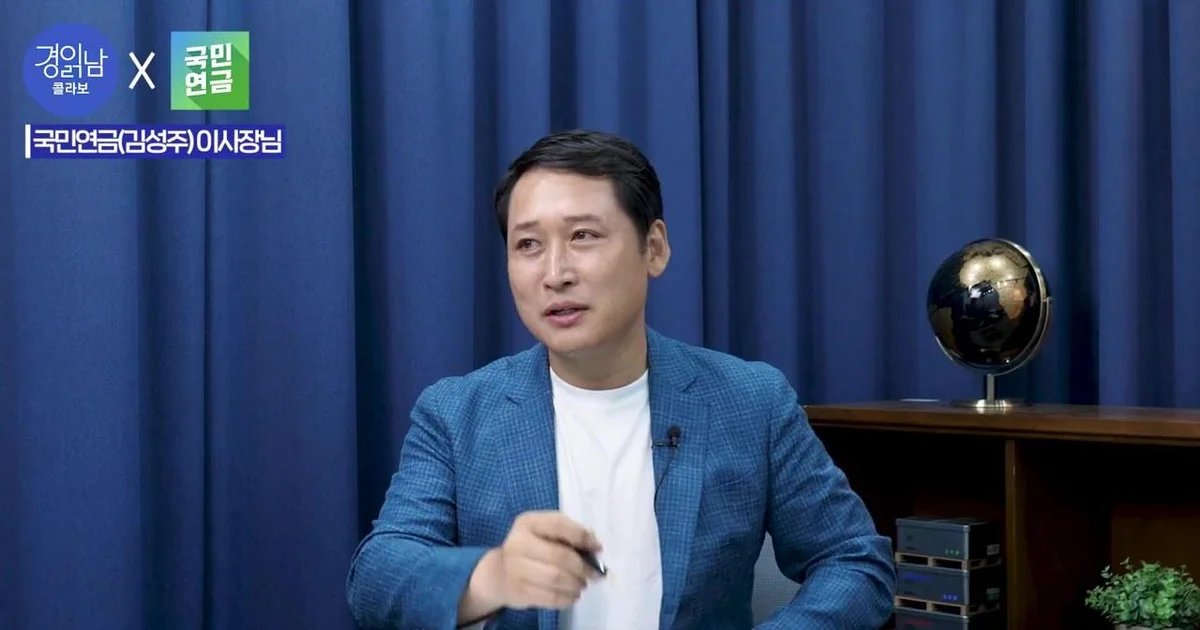
Kim Sung-joo, Chairperson of the National Pension Service, presented 'independence' as a core principle for the management of the National Pension fund. In a conversation with the YouTube channel 'The Man Who Explains the Economy', Chairperson Kim stated that the fund, which serves as the retirement funds for the people, must not be swayed by political purposes or the will of specific individuals.
"An expert domain without political involvement"... Principle of fund management independence
Chairperson Kim Sung-joo specified that the National Pension fund is the precious retirement fund of the people, not the property of the President or specific businesspeople. Referring to the case of the Samsung merger in the past, Chairperson Kim pointed out that changing fund management decisions due to pressure from power is akin to the core of state affairs manipulation. He explained that fund management is an expert domain based on market judgment, and it is against principle for politicians to involve themselves in individual investment decision-making.
Currently, the decision-making structure of the National Pension has check-and-balance mechanisms to maintain political independence. According to the explanation in the video, agenda items for the Fund Management Committee are first handled by the Investment Policy Advisory Committee, which follows a '3·3·3 structure' where 3 members recommended by the government, 3 members recommended by labor unions, and 3 members recommended by employer groups participate. This structure is designed so that no specific group can make decisions unilaterally, and only items that pass the advisory committee are submitted to the Fund Management Committee for final decision. Chairperson Kim emphasized that this process takes anywhere from one week to more than three weeks, highlighting that it is a structure that cannot be decided immediately upon government request.
Extending the fund depletion point and the goal of 2100
Chairperson Kim also mentioned specific figures regarding the financial soundness indicators and future goals of the National Pension. Previously, the point of turning into a deficit was expected to be 2048, and the fund depletion point was expected to be 2064, but he explained that the depletion point is being pushed back due to the recent high returns of the fund and the impact of the 2025 pension reform. Chairperson Kim presented the goal of creating a National Pension system that has no worries about fund depletion until the end of the 21st century, in 2100.
As conditions to achieve these goals, Chairperson Kim cited three elements: trust, the active role of the National Pension, and government support. In particular, he emphasized that as citizens are making efforts by accepting increases in insurance premiums, the state must also contribute in various forms for the sustainability of the National Pension. Chairperson Kim added that if an annual return of around 1% produces a compound interest effect, the fund depletion period can be delayed much further.
State's guarantee of payment and the role of the social security system
Regarding the anxiety of the younger generation about receiving pensions, Chairperson Kim emphasized the responsibility of the state. He explained that since the National Pension is a social security system created by the state to guarantee the retirement of citizens, the core is the belief that pensions will be paid as long as South Korea exists. He stated that in the process of the 2025 pension reform, work was actually carried out to concretize the details of the payment guarantee by the state.
Chairperson Kim said that it is not the essence for citizens who have fulfilled their obligation to pay pension insurance premiums to worry about not receiving pensions later. He made it clear that the responsibility for pension payments is a task that politicians and government officials must bear. Furthermore, regarding the decision-making structure of the Fund Management Division, he stated that it is a principle that superiors do not involve themselves in or present opinions on individual investment decisions, emphasizing that fund managers should listen to various opinions but must maintain the center of their judgment.
0Comments
Comments are currently disabled.