
"AI feeds you the answers"... Director Gu Bon-gwon speaks on the trap of 'cognitive outsourcing'
Director Gu Bon-gwon discusses the risks of "cognitive outsourcing" caused by generative AI and suggests that humans must develop discernment and proactive learning abilities to thrive in the AI era.
An era has arrived where artificial intelligence (AI) achieves perfect scores on all subjects of the CSAT (College Scholastic Ability Test) and solves mathematical problems that remained unsolved for decades. As a situation arises where humans cannot surpass AI in the speed and accuracy of finding answers, fundamental questions are being raised regarding existing educational methods and the meaning of 'studying.' Recently, when Astra recorded a perfect score on the CSAT and solved a mathematical problem that had been unsolved for 90 years, the shock in the educational field was so substantial that Fields Medal winners, including Professor Ho Jun-hee, released a collective statement saying, "Mathematics education should no longer use (AI)."
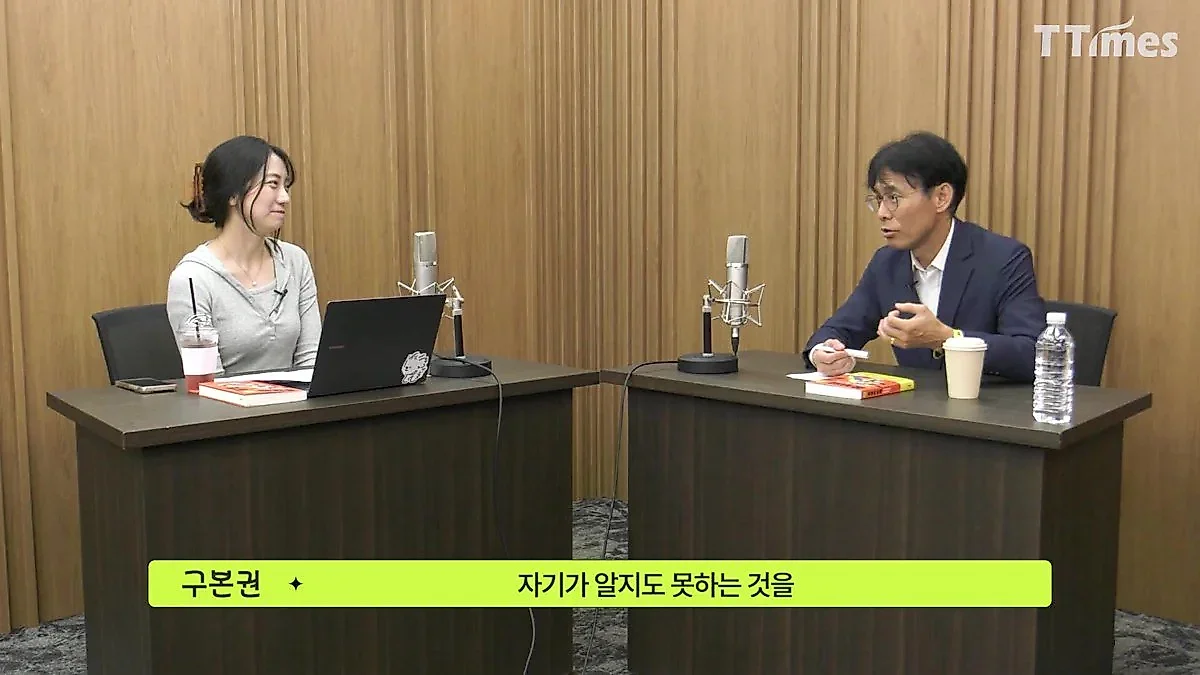
The interview with Director Gu Bon-gwon (author of the book 'The Future of Learning') presented by T Times TV contains the crisis of learning faced by humans in the AI era and a new breakthrough. Director Gu diagnosed that the emergence of generative AI goes beyond the mere advancement of tools and is accelerating 'cognitive outsourcing,' which replaces human thought processes. This differs in nature from what Marshall McLuhan once defined as media being an 'extension of human senses.' While tools like glasses are an extension of the eyes and clothes are an extension of the skin, there are concerns that AI may replace and cause the regression of human judgment and thinking functions themselves, rather than simply enhancing capabilities.
"AI produces only smooth results... Do not fall into the trap of fluency"
Director Gu pointed out that generative AI is causing problems on a different dimension from past search technologies or computer technologies. In the past era of internet searching, the process of humans directly 'selecting' and 'judging' what to read and trust among vast amounts of information was essential. This was because a high-level judging action was required to decide which items to take from the list of search results. However, generative AI is different in that it immediately 'feeds' the user perfect and smooth results so that the user does not need to worry.
"Generative AI combines and shows the language with the highest probability of appearing in response to a question," Director Gu warned, "Because the sentences are cleaner and more fluent than anyone else's, humans are prone to falling into the 'trap of fluency,' accepting them without criticism." The concern is that as artificial intelligence takes over the process of thinking, human judgment and thinking abilities may regress. This aligns with what Nicholas Carr warned in his book 'The Shallows'—that Google is making humans stupid—but Director Gu explains that with AI, the degree is much more serious.
In particular, Director Gu mentioned the collapse of the existing education system. In the past, the process of learning (studying) and the result (grades) were closely linked. The process of memorizing words and learning formulas to prepare for exams was itself part of learning. However, by using AI, perfect results can be produced without the process, meaning the existing method of evaluating learners solely based on the results will inevitably become unfair. Director Gu noted, "The traditional learning method where you just study hard with 'stamina' no longer works."
Conditions for talent sought by companies: 'Discernment' and 'Learning Ability' rather than knowledge
Then, what should humans, who must compete with AI, prepare? Director Gu asserted that competing with AI in a battle of knowledge is meaningless. He emphasized that when companies hire new employees, they are no longer preoccupied with 'hard skills' such as Excel or internet proficiency. This is because AI is already a basic tool provided to all office workers. Companies now look for people who can handle and collaborate with AI most wisely, rather than people who compete with AI.
Director Gu cited 'soft skills' as the core competency required by future companies. He particularly emphasized 'discernment' and 'judgment.' He explained that the role of an 'overseer' who can verify whether the results produced by AI are factual and logically valid will become the core competitiveness of an expert.
"An expert is someone who can exercise the intuition to feel, 'This is a bit strange,' based on their own unique experience," he said. "It will not be those who use AI's results as they are, but those who possess the ability to judge, verify, and think comprehensively that will survive." In other words, the capability of an 'overseer' who monitors AI's results is precisely what expertise is.
Additionally, a 'flexible attitude' and 'learning ability' to quickly adapt to changing environments were also mentioned as essential soft skills. In an uncertain future where it is unknown what kind of tasks will be given, a proactive attitude to learn most diligently and solve any problem that arises will become the most powerful weapon. Director Gu emphasized, "To be proactive in learning and problem-solving in any situation is the essence and the future of studying."
AI can become a 'personalized partner' that lowers the barriers to learning
Regarding the pessimism that AI will cause human thinking to regress, Director Gu presented a different perspective. He predicted that AI could instead become a 'powerful assistant' that lowers the entry barriers to learning. In the past, just as with the invention of writing in the era of Socrates, the form of knowledge has changed whenever new tools emerged. Just as writing popularized knowledge and computers created new learning methods, generative AI is also demanding new learning methods.
In the past, there were 'entry barriers' where one could not move to the next stage without basic knowledge of a specific subject. This was also the reason why some people gave up on specific fields like mathematics or physics early on. However, Director Gu evaluated that "generative AI is a learning tool just for me that can fill in an individual's deficiencies." He said that a path has opened to approach the essence by supplementing lacking foundations through AI.
"For learners who could not approach the essence due to a lack of basics, AI can be a great partner," he added. "If you use AI to fill in your own deficiencies and develop problem-solving skills, it will actually enable a wider range of learning than in the past." Ultimately, his suggestion is that studying in the AI era should not remain at 'cognitive outsourcing' where everything is left to AI, but should move toward expanding human judgment and comprehensive thinking by using AI as a tool.
Source: original video (YouTube)


0Comments
Comments are currently disabled.