
Food processing majors expand into 29 career fields via food tech
Food processing majors are expanding their professional reach into 29 different career groups, driven by the integration of smart manufacturing and food technology.
The Korea Employment Information Service has released a career guide showing that food processing majors can now enter 29 different career groups, including roles in smart manufacturing and functional food research.
As food evolves beyond simple sustenance into a convergence of advanced technologies, the role of food processing majors is also changing. Their expertise—combining biology, chemistry, and engineering to design the entire process from food production to storage and distribution—is trending toward expansion alongside the growth of the smart manufacturing and food tech industries.
According to the "Career Guide by University Major - Food Processing" released by the Korea Employment Information Service (feat. Employment 24), food processing majors can enter a total of 29 career groups, ranging from management, administration, and office roles to natural and life science research, manufacturing R&D, education, sales, and food processing and production. Rather than being limited to simple food-making techniques, this field functions as a comprehensive engineering discipline encompassing research to improve quality and safety, new material development, and advanced processing technologies.
Four Core Areas Linking Basic Science and Process Design
The food processing curriculum is largely divided into four areas: 'Food Analysis and Chemistry,' which analyzes the structure and reactions of food components; 'Food Microbiology, Enzymes, and Storage,' which studies fermentation and storage stability; 'Food Engineering,' covering processing technology and process design; and 'Hygiene and Quality Control,' which teaches food safety and quality management systems.
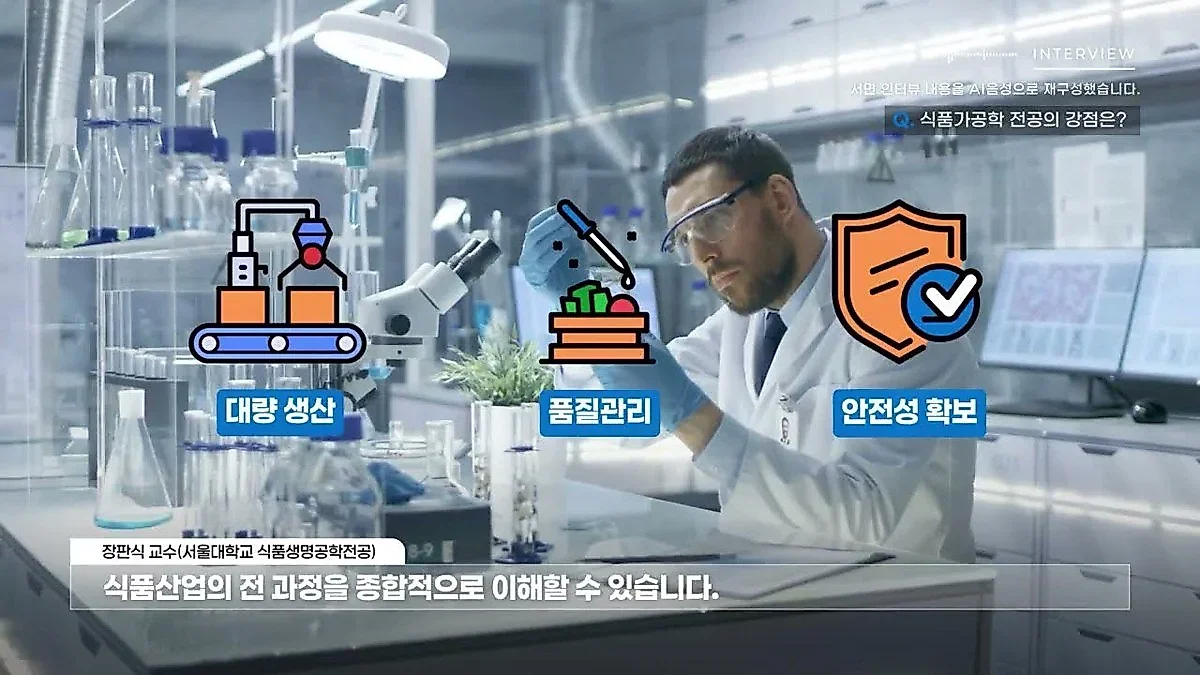
The most significant characteristic of this major is the connection of basic scientific understanding to practical industrial skills. In addition to the scientific capability to understand food structures, students simultaneously learn engineering skills such as process design, automation, and process optimization. This enables graduates to possess the capacity to comprehensively manage the entire food industry process, from establishing mass production systems to quality control and ensuring safety.
Three Representative Roles from Production Management to Functional Research
The guide specifically presents three representative roles that graduates will perform in the field. First, 'Food Production Managers' establish production and material usage plans for each product and are responsible for managing manufacturing work standards, equipment inspection, and production performance. The ability to apply quality and hygiene standards, such as HACCP or smart factory operations, is key.
'Food Sales Representatives' perform the role of proposing products based on market information and managing clients. They develop sales strategies by identifying the needs of consumers and clients and coordinate order conditions and delivery schedules. This requires a deep understanding of products along with market analysis and negotiation skills, and gaining field experience through internships at manufacturing companies is recommended.
In the research field, the role of 'Functional Food Researchers' is prominent. These researchers develop health functional foods by discovering ingredients useful to the human body, evaluating the efficacy and safety of materials, and standardizing components. Experimental design and component analysis skills are essential, and it is advantageous to gain practical experience in research institutes based on majors in functional food science and food chemistry.
Data and Bio-technology as Competitiveness in the Food Tech Era
In the food tech sector, which is the core of the future food industry, the ability to combine traditional processing knowledge with digital and bio-technology is considered the key to survival. Data science and artificial intelligence (AI) are utilized for optimizing production processes, predicting quality, and analyzing consumer preferences, while bioengineering and metabolic engineering lead to the development of alternative proteins or new microbial-based materials.
Ultimately, graduates equipped with smart manufacturing, automation technology, and an understanding of environmental regulations are expected to hold strong competitiveness in the future food industry. To assist with everything from understanding the major to specific career design, the Korea Employment Information Service provides this guide through Employment 24 and its website.
Source: original video (YouTube)



0Comments
Comments are currently disabled.