
How to manage employee anxiety during AI transformation
Jang Hyeon-min, CEO of Team J-Curve, outlines strategies for converting individual expertise into organizational assets through structured MD files and incentive systems to address employee fears during AI implementation.
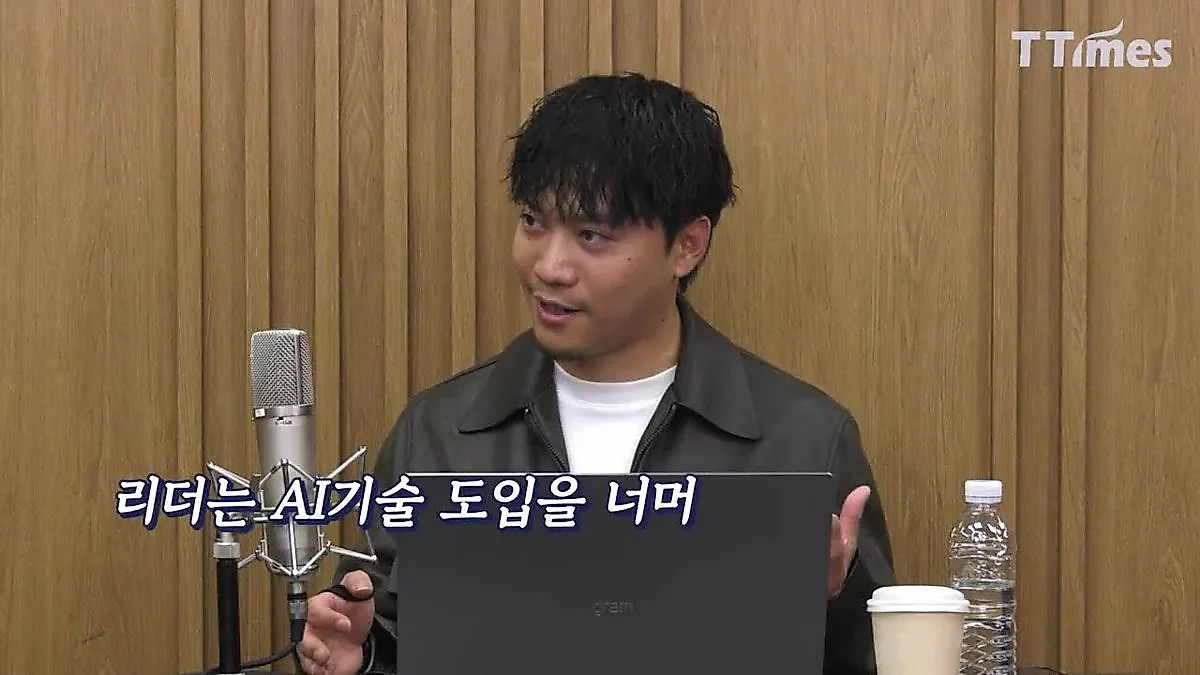
Team J-Curve CEO Jang Hyeon-min suggests using MD files and new compensation models to mitigate employee resistance as AI aims to make the work of 10 people doable by only 3.
What is the ultimate goal of Artificial Intelligence (AI) transformation (AX)? While many companies focus on efficiency, Jang Hyeon-min, CEO of Team J-Curve, points to a more provocative reality: "making the work of 10 people doable by 3." Behind this drive for efficiency lies a fundamental leadership challenge: how to manage the seven remaining employees.
The message delivered by Jang on T Times TV provides practical insights into how individual work knowledge can be converted into organizational assets in the AI era, and how to resolve the resulting employee anxiety and compensation issues.
From Personal Notes to Organizational Knowledge Assets: Using 'MD Files'
Ways to utilize AI are largely divided into using personal "memory" functions and utilizing organizational "MD (Markdown) files." Jang noted that AI's memory functions are tied to individual accounts, posing risks of personal information leakage and making sharing difficult. He mentioned that checking AI memory functions often reveals unwanted personal details, such as a user's profession, residence, or even family names, making it hard to share with others.
Conversely, structuring work knowledge into MD files immediately turns it into a "shared knowledge asset" for the team. MD files offer the advantage of being able to be split and stored for various purposes without sending large amounts of text all at once. For efficient team collaboration, Jang proposed two types of MD files.
The first is the "Index MD," which acts as a map indicating where files are located. By allowing an AI agent to check only the index file instead of searching through every folder, companies can save tokens (AI computation costs) and increase response accuracy.
The second is the "Log MD." This solves the problem of "who, when, and what was modified" during the "co-parenting" process of multiple people collaborating with AI. "With a Log MD, even if you return to a project after several days, the AI can summarize the previous work, drastically reducing communication time," Jang explained. This can also function as a "rollback" feature to restore a previous state if data is corrupted by a new employee's mistake. Jang added, "It is important to structure MD files suited to each company so that AI can work within that environment."
Compensation Systems for Employees Fearing "Will My Job Disappear?"
Managing the psychological resistance of employees is more difficult than technical implementation. From a practitioner's perspective, the process of training AI with their own know-how and tacit knowledge can feel like "an act of cutting one's own throat." Jang emphasized that leaders must go beyond a technical approach and design the organization's ecosystem and compensation structure. He warned that if one does not approach it with the intent to change the organizational ecosystem itself, discord will continue.
In fact, the ownership of AI knowledge assets created by departing employees is emerging as a new source of corporate conflict. Jang cited a case from an AX contest at a cosmetics manufacturer. When a team member who won first place left the company, a dispute arose regarding whether the company had the right to own the knowledge assets the individual had created in HTML format using tools like Claude.
He advised that the scope of knowledge assets accumulated by an individual should be clearly defined from the time of hiring. Using an example from a Japanese media company, Jang presented a specific compensation model. That company operates a system that evaluates the revenue value generated by AI solutions or agents created through hackathons and returns a certain percentage of that value as performance bonuses. "There must be a framework to measure productivity improvements and revenue contribution so that employees are willing to pour out their knowledge," Jang said. "Only when such an environment is created can 'stars' who handle AI be born within the organization." He noted that if someone creates an agent capable of replacing an external service (such as SI), it is possible to compensate them with the amount of cost savings achieved.
Combining Human Capital and Token Capital: Do Not Stop the 'Learning Loop'
The "decline in cognitive ability" that occurs when work is excessively delegated to AI is a crisis facing both leaders and employees. Jang confessed that when he recently left the drafting of a proposal entirely to AI, he experienced a decline in his ability to analyze customer requirements and establish structures. "I couldn't understand what the AI made, and I didn't know what structure or direction to take when making new proposals in the future," he said, noting the regression in cognitive ability.
To solve this, he argued that three concepts emphasized by Microsoft CEO Satya Nadella must be combined: "human capital" (individual capability), "token capital" (the environment in which AI works, such as MD files and database access rights), and the "learning loop" that connects the two.
Jang warned, "If you only provide unconditional delegation to AI, human capital will not grow, and ultimately the value of token capital will also decrease." As an alternative, he proposed an "intentional learning loop." Instead of handing drafts directly to the AI, team members should first discuss the direction thoroughly through voice or conversation, and then go through a process of reviewing and critiquing the AI's draft. By creating a structure where human insights are reflected back into the AI through this process, organizational capabilities can grow continuously without regressing.
Source: original video (YouTube)

0Comments
Comments are currently disabled.