
Gangnam real estate enters downturn as market dynamics shift
The Seoul real estate market has reached a turning point in 2026, characterized by a divergence where Gangnam enters a downturn while parts of Gangbuk retain growth potential. The expansion of the GTX network is driving a "Time-Space Convergence" that is redefining property values based on travel time to business districts.

The Gangnam area has entered a downturn in 2026, causing the overall Seoul apartment price index to dip by 0.1% this past October. While Gangnam faces vulnerability due to low cash liquidity among "house poor" owners, some parts of Gangbuk still possess growth potential.
The real estate market has entered a new turning point in 2026. While apartment prices in Seoul continue a long-term upward trend, the movements of Gangnam and Gangbuk are diverging sharply. The Gangnam area has entered a downturn, whereas some areas in Gangbuk still possess room for growth.
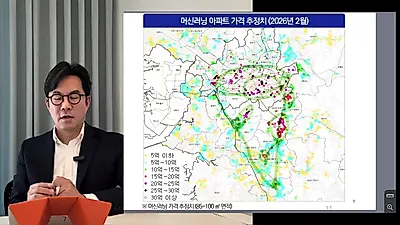
According to an analysis by Professor Kim Kyung-min reported by KB Real Estate TV, the current Seoul real estate market is split into two distinct markets: the Gangnam and Han River areas versus all other regions. In the past, the Han River area would follow Gangnam with a time lag when prices rose, but since 2023, the Gangnam and Han River areas have moved together as a synchronized "high-priced market." Kim explained, "As a result of estimating the total apartment prices in Seoul, the index dipped by 0.1% this past October. Because the decline in the Gangnam and Han River areas is large, it may appear as though the overall index has turned, but this is a result of the movements in these two markets changing."
Vulnerability of Gangnam 'House Poor' and Growth Potential in Gangbuk
Kim cited "bubbles" and "asset structures" as major reasons why the Gangnam area has entered a downturn. He analyzed that the Gangnam area showed a rapid upward trend starting in 2023, with a slope as steep as the price surge seen in 2020–2021. In particular, he pointed out that many asset holders in the Gangnam area have a "house poor" character, lacking actual cash liquidity, making the structure highly vulnerable to external shocks. "The asset class has extremely low cash mobilization capability. Such a market is bound to be very vulnerable to external shocks," Kim added.
He also explained the signs of a bubble through changes in transaction volumes in the Gangnam area. In Gangnam District, transaction volumes showed a volatile pattern: after rising from 2025, they plummeted to 1,885 cases in the first quarter of 2026 before jumping again to 3,460 cases in the second quarter. Kim analyzed that "the fact that transaction volumes are shaken by external shocks, such as strong government messages, means a bubble is present," noting that the possibility of a bubble is higher for expensive housing.
The situation is different in the Gangbuk area. Some parts of the Gangbuk area, such as outer areas of Line 2, are evaluated to have remaining growth potential as many locations have not yet recovered to their 2021 peaks. However, Kim warned, "Since Gangbuk is an area for ordinary citizens, the proportion of mortgage loans is high. If interest rates rise in the future, the actual burden of purchasing will increase, which could cause the market situation to change rapidly."
'Greater Seoul Area' created by GTX... An era of Time-Space Convergence
The paradigm of the real estate market is being reorganized around "accessibility to business districts." While the market was previously centered around Seoul's major business districts (CBD, YBD, GBD), the scope has now expanded to the "Greater Seoul Area" through the Great Train eXpress (GTX). Kim defined this phenomenon as "Time-Space Convergence."
With the opening of the GTX-A line, it will become possible to travel from Seoul Station to KINTEX Station in just 17 minutes, making "temporal distance" rather than physical distance the key factor determining housing prices. Kim explained that it is "the fastest underground metropolitan transport network in the world spanning 180km," and that when time and space converge, the entire scope of the housing market changes. In particular, as the Gangnam business district and the semiconductor belt in the south form two powerful axes, the value of areas connecting these axes is being re-evaluated. The line connecting Bundang, Pangyo, Dongtan, Gwanggyo, and Suseo is a representative example.
Yeonsinnae and Daegok Station: "Need for development utilizing business district accessibility"
Kim expressed regret regarding the phenomenon where the benefits of the metropolitan transport network are concentrated only in specific station areas. In the case of Dongtan, price increases are concentrated only within a 2km radius of the station area while other areas remain stagnant, which he analyzed is due to a lack of connecting transport systems such as bus networks. For true urban development, it is essential to build transport infrastructure so that benefits can spread to areas outside the immediate station vicinity.
In particular, he highly evaluated the potential of Yeonsinnae and Daegok Station. He stated that once GTX-A is connected, the time to travel from Yeonsinnae to Samseong-dong could be faster than traveling from Umyeon-dong to Samseong-dong. "Yeonsinnae and Daegok Station are locations that can access the massive business districts of Seoul Station and Samseong Station within 30 minutes," Kim emphasized, adding, "To utilize these locational advantages, active development, such as increasing floor area ratios, must be supported at the urban planning level." Regarding Daegok Station, he expressed difficulty understanding why development remains insufficient despite its excellent accessibility to Seoul's core business districts, even though the surrounding area is currently tied up in land and zones.
Source: original video (YouTube)
0Comments
Comments are currently disabled.