
"Living zones expanding south from Gangnam to Dongtan"... 'Greater Seoul Inverted Triangle Zone' reshapes the metropolitan housing market
Professor Kim Kyung-min of Seoul National University analyzes how the metropolitan housing market is being restructured around…
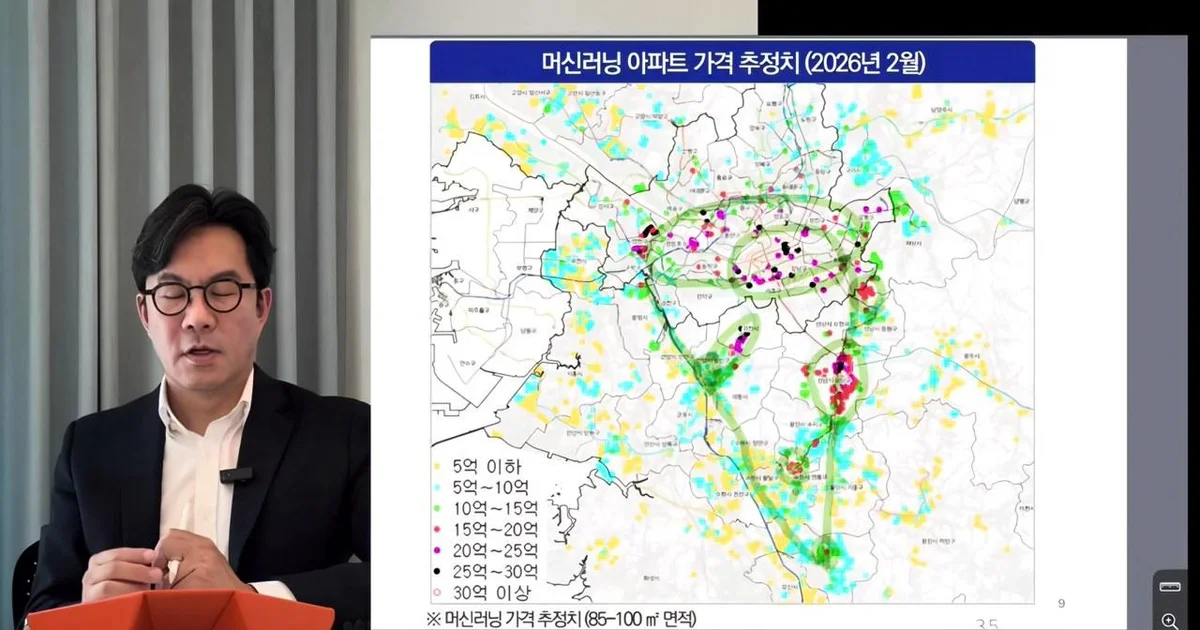
The central axis of the metropolitan housing market is expanding southward from the existing center of Seoul, being restructured around the so-called 'Greater Seoul Inverted Triangle Zone'. Professor Kim Kyung-min of Seoul National University analyzed in a recently released video that accessibility to business districts and the connectivity of the Great Train Express (GTX) are forming a new paradigm in the housing market.
The 'Greater Seoul Inverted Triangle Zone' created by the connection of the semiconductor belt and regional railways
According to the video, the current metropolitan housing market is being connected as the existing Seoul business districts—leading to the three Gangnam districts, CBD, and YB—and the semiconductor belt, including Samsung Electronics and SK hynix, play a powerful 'Anchor' role. Based on data from workplaces participating in the National Pension, Professor Kim mapped workplaces with monthly salaries of 5.7 million won or more and noted the point where the axis of the three Gangnam districts, Pangyo·Bundang, and the southeastern axis where Samsung Electronics is located connect.
This trend is materialized through the GTX-A line, SRT, Shinbundang Line, and Gyeongbu Expressway. Professor Kim named this axis, which leads through the three Gangnam districts, Suseo, Bundang·Jeongja, and Dongtan, the 'Greater Seoul Inverted Triangle Zone', explaining that high-priced residential areas are overlapping along this line and the housing market is being restructured. In particular, the analysis suggests that as the existing anchor, Gangnam, connects with the new anchor, the semiconductor belt, the growth axis is heading south.
The mechanism where reduction in transportation costs leads to rising housing costs
The difference in the modal split of commuting within Seoul versus the metropolitan area was cited as a key variable explaining the changes in the housing market. According to data in the video, the proportion of public transportation for travel within Seoul reaches 61%, with railways accounting for 37% of that. On the other hand, for metropolitan residents commuting to Seoul, the use of private cars is 65%, which is higher than public transportation (35%).
Professor Kim analyzed that if people traveling from Gyeonggi Province to Seoul use regional express railways like GTX instead of private cars, transportation costs are reduced, increasing the capacity to use those funds for housing costs. In other words, when income is constant, the decrease in transportation costs becomes a factor that induces an increase in housing prices. Accordingly, regional railway networks such as GTX, KTX, and SRT are becoming variables that go beyond simply shortening commuting distances to changing the paradigm of urban planning and urban development.
Expansion of living zones beyond administrative boundaries and the challenge of the northeastern region
The reason Seoul's growth axis is leaning south is that powerful business districts, such as the Seoul Subway Line 2 line and the semiconductor belt, are formed in the south. Professor Kim pointed out that while Seoul's administrative boundaries maintain their existing form, the living zones are expanding southward. The analysis suggests that if there had been a powerful business district belt in northern Seoul, the growth axis would have headed north.
In this process, concerns were also raised about the possibility of the northeastern region of Seoul being marginalized. Professor Kim emphasized that to lead the growth of the northeastern region, it is not enough to simply establish the GTX-B and GTX-C lines; the priority must be the development of business districts centered around stations and the attraction of anchor companies. He suggested that urban planning considerations regarding how to supply housing around the areas after the expansion of the railway network must be carried out in parallel.

0Comments
Comments are currently disabled.