
SK hynix unveils MARS technology at Supercomputing 2026 in Chicago
SK hynix has introduced next-generation AI infrastructure solutions, including the MARS (Memory-centric AI Rack System), at Supercomputing 2026 in Chicago, Illinois, to address growing data processing demands.
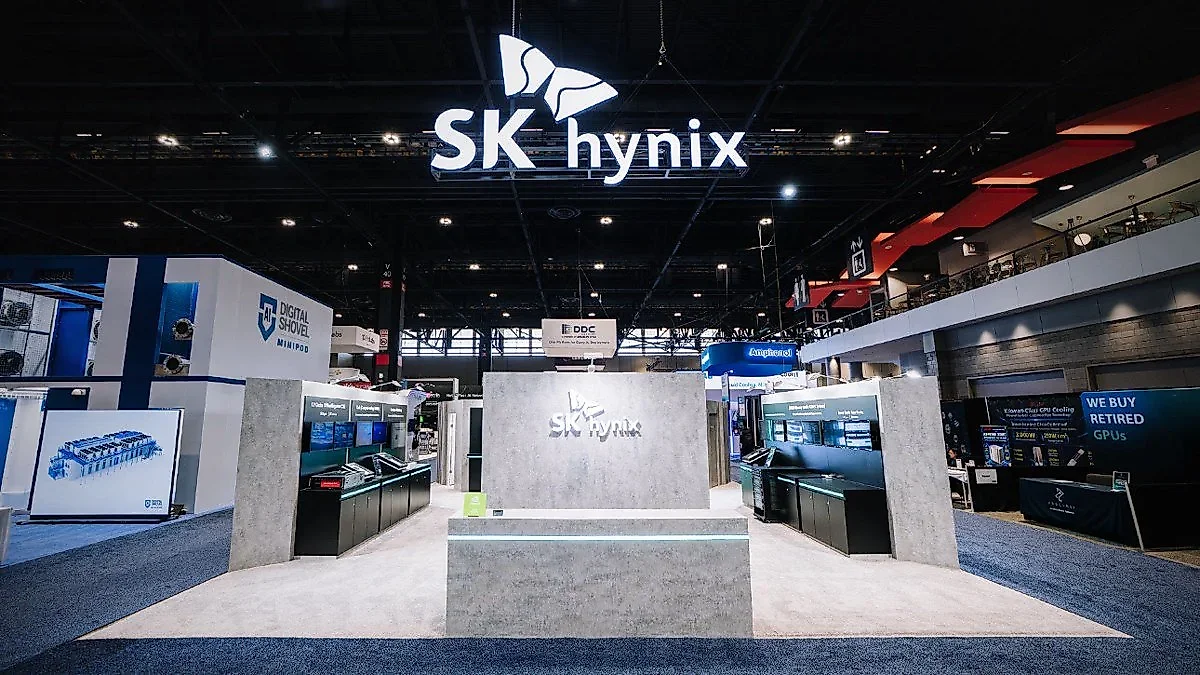
SK hynix introduced its MARS memory-centric AI server rack system at Supercomputing 2026 in Chicago to address data bottlenecks. The exhibition featured advanced solutions including Pooled Memory and Compute-using-DRAM technology designed to enhance computational efficiency for AI infrastructure.
As the scale of data that artificial intelligence (AI) must process grows rapidly, memory technology—which goes beyond simple data storage to efficiently manage and perform computations—is emerging as a key variable in AI performance. Based on a vision to reshape the AI ecosystem around memory, SK hynix has presented next-generation AI infrastructure solutions.
Participating in Supercomputing 2026 held in Chicago, Illinois, United States, SK hynix unveiled next-generation technologies, including the MARS (Memory-centric AI Rack System), a memory-centric AI server rack system. During this exhibition, SK hynix presented ways to overcome the limits of AI computing through memory technologies that increase data transfer efficiency and enhance computational functions.
Next-generation server rack 'MARS' system to resolve data bottlenecks
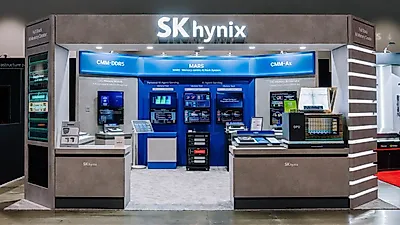
The MARS section, the centerpiece of the exhibition, featured three core demonstrations for implementing next-generation memory-centric systems. MARS is a system that maximizes efficiency by integrating partner solutions into a single rack.
The first demonstration is 'Pooled Memory' technology utilizing CXL (Compute eXpress Link) based hybrid memory. This method stores 'KV cache'—temporary data generated by Large Language Model (LLM) based AI agents during conversation—in CXL hybrid memory that combines DRAM and SSD, and retrieves it quickly whenever needed. This allows for both securing large storage capacity and achieving fast read performance simultaneously.
The second demonstration, 'Computational Pooled Memory,' is a technology that adds computational functions inside the memory. It focuses on increasing the efficiency of AI agent serving systems by connecting multiple servers and GPUs. It demonstrated that by processing simple computations inside the memory before sending data to the CPU or GPU, system performance can be significantly improved compared to existing network communication methods.
The third demonstration is 'Token Sharing' technology, which enhances the performance of multimodal AI services. It showed the process of improving overall serving performance by reducing redundant processing through the sharing of tokens generated by CPU servers connected via CXL pooled memory, thereby shortening GPU latency and optimizing task distribution.
'Compute-using-DRAM' performs computations directly inside memory
The system demonstration section introduced innovative technologies that expand the role of memory. In particular, 'Compute-using-DRAM' technology performs computations directly inside the memory by utilizing the charge-sharing operation of DRAM cell arrays. Because it utilizes standard DRAM without adding separate computational units, it is characterized by its ability to simultaneously increase bandwidth and power efficiency while minimizing loss in chip area and capacity.
It drew attention as a next-generation solution to resolve data transfer bottlenecks, as it can perform arithmetic operations or data comparisons directly inside the memory instead of moving large volumes of data generated during AI computation processes to computational units, transmitting only the results.
Additionally, 'Custom HBM Array' technology was unveiled. Existing GPU-based systems have limits on bandwidth expansion due to a restricted number of connectable HBM (High Bandwidth Memory) units. This technology presented by SK hynix features a structure that connects multiple customized HBM (cHBM) units equipped with computational functions, and is expected to mitigate data movement bottlenecks by providing faster response speeds and higher energy efficiency than before.
Building an AI infrastructure portfolio from HBM to eSSD
SK hynix gathered its core product lineup for AI infrastructure alongside its next-generation memory technologies. The HBM zone exhibited the market-leading HBM3E as well as next-generation products HBM4 and HBM4E.
In the server DRAM field, the company introduced the '256GB 3DS DDR5 RDIMM' which achieves the largest capacity in the industry, the high-bandwidth '128GB DDR5 MRDIMM', and the '192GB SOCAMM' which improves power and space efficiency. In the eSSD zone, a lineup was presented to meet various customer needs, including products supporting Direct Liquid Cooling (DLC) and NVMe standard products that achieve high capacity and low power consumption.
During the presentation session, Min Yeong-hun, a TL (AI System Infra) at SK hynix, explained in detail the Agentic AI serving technology utilizing a shared memory pool and emphasized that the MARS architecture will become a core foundation for future AI systems. An SK hynix official stated, "Memory is emerging as a key factor that determines the performance and efficiency of AI infrastructure," adding, "We will continue to grow with our customers as a key technology partner that enhances AI computing performance."
Source: news.skhynix.co.kr


0Comments
Comments are currently disabled.