
SK hynix presents memory-centered servers to tackle AI data bottlenecks
SK hynix unveiled memory pooling, computing and storage solutions at OCP Global Summit 2026, presenting its vision for memory-centered AI infrastructure. The company demonstrated systems designed to improve resource use, accelerate data sharing and reduce service response delays.
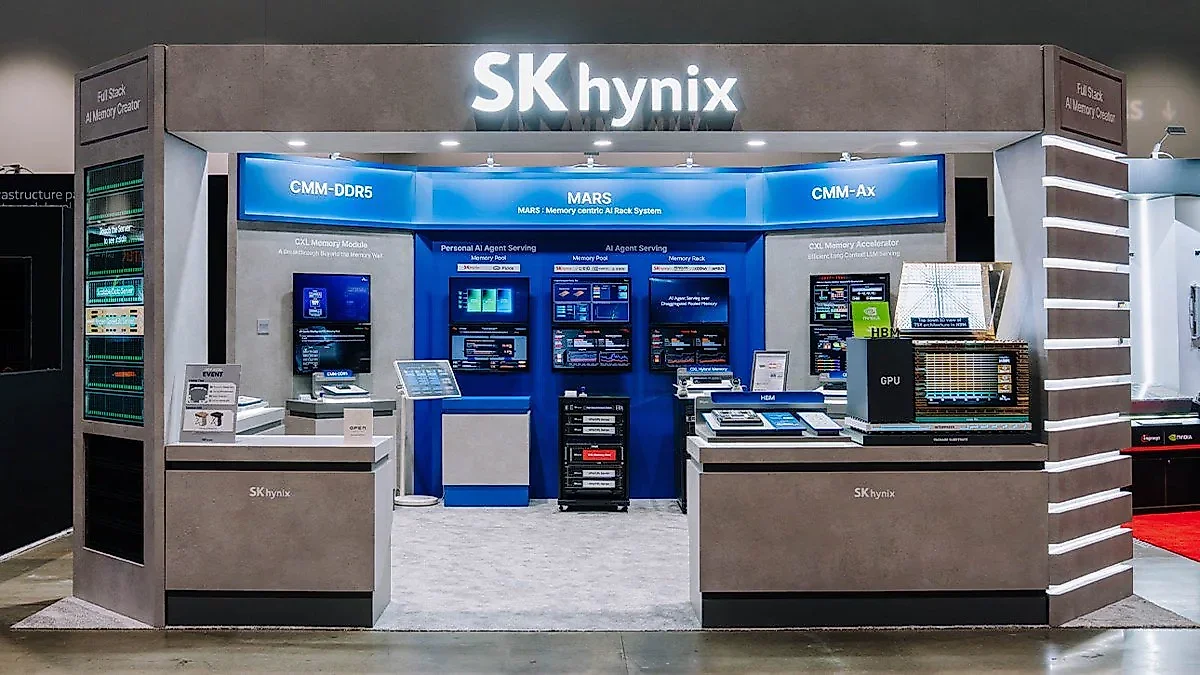
SK hynix presented a vision for memory-centered AI infrastructure at OCP Global Summit 2026 in San Jose, California, United States, unveiling next-generation solutions aimed at easing data bottlenecks as the volume of data handled by artificial intelligence grows rapidly.
The company's exhibits included next-generation memory modules based on CXL and its MARS memory-centered AI rack system. Together, they illustrated its proposed shift toward placing memory at the center of server infrastructure to address the limits of existing computing architectures.
Speaking at the summit's “Executive” session, SK hynix Vice President Kim Ho-sik said the growth of generative AI and hyperscale data centers had left conventional CPU- and GPU-centered architectures facing a bottleneck known as the “memory wall,” alongside rapidly rising power consumption.
“A memory-centered AI rack system that implements rack-level memory pooling and dynamic data sharing through next-generation CXL technology will be a solution,” Kim said.
Pooling memory across servers
A central exhibit was a next-generation server system built around CXL pooled memory. Using the CXL interface, the system creates a memory pool that allows multiple servers to share memory resources according to their needs, which SK hynix presented as a way to maximize resource utilization.
The second-generation 256GB CMM-DDR5 unveiled at the exhibition delivers bandwidth of 80GB/s, at least double that of the previous generation, and improves energy efficiency by about 30%, according to the company.
SK hynix also shared results from its ongoing collaboration with NAVER Cloud, reporting that it had verified working solutions for sharing KV caches in agentic AI environments and sharing embeddings in omni-modal services.
MARS integrates partner solutions into a single rack around memory to improve efficiency. SK hynix conducted pooled-memory system demonstrations with global partners including Arcee, Liqid and Marvell. The company said the demonstrations established a substantial improvement in system performance compared with conventional methods that use network communications.
In a demonstration with AMD, Penguin and Xcena, the company combined CXL memory with hybrid memory to show how large KV caches could be stored efficiently and reused quickly. With personal AI agent company Pickle, it demonstrated how pooled-memory streaming technology could reduce service response delays.
Adding computation to memory
SK hynix also introduced CMM-Ax, a solution that performs computation directly within memory to minimize data movement and reduce power and cost burdens.
A demonstration using CMM-Ax showed efficient acceleration of long-context processing, a task that had been difficult for conventional GPU-based systems. The associated research was accepted at MICRO 2026, a prestigious computer architecture conference, providing recognition of the technology.
The exhibition also featured products the company described as currently leading the market. These included the PS1010, PS1110 and PEB210 enterprise SSD products for AI infrastructure. Server DRAM exhibits included a 256GB 3DS RDIMM, described as offering the industry's largest capacity, and a 192GB SOCAMM designed to improve power and space efficiency.
High-bandwidth memory and flash
In its high-bandwidth memory exhibition area, SK hynix displayed a model of NVIDIA's Vera Rubin Superchip to illustrate the companies' partnership. Physical HBM4, HBM4E and HBM3 products allowed visitors to trace the technology's development across generations. Models explaining through-silicon via, or TSV, technology and next-generation MR-MUF technology were also on display.
The company also introduced the emerging high-bandwidth flash technology HBF. This next-generation NAND solution applies TSV technology, as HBM does, to combine the high capacity of conventional storage with high bandwidth.
SK hynix outlined a differentiated strategy: using HBM in environments that require fast responses and HBF in agentic AI environments that need large memory capacity.
Source: news.skhynix.co.kr

0Comments
Comments are currently disabled.