
Professor Oh Cheol analyzes global macroeconomics and industry shifts for 2027
During a Bank of Korea lecture, Professor Oh Cheol of Sangmyung University provided an in-depth analysis of global macroeconomic trends and industrial outlooks leading up to 2027.
During a Bank of Korea lecture, Professor Oh Cheol of Sangmyung University warned that South Korea may face inevitable tax increases if high welfare is maintained. He also forecasted that China's growth rate is expected to fall to the 4% range next year.
As global macroeconomic trends undergo rapid changes, key variables determining the direction of the economy and industries in 2027 are drawing attention. In a recent "Friday Lecture" hosted by the Bank of Korea, Professor Oh Cheol of the Department of Global Business at Sangmyung University delivered an in-depth analysis on the theme of global macroeconomic trends and major industrial outlooks for 2027.
"The source of information is key"... Reading economic data through the Nvidia case
Before diving into the economic outlook, Professor Oh emphasized the importance of "acquiring economic information." He asserted that in the AI era, where a massive amount of economic information is being released, the ability to verify the source of that information is essential. He advised that rather than focusing on visually impressive information, one should consider the source, explaining that judging the accuracy of economic information is crucial when acquiring it.
To illustrate the importance of insight in reading economic trends, Professor Oh shared an anecdote about a listener who attended a previous lecture on the Fourth Industrial Revolution, identified the potential of Nvidia, and achieved significant profits through investment. A high school English teacher who attended the 2017 lecture recognized the potential of Nvidia around 2014 based on a value chain analysis mentioned during the session. The teacher subsequently invested 30 million won borrowed around 2024, resulting in returns of more than 10 times the investment. Mentioning how Nvidia's stock price surged during the 2020–2021 cryptocurrency mining boom before falling due to decreased mining demand, and its subsequent rise from 2022, Professor Oh suggested that one should read macro-level changes in the value chain rather than seeking specific stock recommendations.
"It is important to read the economic flow," he said, continuing his macro-level analysis based on the research from the "2027 Outlook for the Korean Economy," a project he has participated in for 11 years. This research has continued from 2017 to the present, and a book titled "2027 Outlook for the Korean Economy," involving 35 authors, was recently published.
Fiscal expansion and inflation pressure... Structural changes in the global economy
Professor Oh identified "expansion of fiscal policy" as a core keyword that will permeate the global economy in 2027. He analyzed that governments in major countries, including the United States, Japan, and China, are showing a tendency to increase fiscal spending, which inevitably triggers inflation pressure. Citing economic models, he explained that it is extremely difficult to simultaneously achieve three goals: low taxation, low national debt, and high welfare.
Using France as an example, he analyzed that "France gave up low national debt to maintain high welfare, resulting in a debt ratio that soared to 119%." Regarding the situation in South Korea, he offered a cautious forecast, stating, "If high welfare is not given up, a future tax increase (giving up low taxation) will be inevitable." Along with this fiscal expansion, changes in interest rate policies by major central banks, such as the gradual rise in interest rates in Japan, and the possibility of rising long-term interest rates are expected to act as major variables in the global economy.
Regarding the Chinese economy, he diagnosed that a multifaceted interpretation is required. His analysis suggests that unlike the cooperative relationship maintained with South Korea in the early 2000s, the relationship will become much more competitive in the present and future. China's growth rate is expected to be 4.5% at the end of this year, but it is forecasted to fall to the 4% range next year.
South Korean economy driven by exports; industrial temperature gaps to widen in 2027
Regarding the South Korean economy, he pointed out the current trend where exports are driving growth, but warned of the stark differences in "temperature" that will appear across industries in the future. Professor Oh evaluated that the South Korean economy achieved "surprise growth" this year, recording a growth rate of approximately 3.7% based on OECD forecasts, thanks to exports. While consumption is expected to increase and semiconductor-related investment is expected to rise next year, he analyzed that it will be difficult for all industries to grow in tandem.
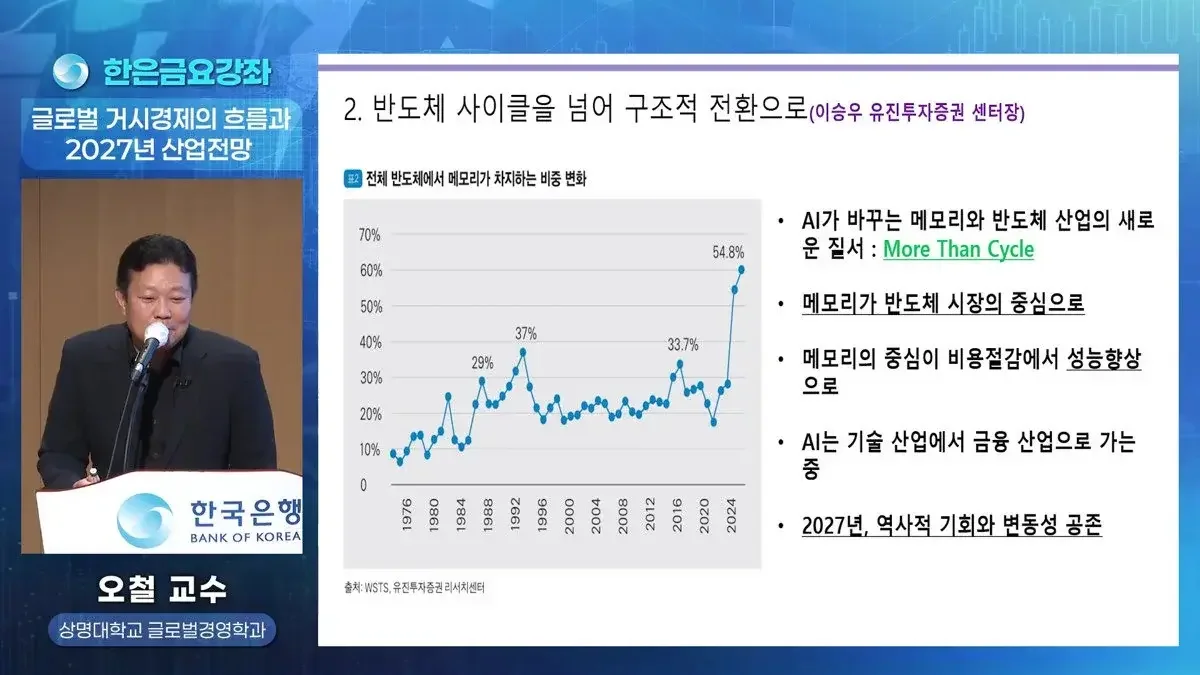
In particular, regarding the semiconductor industry, he diagnosed that expectations for growth and concerns coexist. He explained, "The semiconductor outlook must be analyzed differently by industry, and specifically, the movements of hyperscalers (large-scale cloud service providers) will be an important variable determining the future direction of the semiconductor market." Additionally, the fact that the relationship with China, which was once a cooperative one, is increasingly intensifying into a competitive relationship was also identified as one of the structural pressures facing the South Korean economy.
Source: original video (YouTube)


0Comments
Comments are currently disabled.