
KOSPI plunges below 5,000 as US data center regulation fears hit semiconductors
The KOSPI index plummeted below the 5,000 level following a massive sell-off triggered by fears that US Democratic Party of Korea-led political shifts will lead to strict regulations on AI data centers. This market panic, characterized by heavy foreign selling, has caused semiconductor giants like Samsung Electronics and SK hynix to lose significant value.
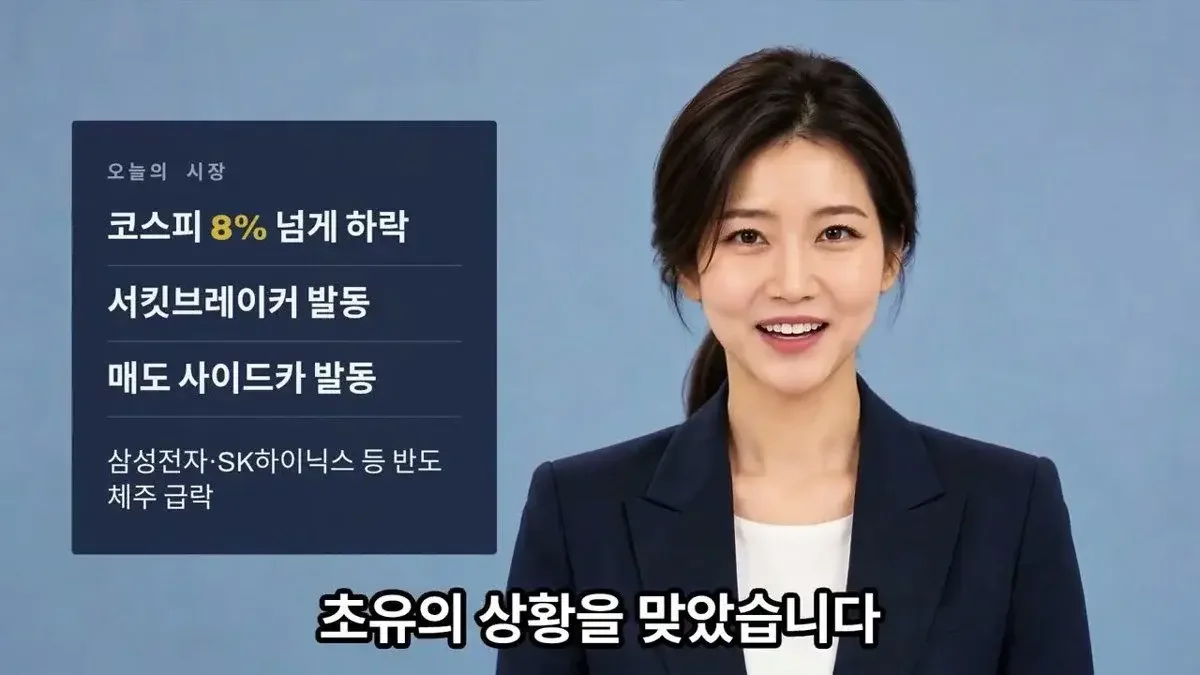
The KOSPI fell below the 5,000 level on November 6, triggering both a circuit breaker and a sidecar after foreign investors net sold 2.8 trillion won. The crash follows US midterm election results that raised fears that Democratic Party of Korea pledges to regulate AI data centers could halt semiconductor demand.
The South Korean stock market fell into a panic immediately after opening. Following a massive crash in the US stock market, the KOSPI index plummeted below the 5,000 level, triggering an unprecedented circuit breaker. Fear is spreading through the market as semiconductor stocks, led by Samsung Electronics and SK hynix, took a direct hit.
According to an analysis from Professor Lee Hyun-hoon's Economic Forum, November 6 was a "Black Friday" for the South Korean stock market. The KOSPI fell to the 4,900 level immediately after opening, closing down 6.19%. During this process, a circuit breaker was triggered around 9:03, followed by a state of panic selling that led to an additional sidecar being triggered at 9:34. Foreign investors led the market decline, net selling 2.8 trillion won in a single day. This marks their sixth consecutive day of selling, following a 3.4 trillion won sell-off the previous day. While institutional and individual investors stepped in to defend against the decline, they were insufficient to stop the foreign selling pressure.
Semiconductor leaders collapse, losing nearly half their value from peaks
The decline in the semiconductor sector is even steeper. Samsung Electronics closed at 188,700 won, down 6.35%, breaking below the 200,000 won mark. SK hynix plummeted 10.44%, barely maintaining the 1.1 million won level. The decline of these companies is severe based on the figures from just the last two days: on Thursday and Friday, the KOSPI fell 11.15%, Samsung Electronics fell 13.44%, and SK hynix fell 18.91%.
The long-term trend presents an even larger problem. Compared to the all-time highs recorded this past June, the decline is more devastating. The KOSPI fell from a level of 9,114 at that time to 5,500, a drop of 44.59%, while Samsung Electronics fell from 362,500 won to 188,700 won, losing approximately 50% of its value. SK hynix plummeted 60.1%. Professor Lee Hyun-hoon diagnosed the situation, stating, "This is not just a problem of yesterday or today, but a chain reaction of crashes occurring after the PHLX Semiconductor Sector Index fell 38.4% from its peak on June 22." The PHLX Semiconductor Sector Index fell from its peak of 14,634.72 to the 9,000 level.
The situation in the US market is also tragic. The Nasdaq index fell 5.52%, and the PHLX Semiconductor Sector Index specifically plummeted 12.2%. The entire AI semiconductor value chain appeared to be collapsing as NVIDIA fell 9.3%, Marvell Technology fell 16.4%, AMD fell 17.3%, and TSMC (ADR) plummeted 27.3%. Micron Technology, a memory semiconductor company, also fell to about half its peak value, while Sandisk fell 22.3% and Intel fell 10.3%. Notably, Intel had previously plummeted 28.6% following its recent earnings announcement due to concerns over slowing next-quarter results. Companies related to AI data centers also fell across the board, including Iland (17.0%), Nebius (15.0%), Applied Digital (14.7%), and CoreWeave (approximately 10%).
Fear of 'data center regulation' triggered by US midterm election results
The decisive trigger for this crash is the political change in the United States. As a "Blue Tsunami" occurred with the Democratic Party of Korea seizing control of both the Senate and the House in the US midterm elections, fears swept the market that the Democratic Party of Korea's promised regulations on AI data center construction would become a reality.
The Democratic Party of Korea has put forward pledges to halt the construction of new AI data centers or to strengthen monitoring and regulation of existing facilities. With Democratic Party of Korea candidates winning in major states including Texas, Georgia, Ohio, Pennsylvania, and New York, these regulatory movements are expected to accelerate. In Texas specifically, regulatory pressure is intense, as a candidate who pledged to completely halt new approvals was elected governor. The market interpreted this as a "halt in AI investment." The logic is that if data center construction is delayed, demand for the AI semiconductors used within them will inevitably decrease, leading to falling semiconductor prices and worsening corporate profitability.
Professor Lee Hyun-hoon explained, "The market fell into a panic due to concerns that semiconductor demand would decrease, given that the Democratic Party of Korea is moving to completely halt new data center approvals or strictly regulate existing facilities." This is the result of investment sentiment from Big Tech companies, which had driven the AI craze, being rapidly curtailed by political variables. It is analyzed that this is not simply a problem of this night, but an explosion of the "peak-out" signs already appearing in the semiconductor sector, coinciding with the election results.
"Beware of panic selling"... Investment strategies amidst the downturn
While the market is gripped by fear, advice has been given to beware of unconditional selling. Professor Lee Hyun-hoon acknowledged the highly unstable state of the market, citing characteristics such as the occurrence of panic selling, failed attempts at technical rebounds, and continuous foreign selling. He particularly noted the movement of foreign investors. He pointed out that while they sold in the past during bull markets for profit-taking or rebalancing, the current pattern is entirely different, as they are selling in anticipation that stock prices will fall further.
Nevertheless, Professor Lee emphasized, "While I judge there is a high possibility of a decline in the medium to long term, one must not engage in 'panic selling' by failing to hold on during a panic situation like this." This is because a "dead cat bounce," a temporary strong rebound during a bear market, can occur.
Ultimately, it must be faced that while the AI revolution may continue, there is no guarantee that AI-related stock prices will rise endlessly. It is a time requiring calm market analysis and risk management, and the expert's suggestion is to be wary of selling unconditionally out of fear.
Source: original video (YouTube)


0Comments
Comments are currently disabled.