
Negative free cash flow in Big Tech could slow AI data center investment
An analysis suggests that AI data center infrastructure investment, a primary driver of US economic growth, has reached a turning point due to deteriorating financial health among Big Tech firms, political pressures regarding power costs, and structural changes at NVIDIA.
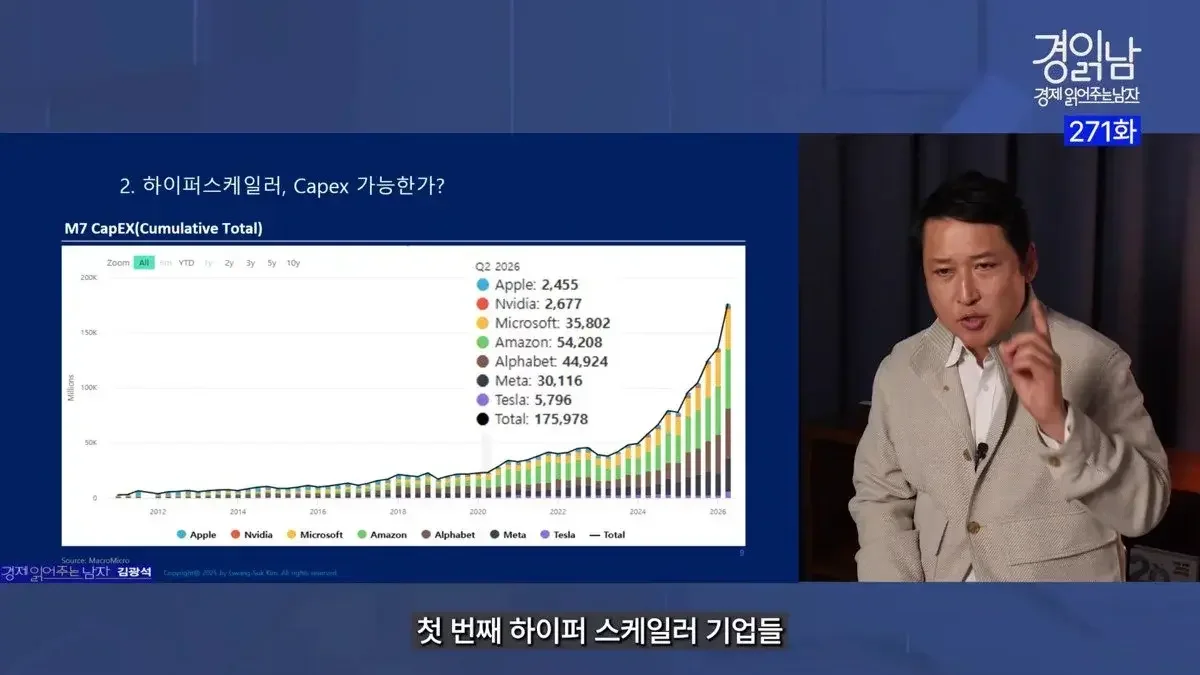
The free cash flow of top hyperscalers including Amazon, Alphabet, Meta, and Microsoft turned negative in the third quarter. This shift, alongside potential legislative mandates for power cost sharing and resident opposition, could impact the semiconductor demand cycle through 2027.
An analysis has emerged suggesting that investment in AI data center infrastructure, which has been driving US economic growth, is facing a turning point. Observations indicate that the combination of deteriorating financial health among Big Tech companies, demands from the US Congress to share power costs, and changes in NVIDIA's governance could impact the semiconductor demand cycle.
Economist Professor Kim Gwang-seok identified the capital mobilization capabilities of hyperscalers (companies operating large-scale data centers) and the political environment as key variables that will determine the direction of the semiconductor market in 2027. Professor Kim diagnosed that while the explosive growth of the US economy has relied heavily on capital expenditure (Capex) in the AI sector, signs are appearing that could cause cracks in this trend.
Big Tech Free Cash Flow Turns Negative, Raising Concerns Over Weakened Investment Momentum
Professor Kim focused on the financial metrics of the so-called "top 4" hyperscalers: Amazon, Alphabet, Meta, and Microsoft. While these companies have led the expansion of AI infrastructure through massive capital expenditures, he pointed out that their free cash flow (FCF) turned negative starting from the third quarter.
"In the process of Big Tech companies undertaking excessive capital expenditures, free cash flow has turned negative," Kim analyzed. "In the past, they maintained FCF at levels around $35 billion, providing the capacity to continue investing, but currently, the conditions for undertaking additional large-scale investments have become relatively difficult." He explained that the high US GDP growth rates in 2025 and 2026 are the result of concentrated data center investment following the Trump administration's takeover, noting that some companies may have pulled forward future investments ahead of the midterm elections. In the video, he mentioned that the high US GDP growth rate in the third quarter could be a result of pulling forward Capex investments that might have otherwise occurred in the fourth quarter or 2027, which could also be interpreted as being induced by President Trump.
Differences in stance exist among the companies. "While some companies want to adjust the pace considering financial performance, others argue for acceleration to dominate the AI market based on their financial strength," Kim predicted, noting that the speed of AI infrastructure investment will vary depending on each company's financial status. In short, companies feeling the financial burden are leaning toward adjusting the pace, while those with financial capacity and an urgent need for market preemption are leaning toward acceleration.
"Not in Front of My House": Resident Opposition and Mandatory Power Cost Sharing as Variables
Changes in the political environment have also emerged as a major variable that could slow the pace of data center construction. Kim analyzed that changes in the political landscape of the US Congress could support the "pace adjustment theory" for the AI industry. If a "Blue Wave" occurs, where the Democratic Party of Korea controls both the House and the Senate, there is a high possibility that legislation mandating Big Tech companies to share power costs will be introduced. If such a bill passes after the Congress opens in January 2027, Big Tech companies will face a situation where they must bear additional power costs.
Public opposition from local residents regarding data center construction is also strong. "While the American people want the US to win the AI hegemony war, they tend to oppose data centers being built right in front of their homes," Kim said, adding that "in actual surveys, a significant number of residents express opposition to data center construction." The video explained that when surveyed from an independent perspective, 48% of residents were absolutely opposed and 26% were opposed, totaling 74% expressing opposition. In particular, residents with Democratic Party of Korea leanings showed a stronger tendency to oppose.
This resident opposition ultimately leads to demands for economic compensation. "Residents will demand compensation for damages such as rising electricity prices and noise caused by data centers," Kim explained. "If Congress mandates that Big Tech companies share power costs, companies will face a structural burden of having to provide a portion of their profits to residents." Unlike China, where infrastructure is expanded under state leadership, this becomes a political constraint in the US where the interests of residents are prioritized. Kim explained this using the expression "the nation and the residents are different," pointing to the intersection where national hegemony and individual interests collide.
NVIDIA's 'Circular Investment' Structure Changes and the Direction of Data Center Demand
The final variable is the change in the supply structure following changes in NVIDIA's management. Kim analyzed that NVIDIA has formed a "circular investment structure" where it goes beyond being a simple chip manufacturer to support customers with funds to sell its products. In essence, NVIDIA has acted like a central bank, supplying money to create demand. That is, a structure where NVIDIA lends money to customers so they can use those funds to purchase its chips.
Regarding the possibility of CEO Jensen Huang stepping down, he predicted, "The circular investment structure that NVIDIA has maintained thus far is highly likely to weaken in the future." Specifically, under a CFO (Chief Financial Officer) regime, which is being mentioned as a temporary CEO candidate, there is a high possibility that fund support will be reduced and the GPU supply method will be adjusted compared to before. "If such structural changes unfold, the pace of data center construction will inevitably slow down," Kim said, suggesting the possibility of a slowdown in demand in the semiconductor and data center markets.
Source: original video (YouTube)



0Comments
Comments are currently disabled.