
SCF CMO Yang Seong-uk advocates data-driven profit management
Yang Seong-uk, CMO of Space Contents Food (SCF), shared his data-driven management strategies and step-by-step marketing tactics during a lecture at the 2027 Food and Restaurant Industry Outlook.
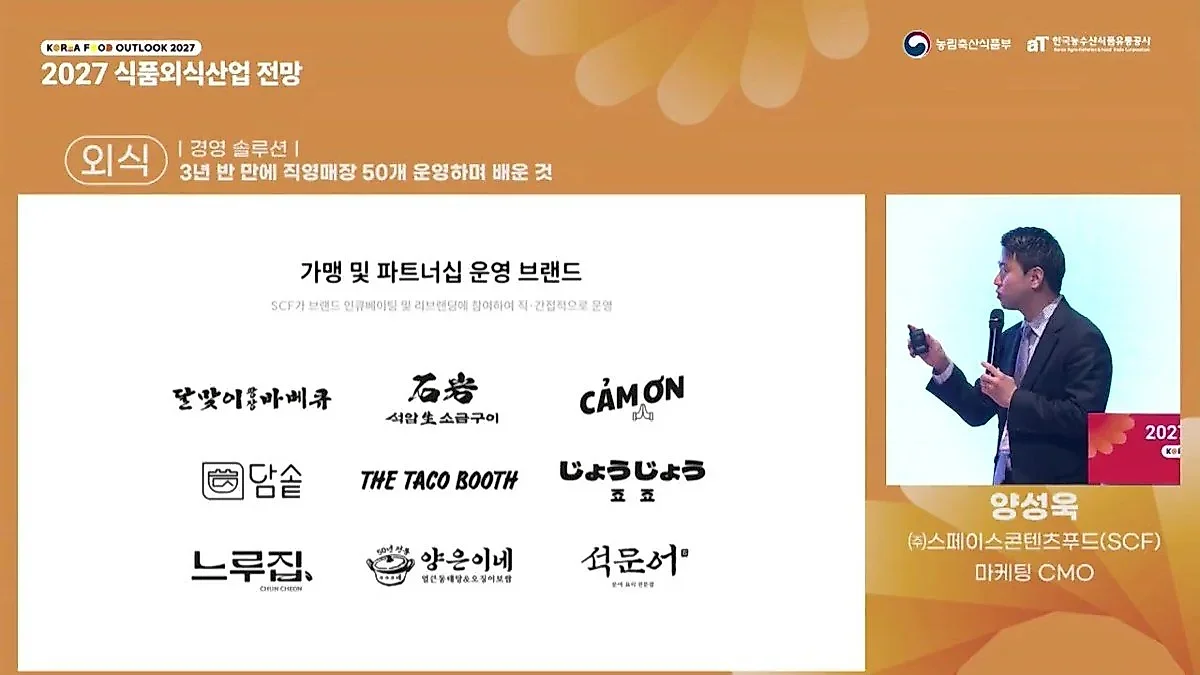
At a food industry outlook lecture in Seoul on November 5, Space Contents Food CMO Yang Seong-uk shared how the company expanded to 50 directly managed stores in three and a half years by prioritizing actual profit margins and data analysis over sales volume.
As the growth speed of the food service industry accelerates, the practical management strategies of a company that has rapidly expanded to operate 50 directly managed stores in just three and a half years are drawing attention. During a lecture at the '2027 Food and Restaurant Industry Outlook' held at COEX in Seoul on November 5, Yang Seong-uk, CMO of Space Contents Food (SCF), shared thorough profit-oriented management based on data and step-by-step marketing strategies.
"Focus on actual profit margins rather than sales volume"
CMO Yang Seong-uk emphasized that in operating food brands, the core is "how much you actually keep" rather than the size of sales. "I do not consider sales volume to be important," he said. "It is truly important to calculate labor costs, cost ratios, and rent to see how much actually hits my bank account." Defining himself as a manager no different from a self-employed business owner, he revealed a field-oriented management philosophy by mentioning the tax burdens, such as value-added tax and corporate tax, that occur every month.
In its early stages, SCF started its business in the form of franchises (agencies) that did not have brand operation authority. The company gained popularity by operating rice-based specialty restaurants such as 'Damso Kkamon' in the Pangyo area, and used the cash secured through this to reinvest in store expansion, reaching its current scale. Yang explained, "In the beginning, due to a lack of F&B knowledge, we operated mainly through franchise businesses to secure cash flow, but we shifted toward creating our own brands to have long-term brand control."
Currently, SCF operates various in-house brands, including 'Katsu Shosi', a collaboration with a Michelin one-star chef; 'Cracking', created with a first-generation barista; and the wellness brand 'Arche Nine'. Additionally, the company holds a diverse portfolio including the ramen brand 'Ollim' created with chef Lee Jeong-yong, 'Arche Nine' which is the first branch at Hyundai Department Store Pangyo, and the passive stretching brand 'Remake Stretch Lab' in collaboration with coach Lee Sang-hwa. Yang added, "Franchising is a job where you must take responsibility for someone else's life, so it does not suit us. We operate all 50 stores as directly managed stores invested with our own funds to directly manage brand quality."
Regarding brand expansion strategies, he emphasized a flexible approach that utilizes the characteristics of commercial districts. While targeting the Pangyo commercial district, the hometown of the founders from Seongnam, SCF is also deploying its brands to target the office worker districts within prime buildings in Seoul (Ferrum Tower in Euljiro, Bithumb Finance Tower in Gangnam, and Shinyoung Securities in Yeouido). Yang stated, "By negotiating with commercial real estate specialists, we are adopting a strategy to lower investment costs and increase profitability by securing favorable conditions such as rent-free periods or tenant incentives (TI)."
"Analyze turnover rates and average transaction values through data"
Yang identified 'data analysis' and 'breakdown' as the core tools of management. He stated that instead of giving emotional commands to field staff, he makes decisions based on customer reviews and Point of Sale (POS) data. In particular, he presented the correlation between 'turnover rate' and 'average transaction value' as a specific methodology to increase sales.
"To increase sales, you must either increase the turnover rate or raise the average transaction value," he said. "To increase the turnover rate, you should place menus with fast processing rates at the top of the menu and ensure thorough preparation (prep)." Conversely, regarding the strategy to increase the average transaction value, he explained, "Simply raising prices is deceiving customers. You must provide value through 'add-on' menus, such as soft-boiled eggs or side dishes, so that customers can naturally place additional orders."
Furthermore, he cautioned against 'unproven expenditures' in marketing. Yang emphasized the importance of step-by-step testing, stating, "I do not spend money on marketing where ROAS (Return on Ad Spend) cannot be measured." Rather than executing large-scale advertising immediately after a store opens, he advised dividing the process into stages—free blog experience groups, utilizing local-based Reels creators, managing Naver Place rankings, and Naver CPC advertising—to individually measure the impact of each marketing effort on sales. He pointed out, "If you do all marketing at once, you cannot measure it, and there is no way to respond when it fails."
"Expansion is possible only when you leave the field"
Practical advice continued regarding the operational structure that enabled rapid expansion. "The moment you operate two or more stores, the owner should not be stuck to the shop," Yang said. "Developing reliable employees who can operate the first store in your stead is a prerequisite for business expansion." He emphasized that one must be away from the field to devise strategies for the next business.
A cost management strategy to maximize profitability was also mentioned. Yang explained, "To lower the cost ratio, we continuously compare three or four different suppliers when purchasing food ingredients." Regarding online marketing, he explained, "To increase the efficiency of keyword marketing, we divide the volume into three groups, A, B, and C, in ratios of 50%, 30%, and 20%, and create competition by concentrating the volume on the most efficient group every month."
Finally, he stressed the importance of internal data for CRM (Customer Relationship Management), which is the core of customer management. He stated that utilizing POS data and data generated at payment points to analyze data by day of the week and by number is essential, noting that data-driven management to induce repeat visits from existing customers determines the success or failure of the food service industry. Meanwhile, SCF announced that it expects to expand overseas next spring and is also designing new business plans, such as acquiring high-quality brands to improve indicators and then selling them.
Source: original video (YouTube)



0Comments
Comments are currently disabled.