
South Korean economic momentum could persist through early 2027
The upward trend in the South Korean economy driven by the 2026 semiconductor boom is expected to continue through the first half of 2027, according to an analysis by Economics Master Kwak Soo-jong.
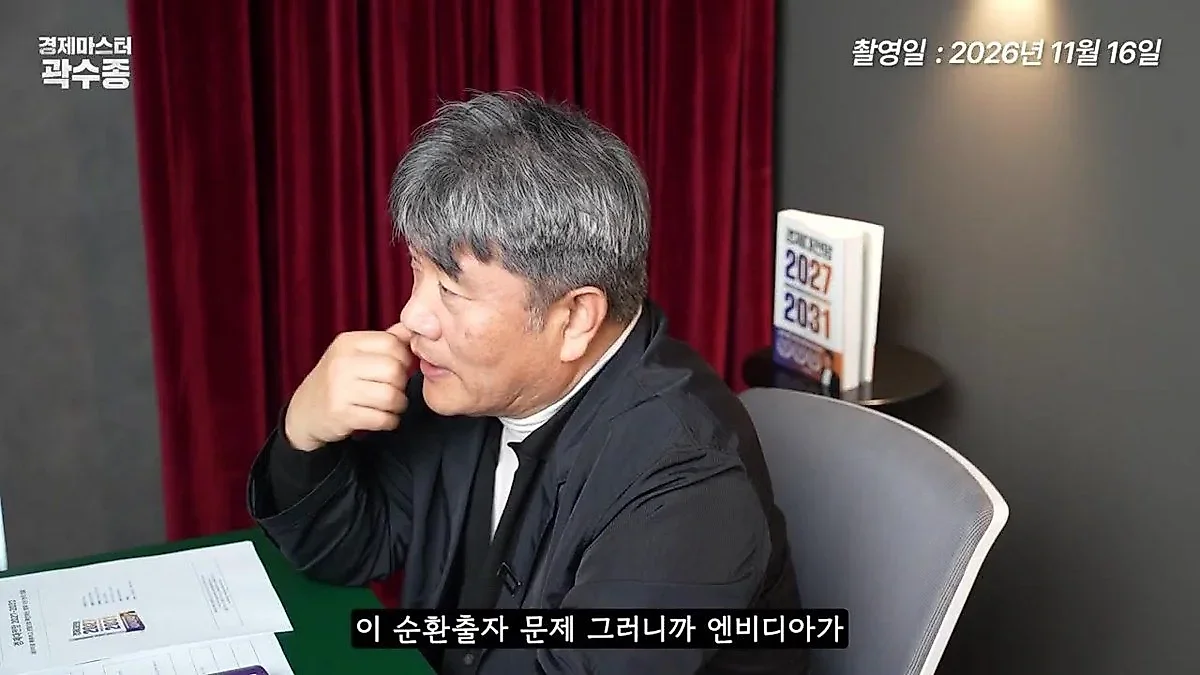
The South Korean economy is projected to maintain its upward momentum through the first half of 2027 following a semiconductor boom in 2026. While growth is forecasted in the low-to-mid 2% range for next year, future stability depends on U.S. interest rate directions and political dynamics in the U.S. Congress.
The upward momentum of the South Korean economy, driven by the semiconductor boom in 2026, is projected to continue through the first half of 2027. Key variables that will determine the future direction of the South Korean economy include the political dynamics of the U.S. Congress, the structural characteristics of the AI industry, and the direction of interest rates.
This analysis, delivered by Economics Master Kwak Soo-jong, is based on the contents of the recently published [Economic Outlook 2027–2031]. Dr. Kwak outlined the flow of the South Korean economy in 2027 by constructing scenarios regarding changes in the power structure of the U.S. Congress, the growth drivers of the AI industry, and short-term shocks and medium-term volatility for the South Korean economy. In particular, he provided a detailed analysis of the ripple effects on the South Korean economy by distinguishing between scenarios where the Democratic Party controls both the U.S. House and Senate and situations where power is divided between a president-centered administration and Congress.
AI industry regulation and economic impact under Democratic control in the U.S.
Dr. Kwak focused on the impact that changes in the U.S. political landscape could have on the AI industry. There are concerns that if the U.S. Congress is controlled by the Democratic Party, regulations on the AI industry and data centers could strengthen. In particular, variables such as opposition from local residents regarding the construction of data centers could play a role. However, Dr. Kwak analyzed that it would be difficult for the Democratic Party to completely abandon or drastically slow down the growth of the AI industry.
He cited "labor market health" as the basis for this reasoning. If the growth rate of the AI and data center industries were forcibly adjusted—for example, by sharply reducing the growth rate from 100 to 30—large-scale restructuring would be inevitable, leading to a collapse in the labor market and a decline in income. "Layoffs of 20,000 or 60,000 people are by no means small numbers," Dr. Kwak explained, noting that because such economic shocks are directly linked to voter sentiment, the Democratic Party cannot avoid the responsibility and duty to revive the U.S. economy. The analysis suggests that the political environment of the 2028 presidential election will be a crucial factor in determining the Democratic Party's policy stance.
Furthermore, the "circular equity" structure of the AI industry, centered around NVIDIA, is a factor supporting the industry's continuity. An interconnected chain has formed where NVIDIA invests in ChatGPT (OpenAI), which in turn leads to Celebrity, CoreWeave, and Anthropic, making it difficult to sever all these links at once due to a specific issue.
U.S.–China AI competition and the reshaping of the global order
Regarding the AI hegemony competition between the United States and China, he suggested the possibility that the two countries might find order by acting as "complements" to each other. The logic is that if the United States must invest approximately $10.3 trillion to build the AI industry foundation, China must also continue to invest around half that amount, $5 trillion, for national survival. This is because, even under a socialist system, corporate profits and investment must support the survival of the state and the Communist Party. Considering that Chinese companies such as Huawei, CXMT, and YMTC are steadily generating profits and persevering, it is viewed that investment through Chinese government subsidies will inevitably continue.
Dr. Kwak forecasted that if the AI industry order between the U.S. and China is settled through future summits, similar to the 1985 Plaza Accord or the U.S.–Japan Semiconductor Agreement, the AI industry will remain a steady future growth engine. The analysis suggests a complementary relationship could form where the existence of the U.S. allows for the existence of Chinese AI. If leaders such as Putin, Xi Jinping, and Trump meet at summits like APEC to settle the order, the AI industry is expected to enter a new phase.
2027 South Korean economy: Semiconductor aftermath and interest rate variables are key
Regarding the South Korean economy, he predicted that the aftermath of the 2026 semiconductor boom would be maintained through the first half of 2027. Dr. Kwak presented a growth rate forecast for the South Korean economy in the low-to-mid 2% range for next year. However, he noted that from the second half of the year, U.S. political stability and the direction of interest rates would be the variables determining additional points for the South Korean economy.
The analysis suggests that if the United States shifts from a stance of raising interest rates to cutting them, and if regulations on the AI industry change moderately, the South Korean economy could gain additional upward momentum. Conversely, if the U.S. maintains a stance of raising interest rates, the Bank of Korea will be pressured to raise interest rates as well, which could increase economic volatility in connection with the real estate market and issues regarding pensions and social security systems. Concerns were also raised that the issues surrounding pensions and social security systems could weaken over time.
Dr. Kwak also mentioned the uncertainty of the South Korean economic outlook. "The uncomfortable truth is that despite having a top-10 global economic scale, the South Korean economy has aspects that are difficult to predict, like a ball that you don't know where it will fall," he said, expressing concern over the situation where the South Korean economy is forecasted in a piecemeal manner. In particular, he cited the difficulty of forecasting due to the lack of clear, specific data, such as how the 260,000 GPUs sent by NVIDIA to South Korea are distributed and allocated.
He presented a worst-case scenario among his projections, where the stock market index forms a range between 4,400 and 4,800 and the exchange rate soars to above 1,550 won. Dr. Kwak advised investors to establish their own asset portfolio strategies based on these various variables—such as exchange rates, stock prices, and interest rates—and recommended referring to the short-term and medium-to-long-term scenarios contained in [Economic Outlook 2027–2031].
Source: original video (YouTube)


0Comments
Comments are currently disabled.