
Subjective energy becomes key driver for food industry in AI era
At a lecture for the 2027 Food and Restaurant Industry Outlook, Park Hyeon-yeong, director of the Life Change Observatory, analyzed how subjective senses and "energy" are emerging as new consumption drivers in the age of artificial intelligence.
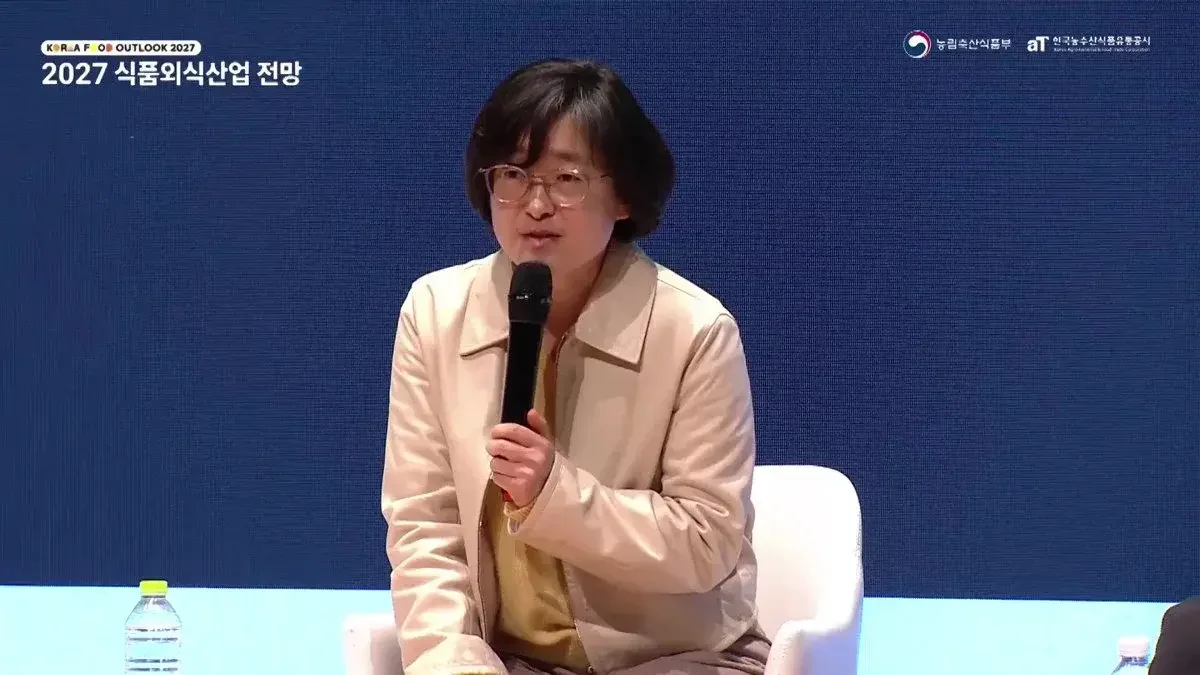
During a lecture at COEX in Seoul on the 5th, Park Hyeon-yeong predicted that the restaurant industry must provide "good energy" to consumers as subjective experiences replace rational drivers in the AI era. Park noted that while solo dining has become a default value since 2016, the focus is shifting toward rituals for self-care and outsourcing the labor of family dining.
In an era where artificial intelligence (AI) has become a part of daily life, people are questioning why they eat and why they visit restaurants. As technology begins to replace human reason, the "subjective senses" and "energy" unique to humans are paradoxically emerging as new drivers of consumption.
During a lecture for the "2027 Food and Restaurant Industry Outlook" held on the 5th at COEX Conference Room 401 in Seoul, Park Hyeon-yeong, director of the Life Change Observatory, analyzed the value of food in the AI era through three pillars: "meals," "health," and "content." Using data to trace shifting food culture trends, Park predicted that the keywords "subjectivity" and "energy" will serve as key insights for the future restaurant industry.
"Who will do the work?"... The outsourcing of meals and the rise of family dining
Park first defined the core question of "meals" as "how to solve them." An analysis of keywords ending in "food" or "meal" written by people over the last 10 years showed a consistent time-series increase in the proportions of solo dining, family dining, and convenience foods. Solo dining, in particular, emerged in 2013, grew dramatically through 2016, and has since become a "default" value within the top 10 in data, re-establishing itself after the pandemic.
A notable trend is the increase in "family dining." Park analyzed that while "gatherings" such as family meetings continue to increase, the labor involved in the process is increasingly being "outsourced." Citing Voice of Customer (VOC), she pointed out that behind records such as "had a family meal for my father-in-law's 70th birthday," there is hidden labor from someone who must prepare the meal. The writer can be both an invited guest and a laborer preparing the food.
This trend is leading to changes in service methods within the restaurant industry. Outsourcing progresses even faster in restaurants that say, "Please do not touch the meat; I will grill it for you," or in hospital situations where guardians cannot be present. Furthermore, this aligns with why large-table restaurants in suburban areas that can accommodate extended families are gaining attention. Park explained that while people are gathering more often, the answer to "who will do the work" is manifesting as outsourcing, predicting that dining spaces providing fresh, plentiful, and pleasant environments will lead the family dining market.
"Rituals to care for oneself"... Seasonal foods and seasonal marketing
Regarding health, the focus has shifted from "caring for others" to "caring for oneself." Park analyzed that through the rapidly increasing keywords for "healthy snacks" and "seasonal foods," consumers are focusing on "rituals" to take care of themselves. The keyword for healthy snacks rose rapidly through 2025 and 2026, a phenomenon supported by the expansion of healthy snack sections at large retailers like Costco.
In particular, eating habits aligned with seasonal divisions are prominent. Examples include eating spring greens during Ipchun to gain good energy, or eating red bean porridge during Dongji to ward off bad luck. Park evaluated that "the act of eating a bowl of red bean porridge on Dongji is a small action to care for oneself, regardless of science or superstition." This trend is also linked to the cyclical demand of the food industry. Patterns repeat where demand for desserts using seasonal fruits surges in June, and demand for stamina-boosting foods and related meal kits surges in July targeting Chobok.
As healthy diets become normalized, an analysis suggested that the standard of food culture has risen to the point where the term "regular meal" itself implies a state of not caring for a healthy diet. Now, the expression "regular meal" is even used in company cafeterias, indicating that healthy eating has become a universal habit.
Moving past the era of a single photo to an era of seeking "good energy"
Park identified the change in consumer drivers as the biggest shift in the AI era. In the past "lifestyle" era, people were moved by "a single photo" to post on Instagram and other platforms. Visual experiences were key, such as a single cafe photo in Woljeong-ri, Jeju, drawing people to the island, or the popularity of infinity pool experiences in Gijang, Busan.
However, in an era where AI supplements the rational domain of humans, "subjectivity" is emphasized. Park cited the "Gwanaksan case" that became a hot topic earlier this year. When a specific fortune teller mentioned on a broadcast that Gwanaksan has good energy, people visited Gwanaksan not to take photos, but to actually receive "good energy." This was presented as a symbolic event showing that the driver moving consumers has shifted from "lifestyle" to the "AI era."
Park noted that while humans are rational and logical beings, they are also beings that feel subjective minds and energy, pointing to the increasing mentions of subjective emotions such as fortune, bad luck, mind, and energy. She predicted that the core task for the future restaurant industry will be to secure a sense of place that can provide "good energy and energy" to visitors, moving beyond simply delicious food or pretty interiors. Indeed, this trend is appearing in the way places like Hyatt Hotel and Bongeunsa are receiving attention.
Source: original video (YouTube)


0Comments
Comments are currently disabled.