
"Even if the pension is cut, I'll take it now"... Surge in early National Pension claims due to National Health Insurance burden
As eligibility requirements for National Health Insurance dependents tighten and National Pension benefits impact insurance premium calculations…
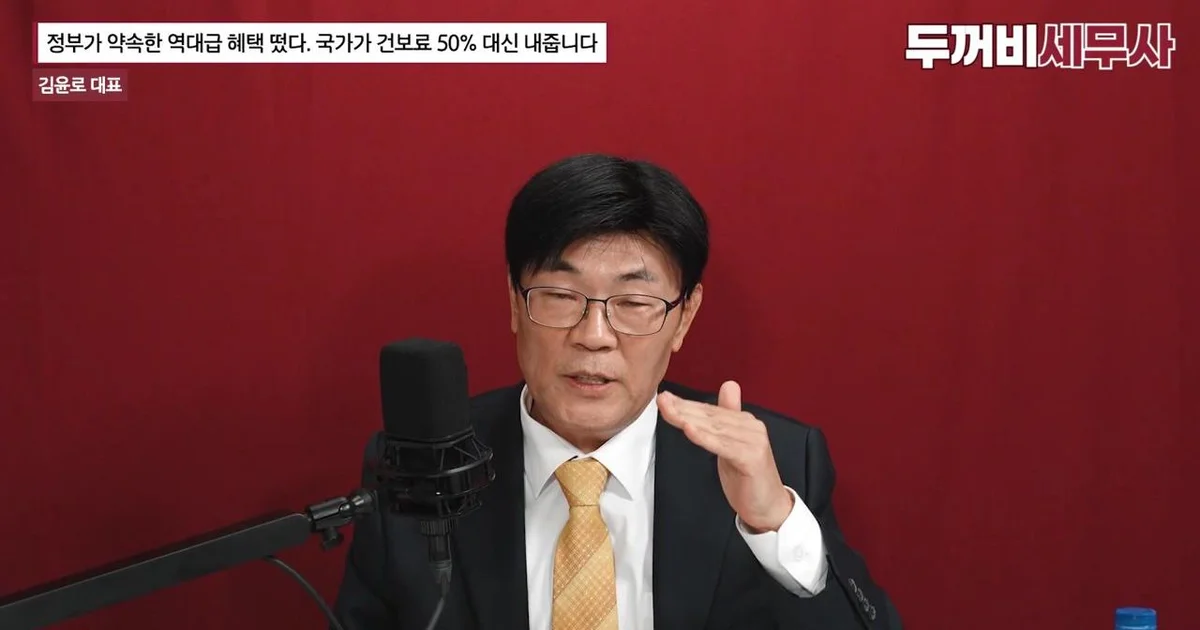
As the eligibility requirements for National Health Insurance dependents are strengthened and the amount of National Pension received affects the calculation of National Health Insurance premiums, the pension receipt strategies of those approaching retirement are changing. In particular, there is a recent trend of a surge in applicants for 'early pension,' which involves receiving the National Pension earlier than the scheduled time.
Strengthening of Health Insurance Dependent Requirements... Must Check 'Property Tax Assessment Value' Standard
Recently, the income requirements for the National Health Insurance dependent system have been lowered, with the threshold dropping from the existing 34 million won to 20 million won. Accordingly, cases are increasing where individuals previously registered as dependents of workplace-based subscribers are being converted to local subscribers because they exceed the income requirements. The speaker emphasized that when judging the requirements for exclusion from being a dependent, one must use the 'property tax assessment value' rather than the house price as the standard.
The property tax assessment value is usually determined at around 60% of the officially announced price. For example, considering that the average officially announced price in Seoul is at a level of 69%, if one holds a house worth 1 billion won in market value, the property tax assessment value becomes approximately 600 million won. The speaker explained, "One must accurately understand the standards, such as the property tax assessment value of 900 million won or the income of 20 million won, which are the criteria for exclusion from being a dependent." Detailed exclusion requirements also exist, such as cases where the property tax assessment value exceeds 540 million won while income is 10 million won or more.
The government's stance is also shifting from 'asset-centered' to 'income-centered.' The speaker analyzed, "The number of dependents per workplace-based subscriber is trending downward compared to the past, and the spirit of 'Universal Taxation Principle,' which makes people pay a certain portion of premiums even if their income is low, is being reflected in the National Health Insurance premium system." In fact, while the number of dependents per workplace-based subscriber was around 1.2 to 1.3 people in the past, a recent survey showed it has decreased by 0.175 people. Accordingly, prospects have also been presented that the income requirements for dependents may be lowered further to 11 million won or 5 million won or less in the future.
In this regard, practical measures to reduce the burden of National Health Insurance premiums after retirement were also mentioned. Pointing out that if one is converted to a local subscriber, the premium burden may increase sharply compared to when they were a workplace subscriber, the speaker suggested utilizing the income settlement system. The explanation is that if a business was doing well but then closed or income decreased, one can reduce the National Health Insurance premiums to be paid immediately by applying for an income settlement after proving the decreased income. Additionally, it was added that if there is housing financial debt, there is a system where one can receive a premium reduction benefit of about 10,000 won per month by applying for it.
Early Pension Applicants Exceed 100,000 Annually... Is it a Strategy to Avoid Health Insurance Premiums?
Choices regarding the method of receiving the National Pension are also changing. According to data from the National Pension Service, the number of early pension applicants has recently increased to approximately 100,000 per year. Compared to the past 10 years, when an average of about 50,000 people applied every year, the scale of applications has doubled. The speaker mentioned the burden of National Health Insurance premiums as one of the main causes of this phenomenon.
The speaker analyzed, "As the National Health Insurance dependent requirements have lowered, if the National Pension amount exceeds a certain level, one can be disqualified from being a dependent and converted to a local subscriber. Even if the National Pension amount is partially reduced (early receipt), an increasing number of people are strategically choosing early pension to avoid the burden of National Health Insurance premiums." In fact, as the National Health Insurance dependent requirements lower, if the National Pension amount reaches a level of 1.67 million won per month, the burden of National Health Insurance can increase, and there are many cases where people choose the 'detour' of receiving the pension early to avoid this.
In fact, while the number of early pension subscribers has exceeded 1 million, the number of deferred pension subscribers (a method of delaying the timing of receipt) remains at around 100,000. The speaker explained, "While early pension also has the purpose of filling the income gap, it is also the result of a strategic choice to receive it quickly even by lowering the pension amount in order not to pay National Health Insurance."
Need to Compare 'Real Value' Considering Inflation Rate and Revaluation Rate
It was also pointed out that when deciding the timing of pension receipt, one should not simply compare nominal amounts. People often agonize over whether to 'receive 1 million won at age 65 or 700,000 won at age 60,' but the speaker argues that this is a simple comparison that does not reflect the time value and the inflation rate.
The speaker explained that one must calculate the real value by applying the average revaluation rate (about 4.3%) and the inflation rate (about 2%) of the recent 10 years. The logic is that if 1 million won at the age of 65 is converted to the present value at the age of 60, the actual felt amount could be lower than 700,000 won. Specifically, if the amount expected to be received at age 65 is converted to the value at age 60 by applying the revaluation rate, it becomes about 810,000 won, and if the 30% reduction due to early receipt is applied to this, the calculation shows the actual money received is at a level of about 570,000 won. In other words, it is pointed out that simply comparing 700,000 won and 1 million won overlooks the time value.
The same applies to deferred pensions. Assuming one receives 1.36 million won at age 70, if the inflation rate (about 2%) is reflected, the real value could reach approximately 1.5 million won. The speaker emphasized, "One must accurately compare based on present value whether to receive 567,000 won at age 60, 1 million won at age 65, or 1.5 million won at age 70."
The speaker explained, "The turning point that distinguishes the timing when early receipt is advantageous and the timing when deferred receipt is advantageous, based on normal receipt, changes depending on variables such as the inflation rate and revaluation rate, and when based on normal receipt, that difference appears around 144 months." Therefore, the speaker advised that one should establish asset management strategies in advance before retirement by considering these variables.



0Comments
Comments are currently disabled.