
Only Three Times in US History Has the Governing Party Won the House at a Midterm, Professor Kim Gwang-seok Says
Professor Kim Gwang-seok said in a live broadcast that the US midterm elections on November 3 are the biggest uncertainty for markets, while the US market hit record highs and South Korea's stayed in a trading range.
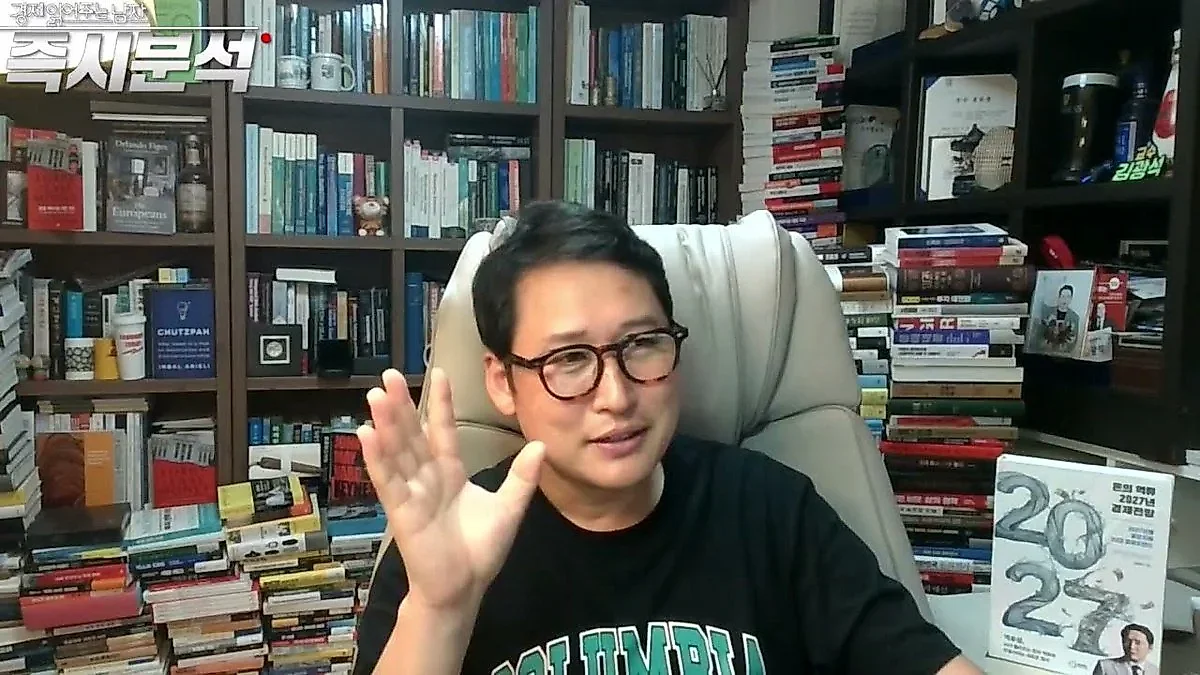
In US midterm elections, the governing party has won the House only three times in the country's history, Professor Kim Gwang-seok said. In a live broadcast on the 18th, he named the November 3 midterms as the biggest factor that will decide uncertainty in the market ahead.
Why the House usually slips away
"There is a very big uncertainty factor in front of us, November 3," Kim said, adding flatly that "no one can know how it will turn out." He explained that the governing party usually loses the House. After a honeymoon period of about a year following a new administration takes office, approval ratings fall, and the House is judged by the opposition, a pattern that repeats. "By about the second year of an administration, approval ratings drop, and historically the House is given up," he said, adding that "it is a fact that President Trump's approval rating in particular has fallen."
Kim divided the scenarios that could follow the midterms into four broad types. "It is very rare in US history for the governing party to win the House, and in terms of probability, the governing party is likely to give up the House," he said. The scenarios he cited included a heavy defeat for the Democratic Party of Korea (a blue sweep) and a case in which the Republican Party wins the Senate. On whether the House could be lost by enough to allow impeachment, he said: "For impeachment, the House has to be fully represented, and simply holding a majority is not enough." He called the chance of losing the House by that margin "very slim."
US at record highs, South Korea stuck in a range
As volatility in the South Korean stock market has grown, investors have become more anxious. Kim used the broadcast to review recent market moves and stressed the importance of investment principles. After July, he said, a liquidity-driven market began, centered on the United States. The South Korean market, unlike the US one, stayed stuck in a range-bound market. While the US market kept up its upward momentum by setting record highs led by the Nasdaq and the S&P500, South Korea was relatively left out. "Just as the Korean market rose especially strongly right before the Korean election in June, only the US market showed a pattern of rising strongly," Kim said. He recalled that around May he had already warned, in videos and elsewhere, that large volatility and a correction would come in June and July, and that a major correction did occur.
"Not a political channel"
Kim said his analysis does not represent any political position. "Please do not interpret it politically," he said. "The reason I go over what I said before is not to boast that I got it right, but to look back on why I made that forecast and to look ahead." He added: "My channel is not a political channel." To analyze specific midterm scenarios, he said he had invited Professor Min Jeong-u of the Korea National Diplomatic Academy for a discussion, suggesting he is closely analyzing how geopolitical views and political variables affect economic trends.
Kim plans to share an in-depth analysis at an offline special lecture on October 24, on the topic "Scenarios after Trump's midterm elections and the outlook for power infrastructure."
Source: original video (YouTube)


0Comments
Comments are currently disabled.