
SpaceX transitions from space company to AI firm as Starlink's profits to offset AI losses
SpaceX is evolving into an AI-driven company following its merger with xAI, with the massive profits from its Starlink satellite service expected to cover the significant operating losses generated by its AI division.
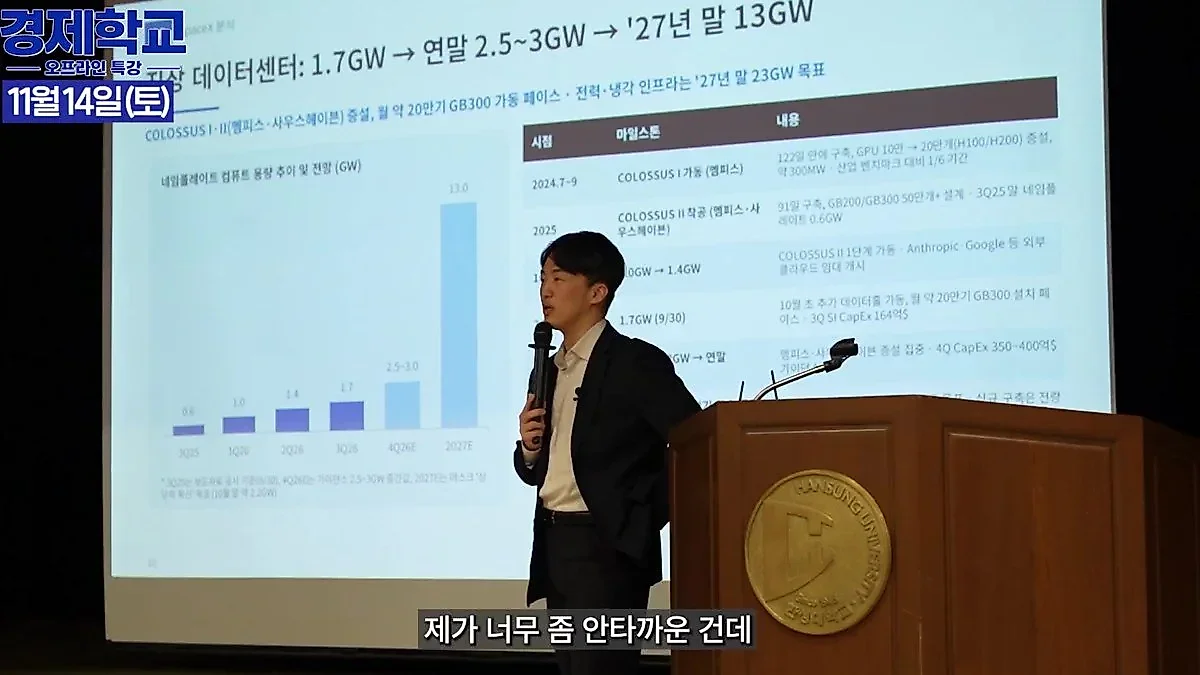
The market's perspective on SpaceX is shifting. It is no longer being viewed merely as a space company that launches rockets, as the core drivers of its performance and stock price have already expanded into the field of artificial intelligence (AI). An era has arrived where AI-related volatility, rather than momentum in the space industry, determines the direction of SpaceX's stock price.
According to an analysis by Jeong Ui-hun, a researcher at Yusin Investment & Securities, shared via "The Man Who Explains the Economy (Kim Kwang-seok TV)," SpaceX's core revenue model consists of three main pillars: the 'Space' division providing rocket launch services, the 'Connectivity' division providing satellite communication services, and the 'AI' division, which was incorporated through the recent merger with xAI. While SpaceX's revenue previously relied entirely on Starlink and rocket launches, the business structure has undergone a rapid reorganization, changing the focus for investors.
Starlink emerges as a 'cash cow' with subscriber growth tripling in 1.5 years
The practical growth engine for SpaceX is its satellite communication service, Starlink. According to researcher Jeong Ui-hun, Starlink enjoys a virtually monopolistic position in the global satellite communication market and was the largest business unit by revenue as of last year. Its profitability is particularly overwhelming; Starlink's operating profit margin exceeded 40% and rose to 45% in recent third-quarter results.
Subscriber growth is also steep. As of this past August, Starlink subscribers surpassed 13 million. Compared to the level of approximately 4 million at the beginning of last year, this represents a more than threefold increase in just 1.5 years. By the end of the year, the number is expected to reach between 15 million and 16 million. Revenue can be estimated as 'number of subscribers × average revenue per user (ARPU),' and Starlink is recording explosive revenue growth by creating strong demand in regions worldwide that lack sufficient communication infrastructure.
Currently, Starlink's weakness lies in the requirement for physical antennas. For home services, users must install an antenna about the size of a pizza pan, which limits mobility. However, SpaceX is preparing a 'D2C (Direct to Consumer)' model to overcome this. This service would allow users to receive satellite signals directly via smartphone without a separate antenna. This is why the company recently received approval from the FCC to use terrestrial communication frequency bands. Once full-scale satellite launches for mobile use begin in 2028, the subscriber base is expected to leap to the next level.
AI merger brings mixed results and a valuation trap
The AI division has emerged as the largest variable in evaluating the corporate value of SpaceX. SpaceX completely changed its business structure at the beginning of the year by merging with xAI, Elon Musk's AI company. xAI holds X and the AI service 'Grok.' This merger has caused the revenue structure of SpaceX to change rapidly.
In the past, Starlink supported the company by accounting for 61% of revenue. However, since the AI division was merged, its share of revenue has grown rapidly, changing how the market evaluates the company. Jeong Ui-hun noted, "The reason SpaceX was criticized as a loss-making company when it was considered for listing was due to the massive costs of the AI division." Indeed, with AI division revenue at $3.2 billion, the operating loss reaches $6.4 billion, meaning the AI business is currently in a deficit stage where costs are three times the revenue.
This point acts as a 'valuation trap' for investors. No matter how much money SpaceX makes in the space business, the market has begun to classify and evaluate the company as an AI firm rather than a space company. Consequently, if volatility in the AI industry increases or AI-related noise occurs, SpaceX's stock price fluctuates like AI-related cloud companies, regardless of the performance in the space industry.
Starship to complete the mobile satellite era
The reason SpaceX is staking its life on the development of the massive 'Starship' rocket is directly linked to the scalability of Starlink. The mobile satellites planned for the future (V3 or higher) will have weights that are difficult to handle with the existing Falcon line of medium-sized rockets. This is because more powerful and heavier satellites must be launched to provide high-quality communication services that can connect directly to smartphones.
Ultimately, the future value of SpaceX converges on a single metric: the number of subscribers. As rocket launch unit costs decrease and demand for satellite launches increases, the key will be whether Starlink can dominate the mobile market. Jeong Ui-hun analyzed, "The direction of SpaceX's stock price will be determined at the point when AI-related volatility subsides and evaluations based on actual performance take place."
Source: original video (YouTube)



0Comments
Comments are currently disabled.