
"Beware of Outsourcing Thought": Critical Thinking is Key to Surviving the AI Era
Economic YouTuber Kim Kwang-seok warns that relying solely on AI could lead to the "end of thinking," suggesting a "SYNC" strategy to effectively control AI as a pilot would control an aircraft.
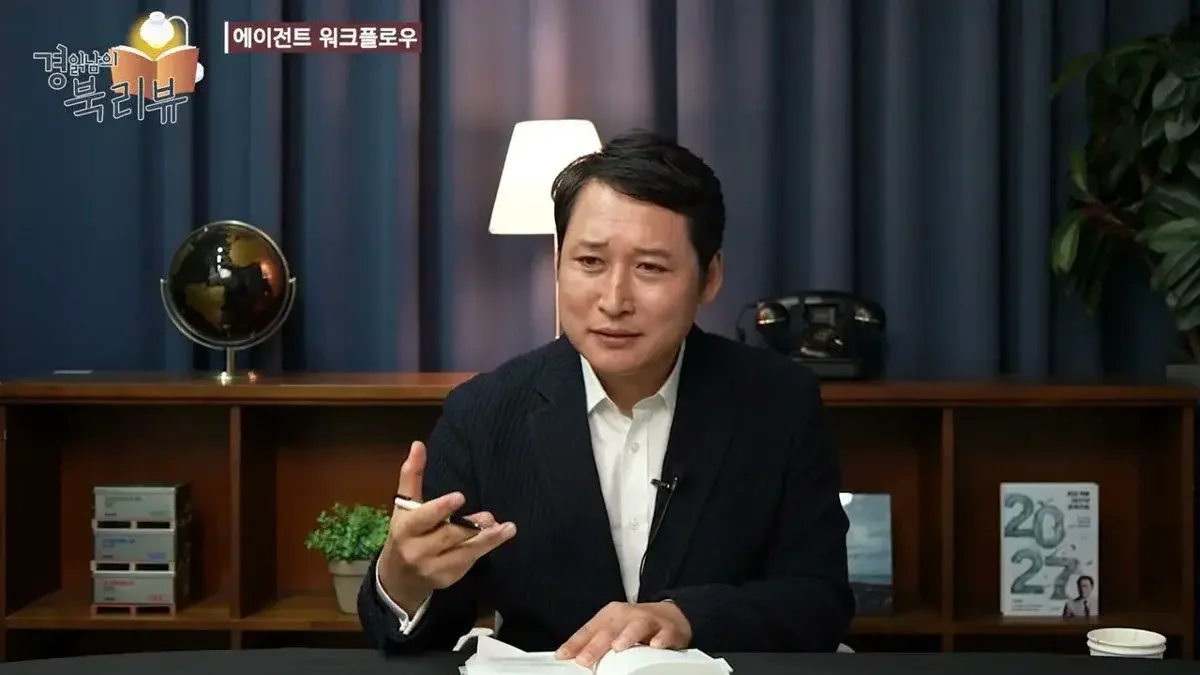
Economic YouTuber Kim Kwang-seok has proposed a "SYNC" strategy to prevent the "end of thinking" by teaching humans to act as pilots who control AI rather than merely depending on it. To avoid falling behind, Kim suggests using four elements—Story, Why, Native, and Cycle—to ensure human judgment remains the core of the decision-making process.
The era has arrived where artificial intelligence (AI) performs human tasks. As technology advances, fundamental questions are being raised beyond the level of simply asking questions, focusing instead on how individuals can live in step with AI. Warnings have emerged that if humans merely depend on AI, they may face the "end of thinking," characterized by the loss of unique human cognitive abilities.
On a recent channel update, economic YouTuber Kim Kwang-seok (The Man Who Explains the Economy (Kim Kwang-seok TV)) introduced the book 『Agent Workflow』 by Ro Sajang (Kim Da-som) and presented survival strategies to avoid being replaced in the era of AI agents. Professor Kim emphasized that while failing to utilize AI leads to a state of "Sink" (sinking/falling behind), the core capability lies in the ability to "SYNC" (synchronize) with AI rather than just using it.
The 'SYNC' Strategy: Controlling AI Like a Pilot
Professor Kim compared the method of utilizing AI to operating an aircraft. Much like the difference between the era of rowing and the era of aviation, AI is a tool that exponentially increases the speed of work. However, no matter how fast an aircraft travels, if the destination is set incorrectly, it will only move in the wrong direction. He identified four elements of "SYNC" (synchronization) as a methodology for handling AI efficiently.
The first is 'Story,' which refers to the past context and memories required when AI performs a task. To prevent AI from racing in the wrong direction, one must clearly communicate not just what is being made, but also why the work is being done and how success is defined. The second is 'Why' (judgment criteria). Rather than using the most expensive model for every task, one should teach the AI appropriate purposes and judgment criteria considering the organization's situation and the nature of the work.
The third is 'Native,' the process of redesigning AI's role to fit the organizational work structure. Just as an aircraft continuously corrects its flight path after takeoff, the role of AI must be updated periodically. The final element is 'Cycle,' which refers to a circular structure where AI performs tasks but receives human feedback to produce better results in the next stage.
"Humans Must Do the Thinking": The Danger of Outsourcing Thought
Professor Kim emphasized that the human, acting as the "pilot," ultimately exists at the core of the SYNC strategy. He argued that in the era of agents where AI continues to process tasks, humans must perform the role of the "pilot" who judges and decides for themselves, rather than depending on AI. He specifically warned against the "outsourcing of thought."
He explained this using everyday examples. If the act of leaving everything to AI—from composing breakfast menus to correcting message phrasing or even delivering a congratulatory speech at a tennis gathering—becomes repetitive, human cognitive muscles will inevitably weaken. He pointed out that thinking is like a muscle that grows stronger through use; if judgment and decision-making itself are handed over to AI, the "end of thinking" may eventually arrive.
In reality, the information provided by AI is not always accurate. "There are many cases where facts are wrong, such as AI still perceiving the current Federal Reserve Chair as Jerome Powell," Kim said. "If one does not think economically and accepts AI's answers as they are, one may fall into the error of perceiving incorrect information as truth." His conclusion is that the secret to surviving the AI era lies in the "power of thinking," where one utilizes AI as a tool while humans lead the final judgment and thought processes.
Source: original video (YouTube)


0Comments
Comments are currently disabled.