
South Korean Government to Increase Smart Manufacturing Budget to 700 billion won as Food Industry Eyes AI Integration
The South Korean government plans to expand its smart manufacturing budget to 700 billion won next year, shifting the policy focus from basic automation toward an "AI manufacturing" ecosystem. During a lecture hosted by aT, An Gwang-hyeon emphasized that food manufacturers must adopt AI-driven intelligent factories to remain competitive globally.

Digital transformation in food manufacturing sites is evolving beyond simple data recording into intelligent factories that utilize artificial intelligence (AI). The government is also accelerating the creation of an "AI manufacturing ecosystem" by significantly expanding the smart manufacturing budget for next year.
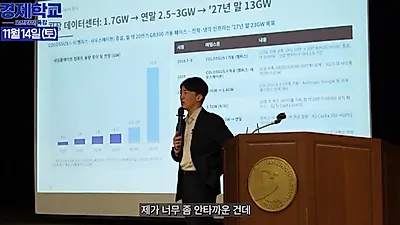
During a lecture for the "2027 Food and Restaurant Industry Outlook" hosted by aT, An Gwang-hyeon, Vice President of Industry-Academic Cooperation at Kyonggi University, emphasized that the future competitiveness of the food industry depends on AI-based smart manufacturing innovation. Drawing on his experience as the head of an AI innovation task force at a public institution under the Ministry of SMEs and Startups, where he oversaw the expansion of smart factories, An highlighted the changes occurring on the ground.
Smart manufacturing budget to expand to 700 billion won next year, shifting paradigm to 'AI Manufacturing'
The government invests a massive budget every year to build and expand smart factories for small and medium-sized enterprises (SMEs). According to An, the smart manufacturing support budget, which was approximately 400 billion to 500 billion won this year, is expected to increase significantly to the 700 billion won level next year. The notable aspect is the direction of the policy: the government's plan is to move beyond existing smart factory construction and enter the "AI manufacturing" stage.
"We are now at a stage where we must move beyond smart manufacturing to AI manufacturing," An explained. "Policies are moving in a direction where AI leads the manufacturing ecosystem, going beyond the level of simply automating processes."
He defined the essence of manufacturing as "improvement." This includes all processes, such as changing production line layouts to increase efficiency or creating added value through facility investment. He advised that in the food manufacturing sector, where hygiene management and compliance with Good Manufacturing Practices (GMP) are essential, such improvements must lead to increased productivity rather than just being a cost, in order to secure price competitiveness.
Smart factories connecting 'real-time data' beyond digitizing paper documents
Smart factories refer to improving production sites using Information Technology (IT), the Internet of Things (IoT), and Artificial Intelligence (AI). While in the past, people manually counted the number of products produced or recorded them in Excel, current technology uses barcode technology to match input and production volumes in real time.
An cited the connectivity of production planning as an example. In the past, plans drawn up in an office using Excel were printed and delivered to the site, but now, when a client clicks an order, production information is shared in 0.01 seconds not only with the production planning manager but also with the partner companies supplying raw materials. This is a key factor in maximizing the efficiency of the entire supply chain.
He categorized the levels of smart factories into four stages according to government standards: Basic, Intermediate 1, Intermediate 2, and Advanced. If a company has transitioned from paper documents to digital and introduced a Manufacturing Execution System (MES) that automatically aggregates production volume or defect rates, it can be considered to have entered the "Basic stage." He explained that to enjoy the true utility of a smart factory, companies must move one step further to the stage of immediately identifying and responding to defective products through real-time sensing.
Global food companies' survival strategy: 'Smart Factory' is a necessity, not an option
The reason food companies are accelerating the introduction of smart factories is for survival in the global market. Major global food companies have already completed or are currently undergoing the construction of intelligent factories that combine AI and data. "Because all global food companies are moving toward smart factories, it is very important for us as well," An urged.
Diagnosing the current state of Korean small and medium-sized manufacturing, he pointed out that among 160,000 small and medium-sized manufacturing enterprises, fewer than 40,000 have even basic-level smart factories. As the government's policy direction heads toward "AI manufacturing," he suggested that food companies must also focus on building intelligent manufacturing environments based on real-time data, moving beyond simple digitalization.
Source: original video (YouTube)

0Comments
Comments are currently disabled.