
Faust's Paper Money Mirrors the Fed's Pandemic Stimulus, Former Investor Says
On the YouTube channel Understanding: All the Knowledge in the World, Al Sang-mu reads Goethe's Faust Part Two as a story about paper money, artificial life and the price of leverage. He ties the emperor's paper currency to Fed liquidity and Homunculus to AI.
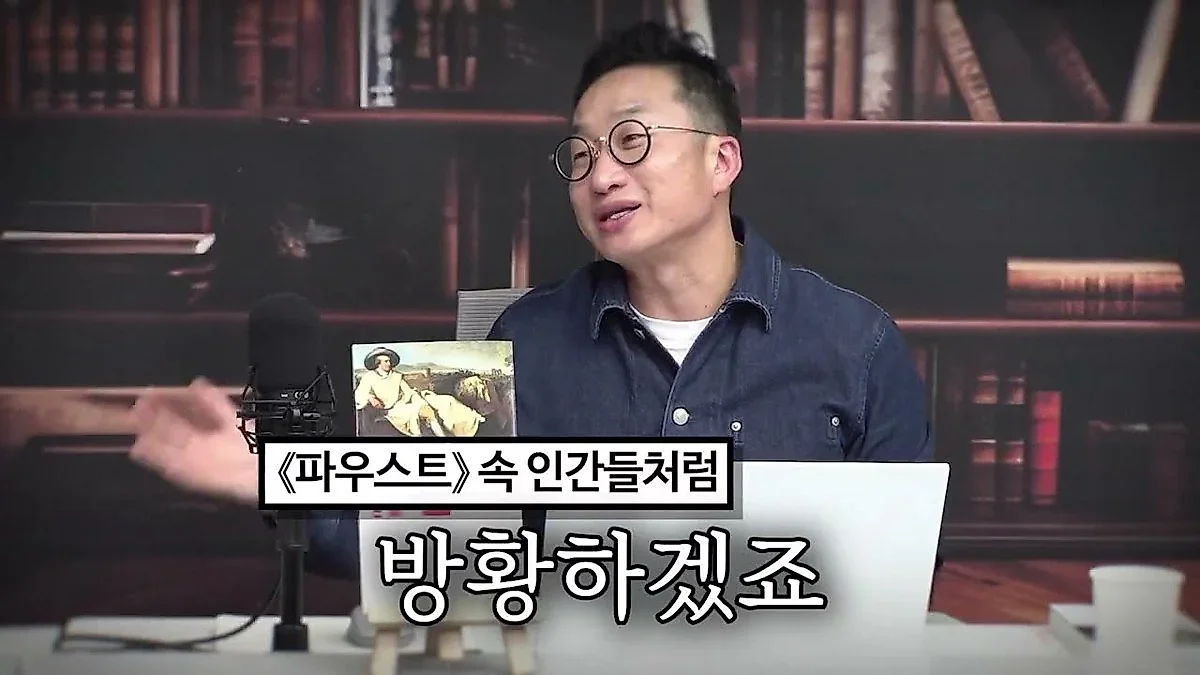
Al Sang-mu, a former financial investment specialist, says the emperor's paper money in Goethe's Faust Part Two closely resembles the Fed's liquidity injections during the Covid-19 pandemic. He also reads the drama's land reclamation project as the price of excessive leverage.
An emperor, a devil and paper backed by buried gold
Part Two of Faust opens at the court of an emperor struggling with a fiscal crisis. Kings in Europe at the time faced a structural limit: the nobles were so powerful that taxes could not simply be raised at will. Mephistopheles, working through Doctor Faust, offers a solution. On the belief that gold treasure lies buried somewhere in the kingdom, paper banknotes are issued with that gold as collateral, supplying liquidity.
The reading comes from the YouTube channel Understanding: All the Knowledge in the World, which covered how this episode of the 200-year-old classic anticipates monetary policy, a core principle of the modern economy. The same account describes how the emperor issues paper money to prop up the economy, and how the artificial being Homunculus sheds light on the human urge to create.
Alchemy with a single core
Al said the scene matches modern monetary policy. "Insisting that gold is somewhere and issuing paper money to stimulate the economy is exactly like modern monetary policy," he said, adding that it recalls the Fed supplying liquidity during the Covid-19 pandemic. This can be read as a literary account of the shift from an age when metal itself served as money to a system built on credit and belief. He also pointed to the shaky foundation of today's monetary system: "We don't even know whether money is being printed digitally, yet we work to receive it."
Al went on to say that this system rests on "alchemical thinking with a single center." Just as alchemy has a core aimed at turning everything into gold, he said, the modern monetary system runs on centralized trust. "Humans feel more comfortable with a structure where someone integrates things than with a distributed one, which is why centralized monetary policy developed," he said, expressing skepticism about decentralized structures such as recent cryptocurrencies. "Cryptocurrency has several cores, and humans don't accept that well," he added.
The little man in the flask
Al defined Homunculus as "AI in a novel." In the play, Faust sets out on a journey into the past to meet the ancient beauty Helen, and Homunculus appears along the way. He is interpreted as a figure symbolizing today's artificial intelligence. Wagner, Faust's pupil, creates this tiny human in a flask using a flame. He has no body but is portrayed as a highly intelligent being.
"Just as humans want to create a being in the image of God, it touches the desire of modern people to build agentic AI through coding and to realize physical AI, or robots," Al said. His comparison links the imagination of the 16th-century alchemist Paracelsus, who claimed a human could be made in a flask by mixing semen, medicinal herbs and animal blood, to today's digital technology. Al analyzed the instinct to embody the image of God as ultimately leading to the drive toward AI and robots.
The cost of leverage, and a door left open
In the play's final moments, Faust mistakes the sound of his own grave being dug for the sound of his land reclamation works and cries out "Stay." The scene heightens the work's tragedy. Al quoted Goethe's line that "as long as humans strive, they are bound to wander," stressing both the nature of humans who pursue desire and the wandering that inevitably follows. He also mentioned the recent plunge in the stock market and the frenzy over excessive leverage, suggesting that the philosophical questions the work raises remain valid for today's economy.
Late in the work, Faust launches the reclamation project and drives sweeping social change, only to meet unexpected tragedy. Al likened this to "the price of excessive leverage," meaning investment using debt, and read it as a warning that leverage borrowed to fulfil overreaching desires can end in economic and social catastrophe. "We are paying the price for having used things like leveraged ETFs and the National Pension Service," he said in the video, referring to the inevitable consequences of trying to realize overreaching desires.
The ending has Faust's soul led by angels rather than by the devil. Al called this "a point that shows the possibility of salvation remains open despite human desire and wandering." He said the end of Part One can seem somewhat absurd, but that Goethe complemented it in Part Two and completed the essence of the work.
Source: original video (YouTube)

0Comments
Comments are currently disabled.