
South Korean public finance for overseas fossil fuels surged to 48.5 trillion won
South Korean public financial institutions provided 48.5 trillion won in support for overseas fossil fuel infrastructure between 2020 and 2024, despite a pledge to halt funding for new coal-fired power plants.
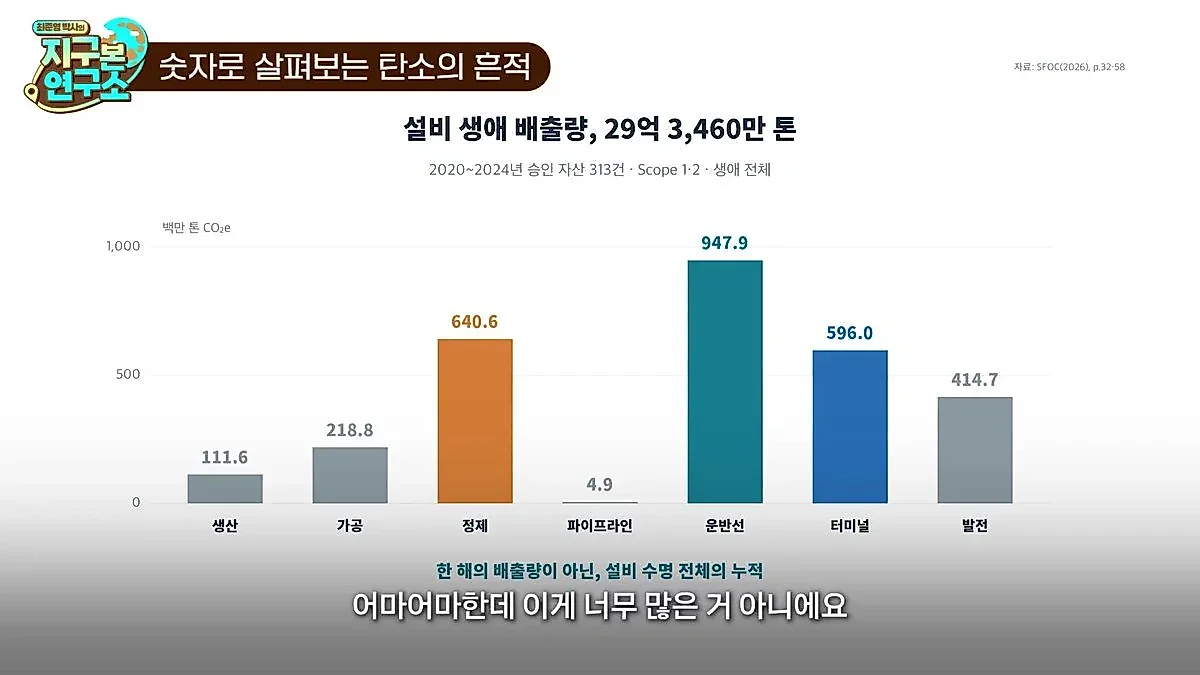
South Korean public financial institutions provided 48.5 trillion won to overseas fossil fuel infrastructure from 2020 to 2024, with support for sectors like LNG carriers more than doubling since 2021. Researcher Yang Ye-bin warned that these emissions are currently not being properly measured or managed despite a government pledge to stop funding new overseas coal-fired power plants.
South Korean public financial institutions provided 48.5 trillion won in support for overseas fossil fuel infrastructure over the past five years. Despite the declaration to stop supporting new overseas coal-fired power plants, financial support for other fossil fuel-related sectors, such as LNG (liquefied natural gas) carriers, has been on an increasing trend.
In a video released by Dr. Choi Jun-young's Globe Institute, Yang Ye-bin, a researcher at the climate crisis response non-profit Solutions for Our Climate, addressed the issue of "carbon neutrality blind spots," a topic recently discussed in a parliamentary audit. Yang pointed out that while the financing provided by South Korean public financial institutions leads to greenhouse gas emissions from overseas facilities, these emissions are currently not being properly measured or managed.
Fossil fuel finance increases despite coal support halt
Yang Ye-bin explained that the core of this research was to reveal "emissions that are not measured and not managed." An analysis of loans, guarantees, and insurance assets provided to overseas fossil fuel infrastructure by public financial institutions operating on taxpayer money—including Korea Development Bank, Export-Import Bank of Korea, and Korea Trade Insurance Corporation—showed that the scale of support totaled 48.5 trillion won from 2020 to 2024. This figure excludes domestic financial support.
The trend in the scale of support is notable. Fossil fuel finance, which stood at approximately 5 trillion won in 2021, surged to over 13.5 trillion won in 2024, more than doubling in three years. This increase occurred because, although the South Korean government declared at the 2021 Climate Summit that it would "stop public financial support for new overseas coal-fired power plants," it did not place brakes on financial support for other fossil fuels excluding coal.
"Because brakes were not applied to other fossil fuels besides coal, the scale of fossil fuel finance continued to grow," Yang analyzed. The fossil fuels mentioned here include all stages of development, production, transport, storage, and refining of oil, gas, and LNG.
Emphasizing the nation's responsibility in responding to the climate crisis, Yang noted that the International Court of Justice (ICJ) recently viewed responding to the 2025 climate crisis as an obligation for all nations and stated that providing fossil fuel subsidies could be seen as a violation of national duties. She further clarified that while South Korea's domestic emission share may be low, the country cannot be free from actual climate responsibility when looking at the flow of money going overseas.
Expansion of LNG carrier finance and risks of support 'without charter contracts'
The analysis revealed that LNG carriers account for a very high proportion of total fossil fuel finance. South Korea has a structural characteristic of needing to import LNG to increase energy self-sufficiency, a process in which transporting liquefied LNG by ship is essential instead of using pipelines to connect gas fields. In this process, public financial support is being concentrated on LNG carriers, which are a mainstay product of the South Korean shipbuilding industry.
Yang noted that while this financial support is sometimes carried out under the pretext of supporting the domestic shipbuilding industry, from a climate perspective, it results in strengthening fossil fuel infrastructure that causes carbon emissions. She also warned about the methods and risks of such financial support.
Shipbuilding is a field where massive funds are invested and it takes about three years from order to delivery. Therefore, when deciding to provide finance, future market outlooks and repayment capabilities must be carefully reviewed. However, Yang pointed to "loose practices" that are easy to occur when the market is booming. Specifically citing a case from Korea Trade Insurance Corporation, she explained that many of the approved cases involved providing finance without a "charter contract," which is an actual contract to lease a ship.
Yang's analysis suggests that providing finance when the use of the funds has not been finalized can lead directly to repayment risks, where financial institutions are unable to recover funds if market conditions change and ship demand decreases. She pointed out that while there is a tendency to provide finance even when the use is unclear during market booms, risk management regarding changes in market conditions may be insufficient.
Challenges of energy security and financial transition
The video also addressed questions regarding the balance between energy security and industrial support. Concerns were raised that since the shipbuilding and plant industries contribute to local employment and overseas business competitiveness, halting support could inadvertently result in tying the hands of energy security and national competitiveness.
In response, Yang replied that the purpose of this research is not to cut off industrial support itself, but to "change the flow of money." She explained that the core is to transition fossil fuel finance into eco-friendly industries where South Korea can secure future competitiveness. She emphasized that, considering the disruptions in energy supply and demand due to geopolitical risks, true strengthening of energy security should be achieved through a transition toward increasing energy self-sufficiency.
Source: original video (YouTube)


0Comments
Comments are currently disabled.