
Rational individual decisions can trigger systemic crisis, warns Bank of Korea
Moon Seong-won, a manager at the Bank of Korea, explained how the "fallacy of composition" can turn individual rational choices into a systemic financial crisis during a recent lecture.
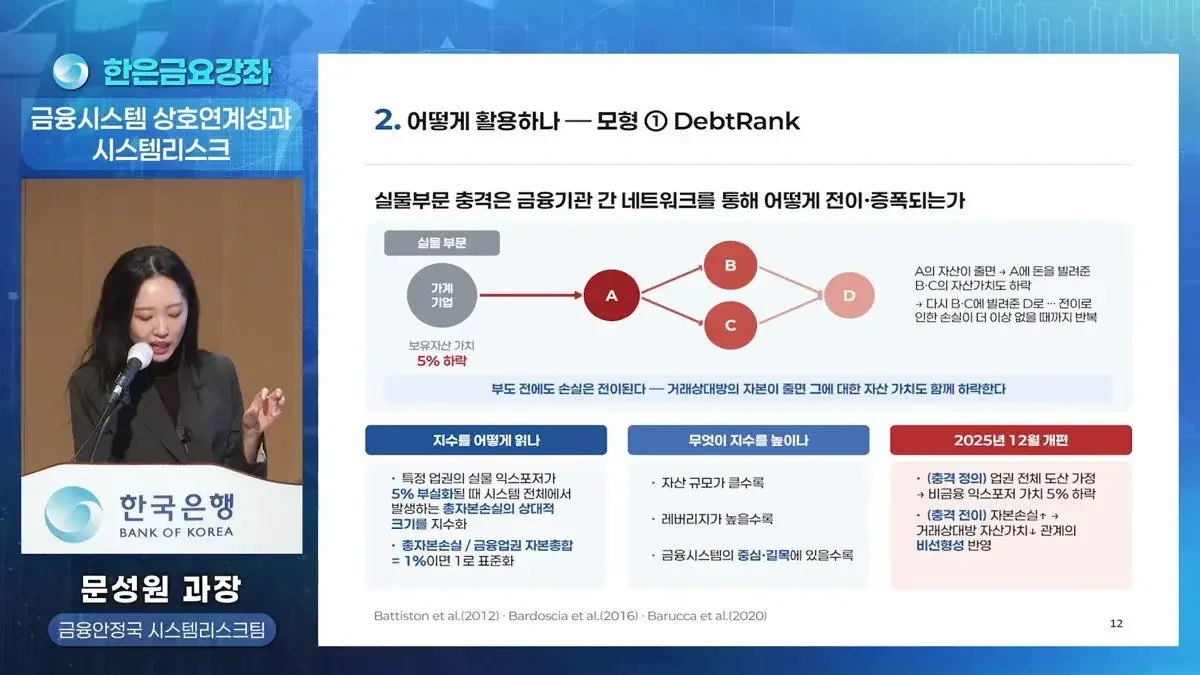
During a Bank of Korea lecture on October 30, 2026, Moon Seong-won warned that rational actions by individual firms to minimize losses can lead to a total financial system collapse through the "fallacy of composition." To manage these risks, the central bank utilizes interconnectedness analysis, including the Debt Rank index, to track how shocks spread through mutual transactions.
Rational decisions made by individual financial institutions to minimize their own losses can paradoxically escalate into a crisis that collapses the entire financial system. This occurs due to the "Fallacy of Composition," where the best actions for individual entities lead to a catastrophe for the whole. To manage such systemic risks, the Bank of Korea utilizes "interconnectedness analysis"—a tool used to identify the links between financial institutions.
Moon Seong-won, a manager of the Systemic Risk Team in the Financial Stability Department at the Bank of Korea, explained the mechanisms of systemic risk and financial interconnectedness during a recent Bank of Korea Friday Lecture (2026.10.30). Drawing on the experience of active research into the contagion and expansion of shocks between financial institutions following the global financial crisis, Moon emphasized the importance of practical analysis performed by the Bank of Korea beyond textbook theories.
The 'Accumulation of Vulnerability' created by rising asset prices and credit expansion
Systemic risk is defined as the risk that the financial intermediation functions of the entire financial system, or a part of it, fail to operate properly, potentially causing serious negative impacts on the real economy. Moon divided the process of how systemic risk accumulates and spreads into two axes: "time-series vulnerability accumulation" and "cross-sectional shock contagion."
In the time-series aspect, vulnerabilities accumulate during economic upswings. For example, when housing prices rise, collateral values increase, expanding lending capacity. This creates a circular structure where funds flow back into the housing market, driving prices even higher. This leads to the accumulation of "financial imbalances," where credit expansion and rising asset prices reinforce each other, causing excessive debt growth. During these periods, while the situation appears positive on the surface, internal vulnerability to external shocks becomes extremely high. This time-series vulnerability serves as the basis for macroprudential policy responses, such as expanding capital buffers or regulating household debt, and is also considered when conducting monetary policy.
If a shock occurs during such a state—such as a drop in asset prices or worsening financing conditions—financial institutions engage in "deleveraging," rapidly selling assets to repay debt. Fire sales of assets cause prices to drop further, which leads to valuation losses for other institutions holding the same assets, thereby amplifying the shock. Furthermore, if the process of liquidity-strapped institutions withdrawing funds from other institutions is repeated, financial intermediation functions deteriorate, eventually transferring the crisis to the real economy. Consequently, policy responses such as expanding capital and liquidity buffers for financial institutions, strengthening management of systemically important financial institutions, and establishing orderly liquidation systems for insolvent institutions become necessary.
Why the 'connection structure' must be viewed beyond individual institutional soundness
Moon identified the "fallacy of composition" as a paradoxical feature of systemic risk. From the perspective of a financial institution, it is a highly rational response to mitigate losses by selling risky assets when risk increases, or by shortening loan maturities and reducing transaction limits when there are concerns about the insolvency of a counterparty. However, if all institutions take the same action simultaneously, the market becomes paralyzed. If everyone sells assets, prices plummet due to a lack of buying demand; if everyone withdraws funds or only provides short-term loans, the burden of repayment and refinancing for those seeking funds increases, spreading liquidity risk across the entire system.
Therefore, checking the soundness of individual financial institutions alone is insufficient. It is essential to conduct "interconnectedness analysis" to understand how financial institutions are linked to one another and how a shock at one location spreads through the interconnected structure of mutual transactions and common exposure. Moon explained, "When vulnerability accumulates in a time-series dimension and interconnectedness expands, the expanded network acts as a channel for contagion when a shock occurs."
Interconnectedness indicators contained in the Bank of Korea 'Financial Stability Report'
The Bank of Korea discloses its analysis through the "Financial Stability Report," published semi-annually (June and October), to identify this interconnectedness. This report comprehensively examines households, corporations, financial institutions, financial markets, and asset markets to evaluate the financial stability of Korea and analyze potential risk factors. According to the video explanation, the most recent report from June 2026 contains the interconnectedness analysis as of the end of 2025.
The report includes the "volume of mutual transactions" and "connection structures" showing the links between different sectors within the financial system, as well as the "Debt Rank index," which indicates the risk of contagion from insolvency. Debt Rank is an indicator that quantifies the risk transferred when a specific shock occurs. Additionally, the interconnectedness model is used in "stress tests" that estimate the impact of a shock by assuming specific issues occur. In fact, the December 2021 report estimated credit and liquidity losses, as well as additional losses, caused by a shock in a specific sector to other sectors, and the recent June 2026 report performed a liquidity stress test on the entire financial system reflecting the interconnectedness structure.
The basic data for interconnectedness analysis is obtained from "Flow of Funds statistics," which shows the financial transactions and asset/liability balances of economic agents. Like GDP, the Flow of Funds statistics belong to the System of National Accounts (SNA) and show how economic agents—including households, non-financial corporations, general government, financial corporations, and the external sector—raise and manage funds through various financial products. The balance sheets of financial assets and liabilities in these statistics serve as the core material for mapping the networks of the financial system.
Source: original video (YouTube)



0Comments
Comments are currently disabled.