
Seoul housing market faces turning point by 2027
Professor Kim Gyeong-min predicts a major turning point for the Seoul real estate market in 2027, driven by interest rate volatility and a looming supply shortage. While the uptrend in Gangnam has already slowed, the Gangbuk area faces potential price plunges if interest rate pressures reach a breaking point.

Seoul real estate prices could face a sharp turning point by 2027 as the Gangnam uptrend has already broken. While interest rates may suppress sales demand, a supply cliff is expected to drive rental prices upward, with Seoul move-ins predicted to drop below 20,000 units in 2027.
The Seoul real estate market is expected to face a sharp turning point in 2027, caught between the two pillars of interest rate fluctuations and supply shortages. While the upward trend in the Gangnam area has already entered a slowing phase, analysis suggests that if pressure to raise interest rates increases, the Gangbuk area will also find it difficult to avoid price drops alongside a sharp decline in transaction volumes.
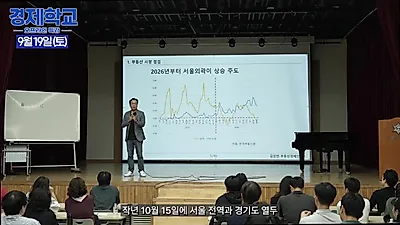
According to an analysis by Professor Kim Gyeong-min shared by KB Real Estate TV, the most significant variable in the current South Korean real estate market is mortgage interest rates. With the Bank of Korea's base interest rate stance being clear, the average mortgage rate in the banking sector currently stands at 4.88%, the highest level since 2010. "There is a possibility that the base rate could be further increased to the 3.5% level," Kim diagnosed, noting that "if interest rate hikes continue, the burden of mortgage interest will increase, inevitably shrinking demand for home purchases." He specifically pointed out that the current mortgage rate range is wide, spanning from the low 4% range to the 7% range, and that policy rates such as the Bogeumjari Loan are also on an upward trend as they are linked to the 10-year government bond yield.
Gangnam contraction and potential Gangbuk crash... Interest rates to decide sales market
While mentioning "Gangnam contraction" and "Gangbuk rise" as key keywords for the 2027 real estate market, Kim warned of volatility due to the impact of interest rates. Diagnosing that "the uptrend in Gangnam has already broken," he predicted that "there is a high possibility that prices in the Gangbuk area will plunge the moment the burden of rising interest rates reaches a breaking point." He explained that the inflection point for the market will be the moment transaction volumes plummet as more buyers delay their timing for purchasing. He expressed skepticism regarding whether current mortgage interest levels are manageable given that income growth has stagnated.
In contrast, the rental market is predicted to show a completely different pattern from the sales market. This is because the supply shortage problem is expected to appear earlier and more strongly in the rental market than in the sales market. "When supply is insufficient, Jeonse and monthly rent prices will wiggle upward first," Kim emphasized, adding that "especially in the case of monthly rent, it will continue to rise as inflation and supply shortages combine, and there is virtually no way to break this trend." Indeed, the Seoul apartment monthly rent index has surged by approximately 85% from the early 2020s (base index 100) to its current level of about 185.
Seoul and Gyeonggi 'supply cliff' becomes reality... Spreading across the metropolitan area
The supply shortage in Seoul and the metropolitan area is expected to intensify over the next few years. In the case of Seoul, the number of move-ins is expected to consistently fall short of the annual balanced supply level of 33,000 units. Looking at specific figures, the move-in volume, which is at the 26,000 level in 2024, is predicted to drop below 20,000 in 2027, fall to the 13,000 range in 2028, and plummet to less than 10,000 again in 2029. This supply cliff is a phenomenon appearing not only in Seoul but also identically in Gyeonggi Province.
Kim viewed that Gyeonggi Province, unlike Seoul, could stabilize the Jeonse and monthly rent market to some extent through supply utilizing state and public land. He suggested, "If organizations such as the Korea Land and Housing Corporation supply housing at appropriate price points in the 1.2 million to 1.3 million won range based on state and public land, the Jeonse and monthly rent market in Gyeonggi Province can be controlled." However, for Seoul, he predicted that while sales might remain in a sideways trend, instability in Jeonse and monthly rent will continue due to the combination of interest rate burdens and supply shortages. In Gyeonggi Province, while certain areas (such as Bundang and areas adjacent to southern Seoul) may show upward trends, the availability of land for supply in the surrounding areas may act as a variable.
Five variables moving the real estate market and the role of policy
Kim identified five core variables that will determine the future real estate market: inflation, interest rates, the asset effect (demand following the increase in asset value of specific companies such as Samsung Electronics), the supply cliff, and government policy. Among these, inflation acts as a factor pushing up Jeonse and monthly rent prices, while interest rates act as a powerful downward factor suppressing sales demand. The asset effect and the supply cliff are upward factors supporting the market. "In terms of the sales market, interest rates are the largest factor," he added, noting, "In the case of Gangbuk, one must watch how transaction volumes change."
Regarding government policy, he expressed regret over the current stance focused on "suppressing demand." He pointed out, "The purpose of housing policy is not simply to catch house prices, but to ensure that the middle class and ordinary citizens can enjoy a stable living environment at an appropriate cost. Current policies have an aspect of limiting financial accessibility, which results in only those with cash being able to buy homes." He particularly criticized recent policies targeting youth (those aged 39 or younger, with homes valued at 400 million won or less, providing 80% LTV support, etc.), stating, "The target housing is limited to villas, and the fact that it is a temporary supply for two years suggests an intention to ultimately support villa demand."
As alternatives, Kim suggested increasing mortgage maturities to 40–50 years to lower monthly repayment burdens, selling only the building while excluding land ownership, or designing financial products that provide initial low-interest benefits. He also argued that when supplying public rental housing, the proportion of units for sale should be increased (e.g., at a level of 70% for sale and 30% for rent, rather than 30% for sale and 70% for rent) to satisfy demand for homeownership. He emphasized, "It is the role of the state to expand opportunities for people to participate in the housing market through financial programs, even if they are not wealthy with cash."
Source: original video (YouTube)


0Comments
Comments are currently disabled.