
Kim Young-ik advises cutting stock holdings to 20% amid market warnings
Professor Kim Young-ik predicts the first half of next year will be the most difficult period for the market, advising investors to secure cash and increase bond holdings instead of aggressive stock investment.
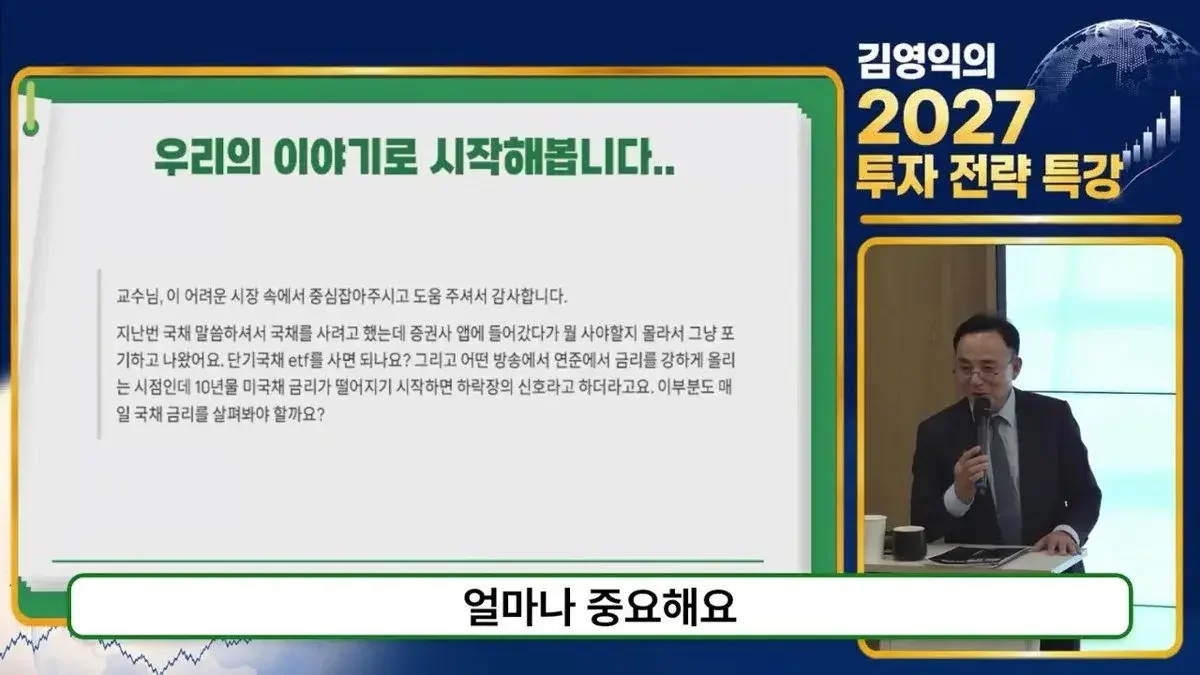
Professor Kim Young-ik predicts the first half of next year will be the most difficult period for the market, advising investors to reduce stock weightings to 20% as the leading stock cyclical fluctuation index turns downward.
Professor Kim Young-ik, an expert in reading financial market trends, has forecasted that the first half of next year will be the most difficult period for the market, suggesting a risk management strategy of securing cash and increasing bond weightings rather than engaging in aggressive stock investment.
Through his YouTube channel, Kim Young-ik's Economics School, Professor Kim revealed an asset allocation strategy based on his 40 years of experience in the financial markets. Having navigated numerous crises ranging from the 1989 stock market correction to the foreign exchange crisis, the IT bubble burst, the global financial crisis, and the COVID-19 pandemic, Kim identified "cash" and "courage" as the keys to survival. "Those who turned crises into opportunities possessed cash and courage," he emphasized, adding, "During difficult times, one must protect precious assets well and prepare to collect good assets at reasonable prices."
"Leading index has turned... stock weight should be reduced to around 20%"
Kim diagnosed the current market situation as a phase where the "leading stock cyclical fluctuation index" has turned downward. "When the leading stock cyclical fluctuation index rises, the weight of stocks in financial assets is kept at over 60%, but when the index turns, it is a method to reduce it to 20% or to take a break entirely," he explained. The cycle of this index typically lasts between 30 and 50 months, characterized by repeating rises and falls. Kim predicted, "The index is turning downward with July as the peak, and the market will be difficult as very dark news continues through the first half of next year."
He presented the "News Sentiment Index" and "average daily export amount" as indicators for reading the market direction. He explained that the News Sentiment Index, in which AI analyzes economic articles from various media outlets to determine if they are positive, negative, or neutral, is a leading indicator that moves approximately three months ahead of major economic indicators such as the KOSPI. "The News Sentiment Index leads the leading index, and it also leads the KOSPI," Kim said, noting, "The decline began with a peak in March, which could be identified around April." He also emphasized the current downward phase by pointing out that the export amount, which is the master of the economy, continues to follow the "dog" (the leading indicator). He diagnosed the current situation by saying, "We are now in a phase where the dog has gone behind the master."
He also urged caution regarding major sectors such as semiconductors. "If you hold semiconductors, you should consider reducing your weight even further, as there is a possibility they could fall more than they are now," Kim said, adding that the opportunity to buy cheaply only comes when asset prices have dropped sufficiently. He identified the ideal time for stock investment as "when it falls below the average," stating, "If you wait, it will definitely come."
"Prepare for the first half of next year by protecting principal with short-term government bonds"
As a specific countermeasure for a declining market, Kim strongly recommended bond investment. "As the first half of next year is predicted to be the worst for the market, a strategy of buying government bonds with a maturity of about 6 to 10 months remaining is effective," he suggested. His logic is that while bonds offer lower returns than stocks, they serve as a shield to protect assets in a declining market because the principal and interest are guaranteed at maturity. He explained that individuals can sufficiently check maturities and yields by utilizing services such as securities firms' "Today's Bond" service.
The cash and bond returns secured in this manner can be used as resources to repurchase stocks once stock prices have dropped sufficiently. "People who are truly good at stock investing buy at the knee and sell at the shoulder," Kim remarked, noting, "The right side when the leading index turns is about the shoulder, and in terms of the KOSPI, it would have been okay to sell when it was around 7,100." He emphasized that once the point where the indicator turns upward again arrives, one should invest aggressively in stocks at that time.
Furthermore, he pointed out the issue of Korea's high real estate concentration and mentioned asset liquidation for retirement preparation. He specifically advised the retirement generation in their 60s, whose real estate assets account for more than 80% of their total assets, to actively utilize liquidation methods such as the housing pension system. "Retirement preparation is not very well-prepared. Many people retire with only one house," he said, stressing the need for asset liquidation.
"Will play a role in setting standards for financial democracy"
While acknowledging market uncertainty, Kim emphasized "standards" as the attitude investors should maintain. "Without standards, one repeats the mistake of buying when stocks are expensive and selling when they are cheap," he said, stating that setting appropriate asset allocation standards whenever economic indicators are released is the core of investment. He warned, "The future is that uncertain," citing the case where the financial crisis occurred following the hike in the base interest rate in August 2008 and the subsequent bankruptcy of Lehman Brothers.
Finally, he stated his purpose for his activities is to "aim for 'financial democracy,' where people study finance to increase and share wealth." He added, "No matter how difficult a period comes, if you manage asset allocation well, you can protect your money and prepare for a new era," and pledged to continue playing the role of setting appropriate standards whenever economic indicators are released.
Source: original video (YouTube)
0Comments
Comments are currently disabled.