
Bank of Korea discusses digital infrastructure amid rise of AI and tokenization
The Bank of Korea hosted the 2026 Bank of Korea Conference on Payment and Settlement Systems in Seoul to discuss how central banks can redesign payment and settlement systems to ensure stability amidst the rise of asset tokenization and artificial intelligence.
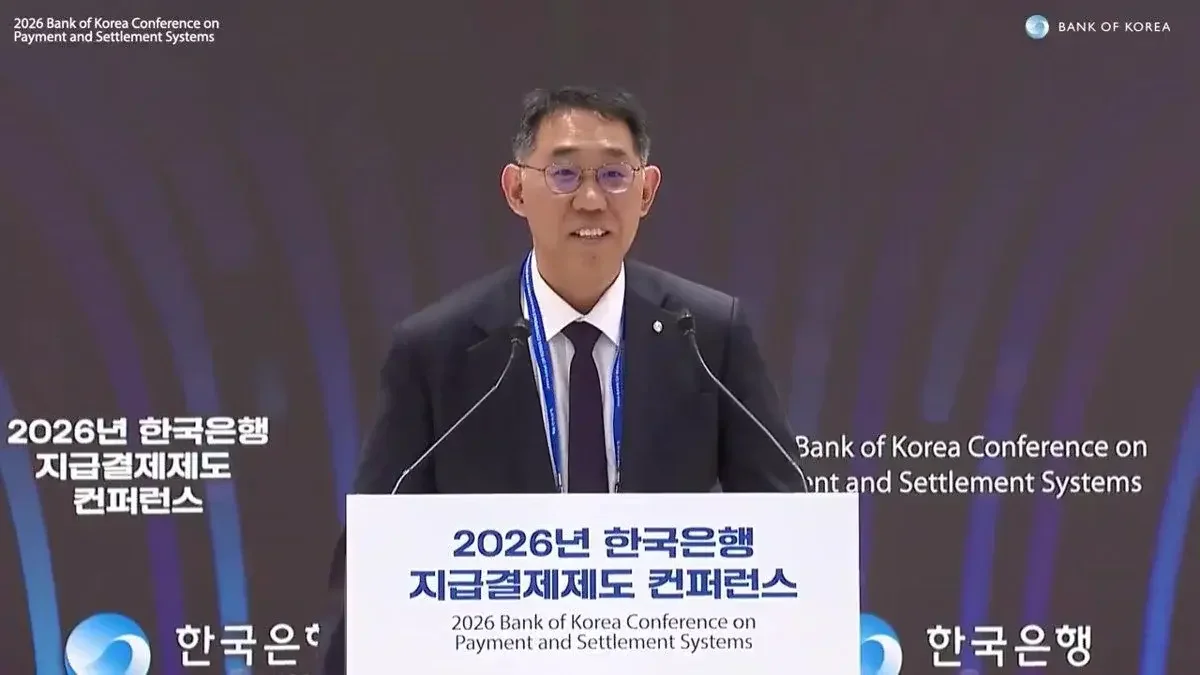
The Bank of Korea held a conference in Seoul on the 11th to address how central bank money can maintain trust as asset tokenization and AI technology reshape the payment landscape. Deputy Governor Jang Seung-su warned that technological progress does not automatically improve payment services and emphasized the need to prepare for new risks.
The rapid advancement of digital financial technology is bringing fundamental changes to the payment environment. As the combination of asset tokenization and artificial intelligence (AI) technology accelerates, discussions have intensified regarding how to redesign existing payment and settlement systems while ensuring stability.
On the 11th, the Bank of Korea held the '2026 Bank of Korea Conference on Payment and Settlement Systems' at the Bank of Korea Conference Hall in Seoul, under the theme "Financial Market Infrastructure in the Digital Finance Era: Innovation and Policy Implications." The conference was organized to address the future direction of digital financial infrastructure, including central bank payment services responding to asset tokenization, the enhancement of cross-border payment efficiency, and innovation in retail payment systems.
In the era of asset tokenization and AI, "technological innovation does not necessarily mean service development"
Jang Seung-su, Deputy Governor of the Bank of Korea, opened the conference by emphasizing a historical turning point in the payment environment. Deputy Governor Jang diagnosed that deposit tokens, stablecoins based on distributed ledger technology (DLT), tokenization of real-world assets (RWA), and the leap in AI technology are reshaping the payment landscape. He expressed concern that if central banks worldwide fail to respond proactively to these technological innovations, the stability of future financial systems could be undermined.
In particular, Deputy Governor Jang made it clear that the emergence of new technologies does not automatically lead to the advancement of payment services. "The progress of new technologies and the payment methods that utilize them does not necessarily mean the progress of payment services," he said. "We must focus on whether innovation contributes to substantially increasing the efficiency and safety of payments and settlements." He explained that while the private sector is developing various payment methods and financial services, policy authorities are building relevant regulatory frameworks, and central banks are preparing infrastructure to support innovation.
Warnings regarding new risks stemming from AI technology were also issued. While opportunities exist, such as increasing demand for high-frequency, small-value payments via AI agents and the possibility of 24-hour cross-border payment services, it was noted that significant social costs, such as the expense of strengthening cybersecurity, could arise. "It is time to soberly examine whether our payment infrastructure and safety nets are prepared to respond to these new risks," Deputy Governor Jang added.
Central bank money emphasized as the 'bulwark of trust' amidst digital innovation
The Bank of Korea's position is that the essence of payment does not change even if technology does. Deputy Governor Jang mentioned the core value of payment—that economic agents must be able to transfer funds safely and efficiently—and emphasized that the foundation of that trust lies in 'Central Bank Money,' a final settlement asset with no credit risk.
He identified the core task for central banks moving forward as building payment and settlement infrastructure that can fully utilize technological advantages while maintaining the trust provided by central bank money. This aligns with a future monetary system vision that seeks to fuse the advanced technological capabilities of the private sector with the reliability of central bank money. Deputy Governor Jang reiterated the vision emphasized by Hyun Seung-sin, Governor of the Bank of Korea, to "fuse the enhanced technological capabilities of the private sector with the trust provided by central bank money."
The future of payment systems through UK and Brazil cases
The conference was divided into three sessions featuring specific case presentations and discussions by central banks and private sector experts from various countries. In the first session, Andrei Pustelnikov, Senior Policy Manager at the Bank of England, shared experiences from experiments in central bank wholesale payment innovation responding to asset tokenization. The session was chaired by Lee Jeong-du, a senior researcher at the Korea Institute of Finance, with Jang Bo-seong, head of the Macro Financial Analysis Team at the Korea Capital Market Institute, and Ryu Jae-min, head of the Digital Currency Analysis Team at the Bank of Korea, participating as panelists.
The second session covered the experience of 'Project Nexus,' a global cooperation project aimed at reducing friction in cross-border payments. Andrew McCormack, CEO of Nexus Global Payments, was the presenter. Park Gi-yeong, a professor at Yonsei University, served as the chair, while Ko Yeong-mi, a professor at Sookmyung Women's University, and Jeffrey Choi, head of the Web3 Financial Business Group at Shinhan Bank, joined the discussion.
The third session looked into the future of retail payment systems through the case of the Central Bank of Brazil's 'Pix,' which has become the most preferred payment method for Brazilians since its launch in November 2020. José Vicente Mattos Santana, head of Pix operations at the Central Bank of Brazil, presented the innovative retail payment model. Seo Jeong-ho, a senior researcher at the Korea Institute of Finance, chaired the session, with Hyun Jeong-hwan, a professor at Dongguk University, Kim Dong-hyeon, head of the Digital Finance Research Team at the Korea Financial Telecommunications and Clearings Institute, and Ko Gyeong-cheol, of the Payment and Settlement Policy Team at the Bank of Korea, participating in the discussion.
Kang Dong-ro, head of the Payment Research Team at the Bank of Korea, who conducted the conference, expressed expectations that this event would serve as a milestone for payment systems undergoing the digital financial transition.
Source: original video (YouTube)
0Comments
Comments are currently disabled.