
FIU marks 25th anniversary with seminar on Risk-Based Approach for AML supervision
To mark the 25th anniversary of the FIU and the 20th Anti-Money Laundering Day, the Financial Services Commission held an international seminar in Seoul to discuss implementing a Risk-Based Approach to combat increasingly sophisticated money laundering.
As money laundering methods become more sophisticated and increasingly cross-border, the "Risk-Based Approach (RBA·Risk-Based Approach)," which concentrates supervisory resources on high-risk areas, has emerged as a core task for financial authorities.
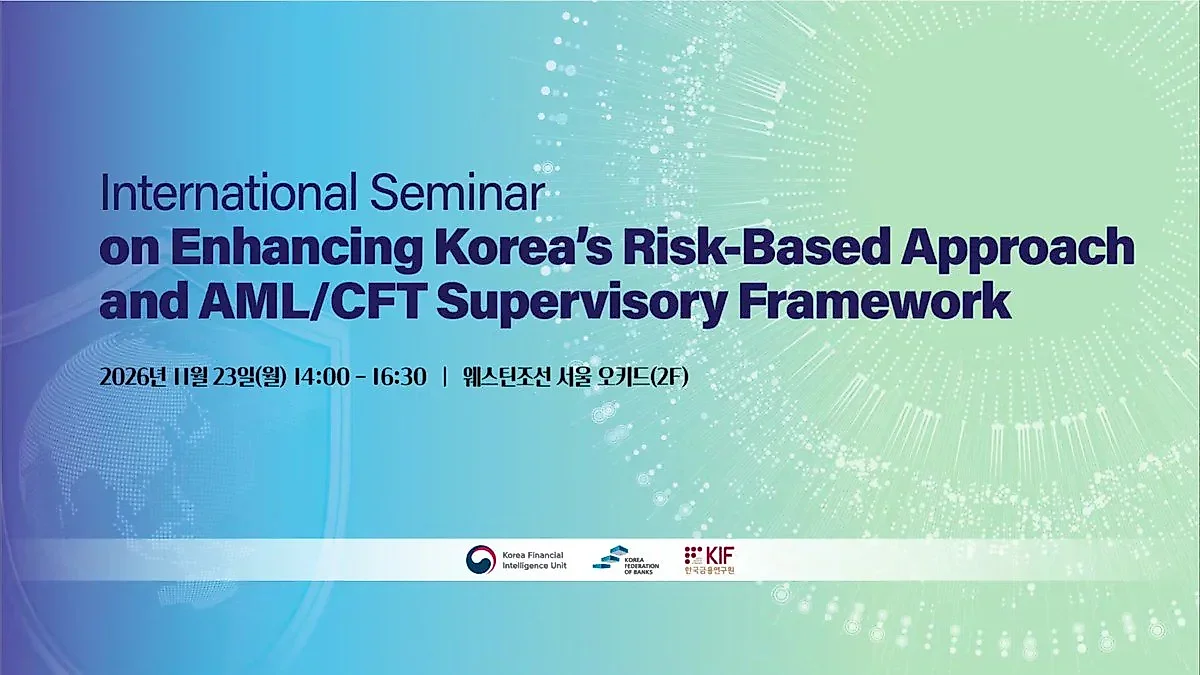
To commemorate the 25th anniversary of the establishment of the FIU and the 20th Anti-Money Laundering Day, the Financial Services Commission held an international anti-money laundering seminar on the 23rd at the Orchid Hall of the Western Chosun in Seoul. The seminar was organized jointly with the Korea Federation of Banks and the Korea Institute of Finance, featuring international experts from Singapore and Japan who shared supervisory cases and field experiences from their respective countries.
"Cannot prevent all risks... differentiated management based on risk levels required"
Financial authorities attending the seminar collectively emphasized the importance of RBA. Shin Jin-chang, Vice Chairman of the Financial Services Commission, stated in his congratulatory remarks, "Due to recent technological evolution and the diversification of crime patterns, it has become extremely difficult to define money laundering risk factors in advance." He added, "We must align with the international trend of recommending that financial companies individually assess the risk levels of customers or business sectors and implement differentiated AML management accordingly."
Shin further noted, "Supervisory authorities must also increase supervisory effectiveness by differentiating risk levels by industry and product, thereby concentrating supervisory resources on high-risk areas." He added that this also means "strengthening responses to high-risk fields while supporting the smooth operation of financial functions in low-risk areas."
Lee Chan-jin, Governor of the Financial Supervisory Service, also stressed the need for preemptive responses, citing the spread of digital finance and the surge in concealment of criminal proceeds using virtual assets. "It is more important than anything to accurately identify the risks faced by financial companies and allocate management capabilities in proportion to those risk levels," Lee said. He added, "We will support financial companies to strengthen their own risk management capabilities, such as encouraging the expansion of dedicated AML organizations across the entire financial sector."
Tasks for advancing national strategy and expanding regulation to non-financial professionals
Lee Hang-yong, President of the Korea Institute of Finance, reviewed the development process of Korea's anti-money laundering system and presented specific institutional tasks to be addressed in the future. "FATF defines the Risk-Based Approach as an essential foundation of international standards," Lee emphasized. "The state and financial companies must accurately identify risks and allocate resources in proportion to their scale."
In particular, Lee called for a virtuous cycle of "Risk-Based Supervision (RBS·Risk-Based Supervision)" for the efficient operation of supervisory authorities. He pointed out that inspecting all institutions with the same frequency and intensity could result in missing actual risks. "A virtuous cycle is needed where inspections are differentiated by evaluating the risks of industries and individual institutions, and those results are then reflected back into risk assessments," he explained.
Furthermore, he identified the following as future policy directions: ▲clarifying the legal basis for Risk-Based Supervision, ▲institutionalizing proportional measures for low-risk areas, ▲expanding the scope of regulation to non-financial professionals such as lawyers and accountants, and ▲improving supervisory consistency and data quality. Lee suggested, "These tasks cannot be achieved through the efforts of a single institution alone; they must be carried out through pan-government cooperation and public-private partnership."
Strengthening global response capabilities through overseas cases like Singapore
In the following session, Tong Lang, Director General of the Anti-Money Laundering Department at the Monetary Authority of Singapore (MAS), served as the first presenter, announcing the current status of RBA operations in Singapore. "Interest in RBA is increasing worldwide, and Singapore also treats RBA as an essential condition to respond to the rapidly changing environment, such as the issue of funding for Russia," Tong stated.
The seminar served as a platform for practical discussion to increase the understanding of risks and improve the precision of response methods among domestic and international supervisory authorities and financial companies in celebration of the 25th anniversary of the FIU's establishment.
Source: original video (YouTube)



0Comments
Comments are currently disabled.