
"300,000 won for mother-in-law, 600,000 won for parents-in-law"... Allowance standards that trigger marital fights
In a recent broadcast of Dongchimi, participants shared various examples of marital conflicts…
Conflicts between couples arise from various points, from minor daily habits to sensitive economic issues related to both sets of parents. In a recently released broadcast video, participants revealed the points where their positions clash and the resulting emotional gaps through specific examples of marital fights they have experienced.
"Don't criticize my acting"… The gap between empathy and criticism
The participants shared cases where their careers as actors and their daily communication styles led to marital conflicts. Hong Ji-min revealed an experience where, during a past drama shoot, she was nervously monitoring her performance because she was not satisfied with her own acting, only to be criticized by her husband. When her husband pointed out, "You shouldn't act drunk like that" and "You weren't focused well back then," Hong Ji-min protested, asking, "You're not even the director, so why bother criticizing?" which eventually escalated into a fight. Her husband responded by saying, "I'm saying this so you can do well," but Hong Ji-min explained that she experienced conflict as her desire to have her professional expertise respected as an actor clashed with her need for emotional support from her spouse.
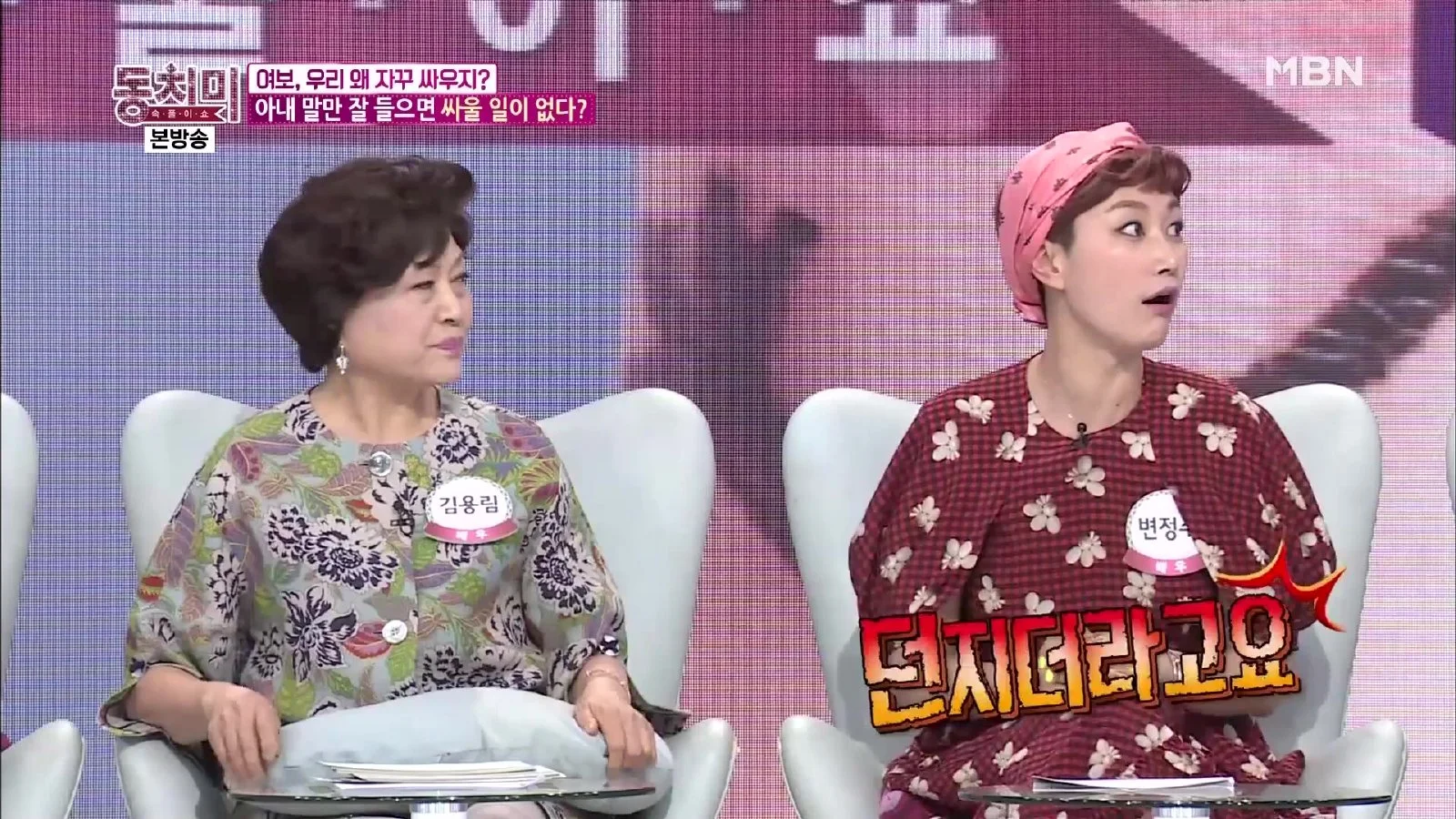
Another participant mentioned a conflict experienced due to her mother's health issues. This was a situation where a comprehensive examination, including a brain scan, was conducted because of a symptom where sounds were coming from her mother's head, but no medical abnormalities were found. The participant hoped for comfort from her husband while worrying about her mother's condition, but her husband tried to brush it off, saying, "All elderly people are like that." The participant shared, "I said those things thinking my husband would be on my side, but instead, my husband fought back by saying my mother was the strange one." This shows a typical pattern of conflict that occurs when a spouse's attitude toward a family matter leads to a lack of empathy.
"300,000 won for overseas trips, 200,000 won for domestic"… Clashing allowance standards
Specific conflict cases were also presented regarding economic support for family members, particularly the standards for giving pocket money. One participant pointed out the problems that arise when the standards for pocket money applied during holidays or parents' trips differ depending on which side of the family they belong to. According to the participant's explanation, she established her own standards, such as giving 300,000 won when her parents-in-law go on an overseas trip and 200,000 won when her mother goes on a domestic trip to Jeju Island, but she said differences in opinion with her spouse arise in this process.
Particularly regarding holiday pocket money, she mentioned that the difference in support amounts for both sets of parents is becoming a subject of debate between the couple, stating, "If we give 300,000 won each to the mother-in-law and the parents-in-law, it effectively means we are giving 600,000 won to the parents-in-law's side." The participant expressed the difficulty of finding a compromise, asking, "Are we some kind of '30 Club'?" This contains the realistic concern of how to maintain equity for both sets of parents while managing the household economy.
Conflicts regarding communication styles, division of household chores, and daily decision-making power also followed. One participant revealed that due to her planned personality, she has a habit of deciding the order of tasks in advance and giving directions to her husband when doing housework or work. Using the example of hanging a picture frame, she explained that she informs him of the order in advance, such as "one, two, three," to prepare for mistakes, but conflict occurs because her husband perceives this as a 'command,' feeling resistance or acting arbitrarily without following instructions. The core of the conflict appeared as the frustration that arises when the husband responds by cutting off communication or blindly finishing an action instead of following the wife's guidance.
In this way, the participants formed a consensus by sharing various forms of marital conflict that arise when the psychology of wanting a spouse to be on one's side clashes with the psychology of rejecting the other person's control or criticism.



0Comments
Comments are currently disabled.