
"If you save 400,000 won every month for 30 years"... Simulation results for retirement funds using S&P500 and Nasdaq 100
CEO Kim In-eung presented a simulation showing that investing in ETFs like the S&P500 or Nasdaq 100 can yield significantly higher retirement assets compared to traditional savings or variable insurance. He also provided strategies for managing retirement pension accounts (IRP) and emphasized the importance of time for long-term investors.
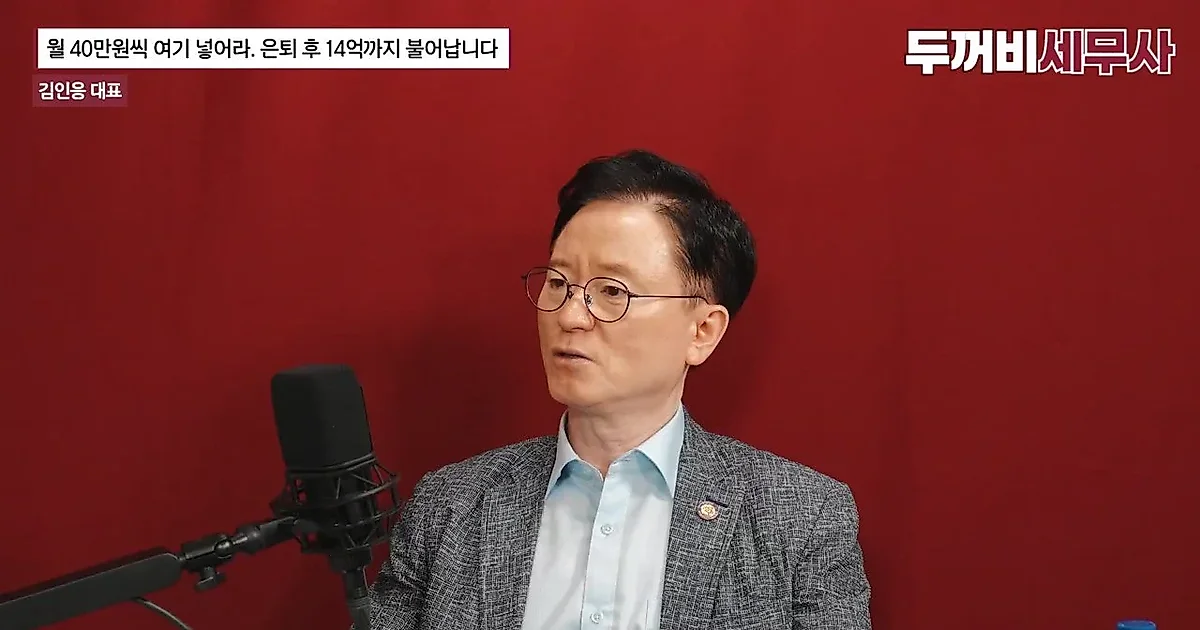
An analysis has revealed that when saving a fixed amount of money every month over the long term, the scale of assets at the time of retirement can vary greatly depending on which financial products are selected. In a video, CEO Kim In-eung disclosed the results of a pension asset formation simulation using the S&P500 and Nasdaq 100 indices and explained specific management methods.
The asset growth effect of using ETFs for pension savings compared to installment savings and variable insurance
CEO Kim In-eung compared the returns of three financial products under the assumption of saving 400,000 won every month for 30 years. First, in the case of installment savings applying a 4.5% annual compound interest rate after taxes, the assets after 30 years were calculated to be around 300 million won. Variable insurance, assuming a 7% return and calculated with simple interest, appeared to be approximately 280 million won.
On the other hand, the simulation results showed that if one invests in ETFs such as the S&P500 or Nasdaq 100 through a pension savings fund and assumes a median annual return of 10%, the assets after 30 years would reach approximately 930 million won. Citing that the S&P500 recorded an average annual return of 8.4% and the Nasdaq recorded 13.4% over the recent 30 years, Kim explained that if the return range is set between 8% and 12%, the asset scale could be formed between approximately 640 million won and 1.38 billion won.
Retirement pension account management methods and the 30% safe asset ratio management method
A strategy responding to the '70% risky assets, 30% safe assets' regulation applied when managing retirement pensions (IRP) was also presented. Kim mentioned that in the case of pension savings funds, there are no management restrictions, so the entire 400,000 won can be invested in index ETFs, but for IRP, 30% must be filled with safe assets.
Under these constraints, Kim suggested a method of utilizing ETFs that mix United States stocks and bonds. Specifically, he explained that products such as 'ACE US S&P 500 US Treasury Bond Mix 50 Active' or 'TIGER Bond Mix' are positioned at the top of net assets and are gaining the trust of investors. He added that the 30% safe asset ratio can be satisfied by allocating 40% to domestic indices (KOSPI 200) and 60% to United States 10-year Treasury bonds, or by using TDFs (Target Date Funds) that adjust the ratio of stocks and bonds according to age.
Long-term investment principles for the youth and the upward market structure
CEO Kim In-eung emphasized that the most powerful weapon held by the younger generation is 'time.' He explained that although market volatility exists, due to the nature of an index, which continuously includes blue-chip companies and excludes failing companies, it has a structure that trends upward in the long term. Pointing out that while individual companies may fail, representative indices do not fail, he recommended investing through ETFs rather than individual stocks.
As three prerequisites for successful retirement preparation, he suggested: ▲Do not withdraw funds in the middle ▲Contribute steadily ▲If the ability to contribute is lacking, avoid withdrawals first. Kim mentioned that rather than investing recklessly to recover losses when the market falls, it is important to have an attitude of choosing blue-chip assets and waiting.
0Comments
Comments are currently disabled.