
Global Government Bond Yields Surge to 5% Range: 5 Background Factors and Market Impact
Global government bond yields are surging, driven by factors such as geopolitical tensions, monetary tightening, fiscal expansion, China's selling of US Treasuries, and corporate bond issuances by big tech companies. This rise in yields is causing increased market volatility and potential economic contraction through the crowding-out effect.
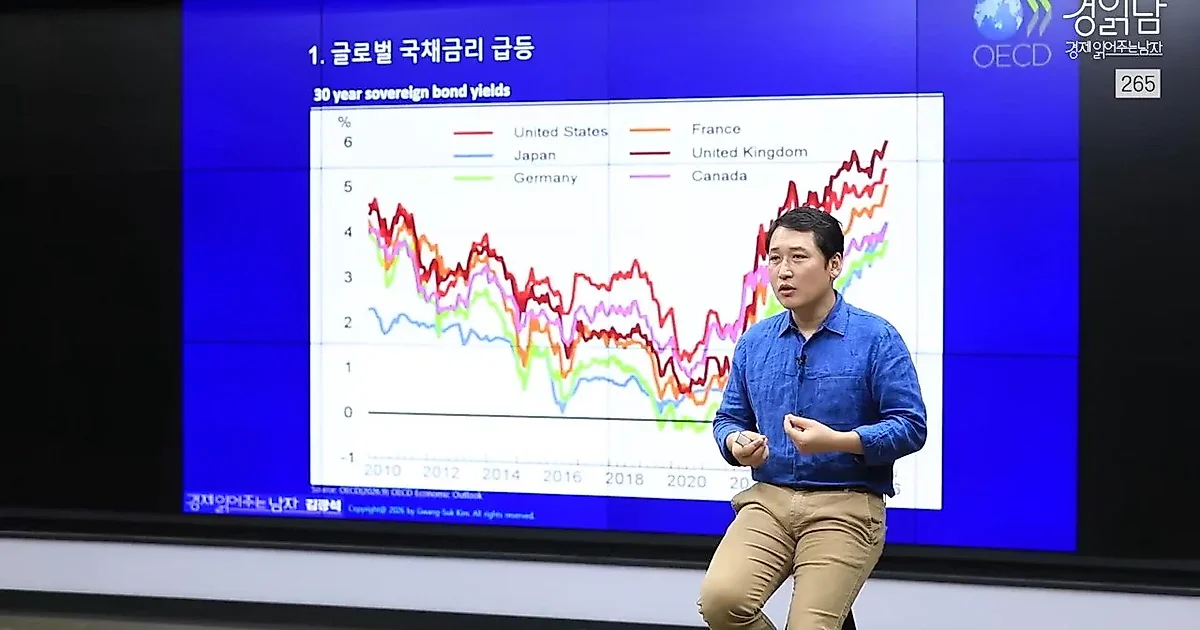
Global government bond yields are surging, increasing market volatility. With the United States 10-year Treasury yield recording 5.3%, government bond yields in major countries are showing a synchronized rise, which is having a complex impact on the real economy and capital markets.
5 Background Factors Driving the Rise in Government Bond Yields
According to the content of the video from the YouTube channel 'The Man Who Explains the Economy', the main factors driving the current rise in government bond yields can be summarized into five points. The first is geopolitical tension. When geopolitical risks, such as wars in the Middle East, escalate, international oil prices rise, leading to inflationary pressure that stimulates government bond yields. The video assumes that the peaks of geopolitical tension were in March and September 2026, and that geopolitical tension will ease somewhat entering October.
The second is monetary tightening. Due to inflation concerns, central banks around the world are shifting from a rate-cutting stance to a tightening stance, resulting in a trend of rising interest rates. The third is fiscal expansion. As governments in various countries significantly increase spending and expand the issuance of government bonds, upward pressure on interest rates is intensifying. One cause of the rising interest rates is that while monetary policy is tightening, fiscal policy is moving in an expansionary direction.
The fourth is China's selling trend of US Treasuries. China was once a major holder of US Treasuries, but it has continued a selling trend every year since its peak in 2013, and this selling trend is appearing even more steeply entering 2026. The fifth is the issuance of corporate bonds by big tech companies. As hyperscale big tech companies such as Google, Amazon, and Microsoft face shortages in free cash flow entering 2026, they are actively issuing corporate bonds to cover the necessary funds. This issuance of corporate bonds by big tech acts as a substitute for government bonds and becomes a factor that pulls up government bond yields.
Changes in Investment Entities and Market Volatility
Another background for the rise in government bond yields is the change in investment entities, namely a "change in hands." The video explains that looking at the proportion of US Treasury holdings, the proportion held by the Federal Reserve has relatively decreased, while the proportion held by the private sector has absolutely increased. The analysis suggests that if the private sector holds a large amount of government bonds, they may demand higher interest rates than the public sector or the Federal Reserve, which can raise interest rate levels; furthermore, because the private sector responds敏捷ly to interest rate changes, interest rate volatility may intensify in the future.
Economic Impact of Debt Dependency and the Crowding-Out Effect
A rise in government bond yields means that the government is supplying funds by relying on debt. This is a concept of pulling forward resources to be used in the future to the present, which can raise concerns about debt repayment capability. In particular, high government bond yields increase the financing costs for private companies, making new investment difficult, and can ultimately become a factor that shrinks the economy.
In terms of capital markets, a "crowding-out effect" occurs. When interest rates rise, the attractiveness of cash increases, leading to a phenomenon where funds that would have flowed into real estate, stock, or coin markets concentrate into cash. In the video, the impact of rising government bond yields on the overall market was explained through an analysis of where capital in the capital market concentrates during such a period of rising interest rates.



0Comments
Comments are currently disabled.