
"2027 will be the 'Reverse Flow of Money' brought by AI"... What will be the next leading sector after semiconductors?
A guest on "The Man Who Explains the Economy (Kim Kwang-seok TV)" predicts that the flow of capital will shift drastically in 2027 with the arrival…
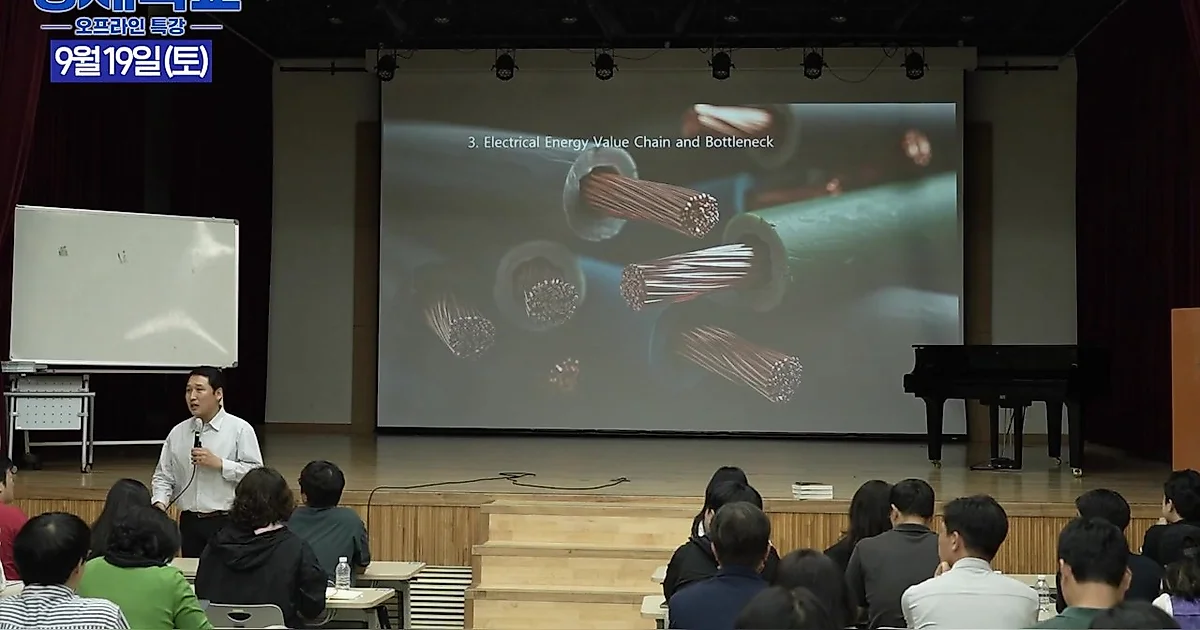
The key keyword for the economy in 2027 is the 'reverse flow of money' created by AI. According to a video from The Man Who Explains the Economy (Kim Kwang-seok TV), the guest predicted that after the conception phase in 2025 and the planning phase in 2026, the era of 'Physical AI,' where AI is actually commercialized, will arrive in 2027, causing a rapid shift in the flow of capital.
Qualitative Changes in Semiconductor Exports and the 'P Trap'
The core driver currently supporting the South Korean economy is semiconductors. Accounting for approximately 40% of South Korea's total exports, semiconductors play an essential role across major industries such as smartphones, refrigerators, and automobiles. In particular, the guest analyzed that although South Korea was a 'Triple A' country (ranking first in oil consumption, foreign oil dependency relative to GDP, and dependency on Middle East crude oil) that could have been most heavily impacted by the Middle East war, it was able to offset that impact thanks to AI hardware exports.
However, points were raised that a cautious approach is needed regarding whether the semiconductor-centered growth trend will continue. The guest explained, "DRAM export volume has decreased compared to last year," adding, "It is only because the export value (P×Q) increased due to surging prices." In other words, the analysis suggests that if prices (P) no longer rise while volume (Q) growth is not supported, South Korea's export growth will inevitably slow down. This implies that whether the semiconductor boom continues is a prerequisite that will determine the future direction of the South Korean economy.
Hyperscalers' Adjustment of Investment Speed and Financial Burdens
The first variable through which the leading sector of the AI industry could change was presented as the 'theory of hyperscalers (large-scale AI companies) adjusting their CAPEX (capital expenditure) speed.' According to the guest, major big tech companies, including Google (Alphabet), have been investing massive amounts of cash to build infrastructure such as data centers through the second quarter of 2026, but they are currently facing a point where that cash is being exhausted.
In particular, due to high government bond yields, additional fund procurement through corporate bond issuance is also not easy. The guest predicted, "From a financial perspective, even if CAPEX investment continues in the future, its growth rate will slow down." This explanation suggests that such changes in demand could eventually lead to a decrease in demand for DRAM, a core component of AI, serving as a catalyst for the weakening of existing semiconductor leaders.
China's AI Price Competitiveness and Market Share Threat
The second and third variables are China's technological and price offensives. The guest warned that a similar phenomenon is occurring in the AI model market, citing a case where expensive LiDAR technology developed by U.S. companies lost the market to the overwhelming price innovation of Chinese companies. Beyond the difference in technical capabilities, a 'cost-effectiveness-centered trend' is emerging where companies choose cheap Chinese AI models to reduce costs.
In fact, the guest analyzed, "Chinese AI models have already overturned (the general-purpose field)," suggesting that if companies rely on cheap Chinese models to maximize cost-efficiency, the demand for AI investment in the United States may change. Additionally, the issue of declining market share for South Korean semiconductor companies was pointed out. The guest emphasized, "Samsung Electronics' DRAM market share dropped for the first time in the second quarter," and "We cannot ignore the fact that Chinese companies are rapidly expanding their market share by becoming self-sufficient in the low-spec semiconductor market."
Ultimately, the leading sectors in 2027 will change even within the AI value chain, and that flow is expected to be determined by the dynamics between AI models, infrastructure (data centers, power, telecommunications), and the hardware that supports them.


0Comments
Comments are currently disabled.