
OECD predicts severe global economic hardship in 2026 as AI drives wealth polarization
The global economy is expected to face unprecedented shocks in 2026, with the OECD forecasting a growth low of 2.9% and an increasing economic divide between nations integrated into the AI value chain and those that are not.
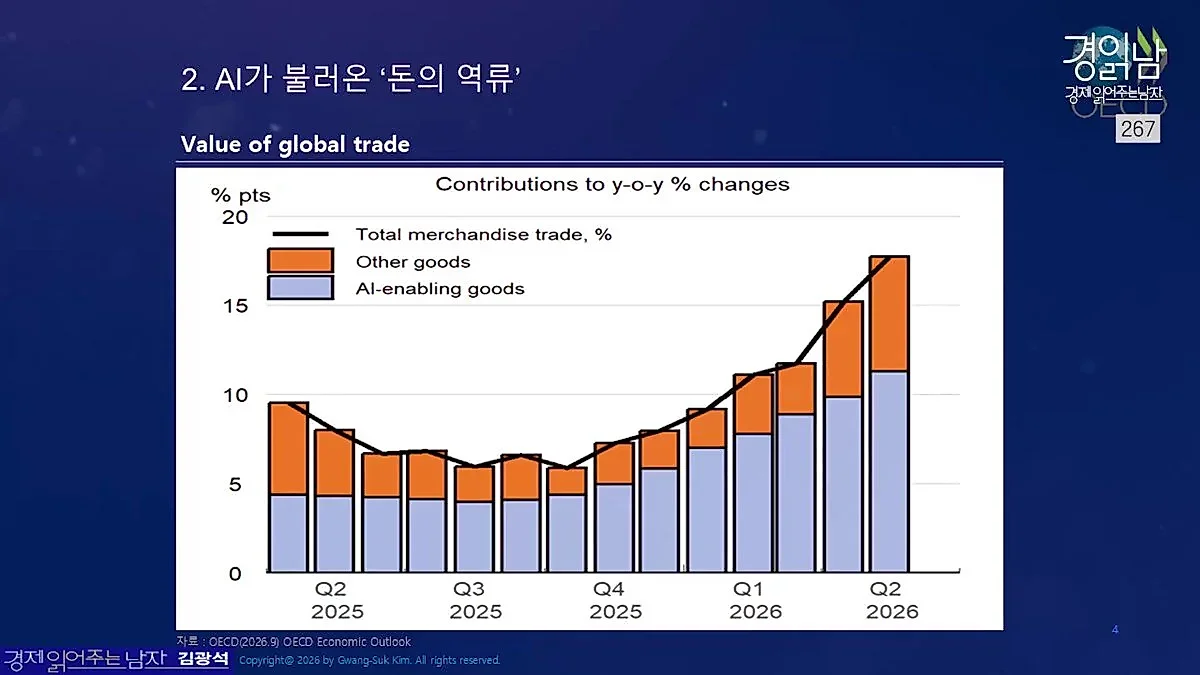
The global economy is projected to face unprecedented shocks in 2026. As continuous external shocks pressure the overall economy, economic polarization is expected to intensify between countries included in the AI industry value chain and those that are not.
According to an analysis by Professor Kim Kwang-seok shared by The Man Who Explains the Economy (Kim Kwang-seok TV), the OECD recently diagnosed that the global economy will go through a very difficult period in 2026 in its economic outlook report. The core message of the report is "weathering successive shocks." This suggests a painful situation where shocks occur in succession before the economy can even recover from the previous one, rather than being isolated incidents. The background image in the video conveys this message by depicting trees having to endure strong winds.
AI drives economic polarization; South Korea to benefit from "reverse flow of money"
According to the OECD diagnosis, the global economic growth rate is expected to hit a low of 2.9% in 2026. However, not all nations will experience the same hardship. Professor Kim explained this as a "reverse flow of money brought by AI," as only a tiny fraction of the approximately 200 countries worldwide can participate in the AI value chain.
Key nations supporting the AI industry—including the United States for design, South Korea for memory semiconductors, Taiwan for foundries, Japan for materials, and the Netherlands for equipment—could enjoy strong growth opportunities in 2026. In contrast, other nations vulnerable to external variables, such as Middle East wars or oil shocks, are expected to experience extreme disparities, making it difficult to feel any economic recovery. "As the contribution of goods that make AI possible surges remarkably, exports will increase tremendously in 2026," Kim analyzed. "Only a few countries can ride this wave of export growth."
The South Korean economy was identified as one of the countries that will experience this "reverse flow of money" most directly. "The OECD forecasts South Korea's growth rate at 3.7%," Kim analyzed. "This is an exceptional figure, as even returning to pre-pandemic levels, 3.7% growth was not easy, and this is a result of riding the AI value chain." However, he pointed out that because this growth is concentrated in specific industries, the felt economic conditions may differ. "Out of 29 million employed people, employees of semiconductor companies number less than 200,000; even if we generously say about 1 million people enjoy bonuses, the remaining 28 million may find it difficult to feel the economic growth and bonus opportunities," he explained.
Middle East war triggers secondary inflation and oil price variables
Warnings regarding inflation trends also continued. The possibility of "secondary inflation"—where inflation, which peaked in 2022, faces upward pressure again from mid-2026—has been raised. In particular, the surge in international oil prices caused by the Middle East war is acting as a key variable stimulating price increases. Kim distinguished between "Price" (the price indicator) and "Inflation" (the inflation rate), emphasizing that this phenomenon is an issue of inflation as confirmed by the inflation rate indicator.
The current rise in oil prices is a structural phenomenon caused by supply disruptions in the Middle East rather than an increase in crude oil demand. "Crude oil demand is decreasing, but oil prices jumped because supply plummeted," Kim predicted. "Even if the Middle East war ends, it will take at least three and a half years for oil price levels to descend to pre-war levels due to the destruction of production and storage facilities." However, he added that depending on the progress of the Middle East war, international oil prices have the potential to stabilize downward toward the $55 level.
This oil price instability is leading to rising government bond yields. However, based on the OECD Financial Stability Index (FCI), it was analyzed that the current rise in interest rates is unlikely to escalate into a direct financial crisis like that seen during the pandemic in 2022. The financial sector is in a relatively stable situation. Instead, a concern was raised that rising government bond yields could cause a "crowding-out effect," where private investment is shrunk amid increasing fiscal spending.
2027 economic recovery and the link to the timing of interest rate cuts
Regarding the timing of interest rate cuts, which the market is most curious about, Kim predicted that the economic situation will gradually improve in 2027 after the severe recession of 2026. According to the OECD forecast, the global economic growth rate, which falls to 2.9% in 2026, is expected to rebound to the 3.0% level in 2027.
In particular, 2027 is expected to be an important turning point where the direction of fiscal and monetary policies shifts. While major countries, including South Korea, are expected to employ very strong and expansionary fiscal policies in 2026–2027, the monetary policy stance is also highly likely to peak and transition toward easing. "If the monetary policy stance peaks and the timing for gradual interest rate cuts arrives, as fiscal policy becomes expansionary and monetary policy begins to transition toward easing, it could trigger a very strong liquidity-driven market," Kim analyzed.
Source: original video (YouTube)


0Comments
Comments are currently disabled.