
SK hynix proposes memory-centric infrastructure to solve AI data bottlenecks
SK hynix presented a vision for memory-centric infrastructure at the OCP Global Summit 2026 to address data bottlenecks caused by the explosive growth of AI data.
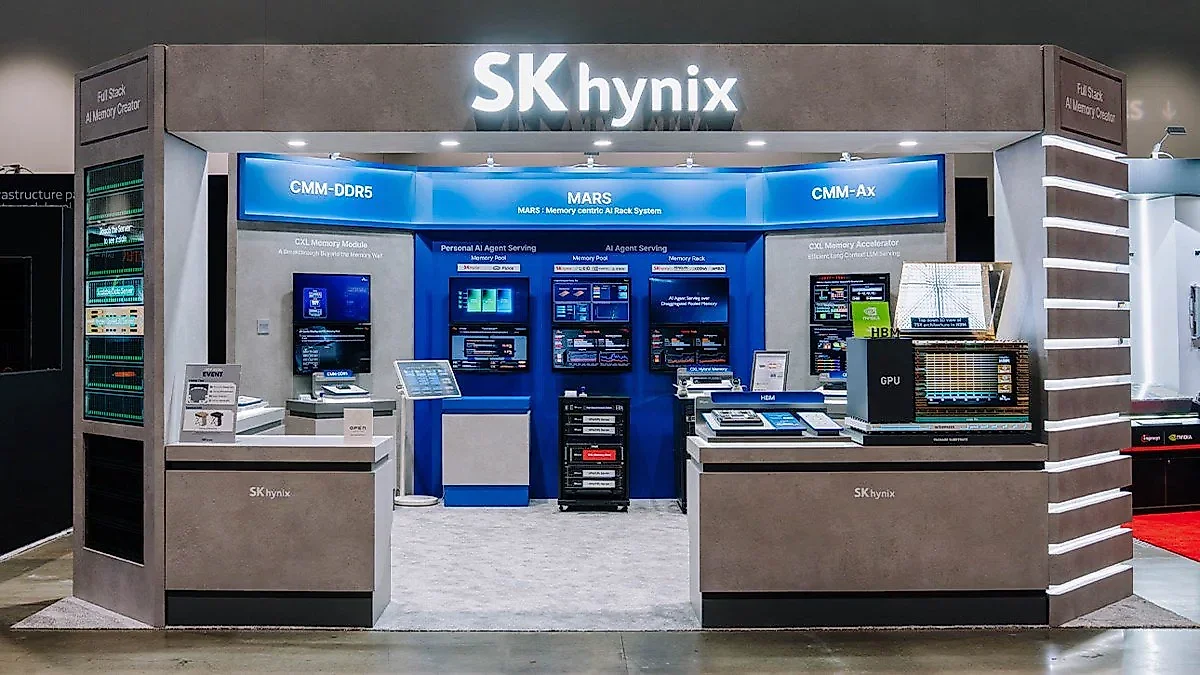
At the OCP Global Summit 2026 in San Jose, SK hynix unveiled a memory-centric infrastructure vision featuring CXL-based pooled memory to address AI data bottlenecks. The company demonstrated second-generation CMM-DDR5 products that offer 80GB/s bandwidth and a 30% improvement in energy efficiency.
As the volume of data handled by artificial intelligence (AI) increases explosively, the "data bottleneck," a limitation of existing computing structures, has emerged as a core challenge. To resolve this, SK hynix proposed a solution for next-generation AI data centers by presenting a "memory-centric infrastructure" vision that shifts the focus of servers toward memory.
Participating in the OCP Global Summit 2026 held in San Jose, California, from the 12th to the 15th, SK hynix unveiled a wide range of next-generation memory solutions. The core of this exhibition focused on proving system-level technological capabilities that increase the efficiency of entire server systems based on CXL (Compute eXpress Link) technology, moving beyond simple component supply.
Maximizing AI agent performance with CXL-based 'pooled memory'
The core of the next-generation server ecosystem presented by SK hynix is "CXL (Compute eXpress Link) pooled memory." CXL is a next-generation interface that efficiently connects CPUs, GPUs, and memory to support high-capacity and ultra-high-speed computing. In particular, through the "pooling" function, multiple servers can share memory resources as needed, maximizing resource utilization.
The exhibited "CMM-DDR5" is a second-generation product (256GB) based on the CXL 3.2 standard, which features more than double the bandwidth (80GB/s) of the previous generation and an improvement in energy efficiency of approximately 30%. SK hynix used this to verify the effectiveness of a "KV Cache (Key Value Cache)" sharing solution, which is essential in Agentic AI environments. KV Cache is temporary memory used by AI models to remember conversation content, and its capacity surges as conversations with users grow longer. This demonstration showed that CXL-based solutions can effectively resolve bottlenecks in high-load AI environments.
The "MARS (Memory Centric AI Rack System)," which integrates partner solutions into a single rack centered around memory, also drew attention. SK hynix conducted various demonstrations in cooperation with global partners such as Arcee, Liqid, and Marvell. In particular, demonstrations conducted with AMD and Penguin proved the process of efficiently storing and rapidly reusing large-scale KV Cache using CXL memory and hybrid memory. Additionally, the company shared results with the personal AI agent company Pickle, showing improvements in service response latency through pooled memory-based streaming technology.
Reducing power and cost burdens with computing-enabled 'CMM-Ax' memory
The "CMM-Ax" solution was also unveiled to address power consumption and cost issues in data centers. CMM-Ax is a form that combines computing functions inside the memory, performing computations directly within the memory without moving data to the CPU. This drastically reduces the power consumption and latency that occur during the data movement process.
SK hynix showcased a demonstration using CMM-Ax to accelerate "Long Context" processing performance, which was difficult to handle in existing GPU-based systems. Considering the characteristics of Large Language Models (LLMs), which require more memory as the context grows longer, CMM-Ax is expected to become a key technology for next-generation AI inference systems. The related research results were accepted by MICRO 2026, a highly authoritative conference in the field of computer architecture, recognizing its technical excellence.
A complete AI memory portfolio from HBM to next-generation HBF
A product lineup connecting the present and future of SK hynix was arranged in one part of the exhibition space. A wide portfolio was introduced, ranging from eSSD (enterprise SSD), a mainstay of AI infrastructure, to DRAM for servers. In particular, the exhibition announced readiness to respond to various customer needs by displaying the "PEB210" series, which supports liquid cooling (DLC), and the "256GB 3DS RDIMM," which implements the largest capacity in the industry.
In the HBM (High Bandwidth Memory) section, physical products of each generation, such as HBM4 and HBM3E, were exhibited alongside a model of the Vera Rubin Superchip, symbolizing a solid partnership with NVIDIA. Of particular note was "HBF (High Bandwidth Flash)," a next-generation NAND solution. HBF is a product that applies TSV (Through-Silicon Via) technology, similar to HBM, adding high bandwidth to the high-capacity characteristics of existing storage.
SK hynix presented a differentiated strategy, suggesting that while HBM is optimized for environments requiring fast response speeds, HBF has strengths in high-capacity memory demand environments that must provide services to many users. During a presentation session, Vice President Kim Ho-sik emphasized the transition to memory-centric infrastructure, stating, "The memory-centric AI rack system implemented with next-generation CXL technology is a structure that can significantly increase the data movement speed of high-load workloads."
Source: news.skhynix.co.kr
0Comments
Comments are currently disabled.