
Synchronization with AI becomes the new formula for professional survival
As concerns grow regarding AI replacing human labor, the ability to "sync" with AI—aligning its operations with human workflows—is emerging as a critical factor for survival.
To avoid being left behind in the AI era, professionals must move beyond simple usage toward "syncing" their work objectives and experiences with AI. This synchronization, which multiplies AI intelligence by the level of user alignment, is essential as technology evolves from reasoning tools to autonomous agents.
As concerns grow that artificial intelligence (AI) will replace human work, the ability to "sync"—aligning one's way of working with AI rather than simply using it—is emerging as a key to survival. Analysis suggests that no matter how high AI intelligence rises, productivity gains will remain limited without a connection to the user.
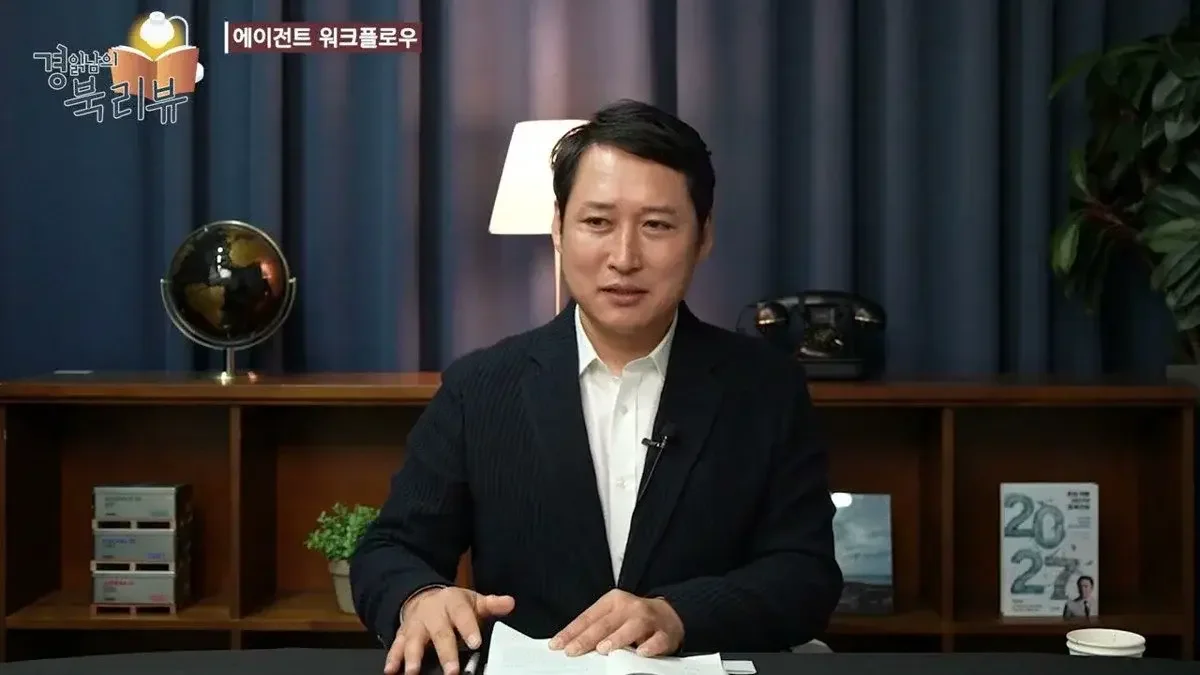
According to a review of the book 『Agent Workflow』 by Ro Sajang (Kim Da-sol) presented by The Man Who Explains the Economy (Kim Kwang-seok TV), the new rule of work in the AI era is not about knowing every AI model, but about how deeply one can synchronize themselves with AI. The video explains that in the face of a massive wave of AI, those who do not respond will merely "sink" (sink); to avoid sinking, "sync" (synchronization) is essential.
"Are you working with a new employee who arrives fresh every day?"
Many users feel limits to their efficiency even while utilizing AI because they treat it like an "unsynced new employee." If tasks are assigned to an AI that does not know the user, it may produce fast and plausible results, but there is a high possibility that the output will have nothing to do with the user's actual purpose or context. This is akin to assigning work to a new employee without any training or learning.
The video explains that just as one cannot assign work to a new employee without education and training, the same applies to AI. "Sync" is the process of connecting the user's records, experiences, work objectives, judgment criteria, and organizational rules and feedback to the AI, allowing the AI to move from the same starting point as the user. Synchronization is not merely a technique to make AI mimic a user's tone, but a process of becoming an "operating system" for working with AI.
As synchronization deepens, the AI begins to reflect past feedback, apply criteria that the user deems important, and even anticipate the next necessary task. Ultimately, practical AI capability is determined by the value of "AI intelligence" multiplied by the "level of synchronization with oneself and the organization." The gap between those who utilize AI and those who simply use it is expected to widen further.
Evolution from reasoning to agents and organizational AI
Ways of working are fundamentally changing according to the stages of AI development. The current era is moving from the "reasoning AI" stage, which answers questions, to "agent AI," which performs tasks on behalf of the user, and further toward the emergence of "organizational AI" that performs administrative tasks for companies or nations. If agent AI is a secretary that handles an individual's work, organizational AI is an entity that handles the work of companies or institutions. "AI Transformation (AX)," where companies introduce AI to change their work systems, may also manifest at the individual level through the use of agent AI.
The book presents four agendas called "Sync Code" as the core framework to respond to these changes: ▲"Story," which gives our memories to the AI; ▲"Why," which provides the goals for the AI to pursue; ▲"Native," which creates a structure for humans and AI to work together; and ▲"Cycle," where the structure repeats and evolves on its own. This implies that AI should not be treated as a "tool" to be used once and discarded, but as a "formula" to work together in the manner of oneself and the team. While a tool is discarded after one use, a formula continues to be used until that formula itself is changed.
Redefining productivity: "Maintain working hours but increase output"
The concept of productivity following the introduction of AI is redefined from the perspective of "Input vs. Output." The denominator, input, refers to the labor and time invested, while the numerator, output, refers to the results produced. There are two strategies to maximize productivity: first, maintaining the same amount of labor time while explosively increasing output through AI; and second, keeping output constant while drastically reducing labor time through AI.
The video defines the situation not as work disappearing, but as the grammar of work that worked in the past disappearing and new grammar emerging. It also mentioned that due to the development of medical technology to overcome cancer and obesity between the late 2020s and 2030, humanity will live in an era of 100 or 150 years. Accordingly, the importance of hobbies that enrich life is emphasized alongside economic stability. The suggestion is that if concerns about making a living decrease, whether or not one has a hobby will become a crucial task that determines happiness.
Source: original video (YouTube)



0Comments
Comments are currently disabled.