
Political uncertainty in France could drive a stronger US dollar
Analyst Min Gyeong-won predicts the won-dollar exchange rate will rise through the end of next year, driven by political instability in Europe and the potential for a weaker Euro.
The won-dollar exchange rate is projected to rise through the end of next year as political instability in France could weaken the Euro and trigger a global strong dollar phenomenon. During a seminar on the 9th, analyst Min Gyeong-won warned that the potential election of Marine Le Pen could increase market volatility.
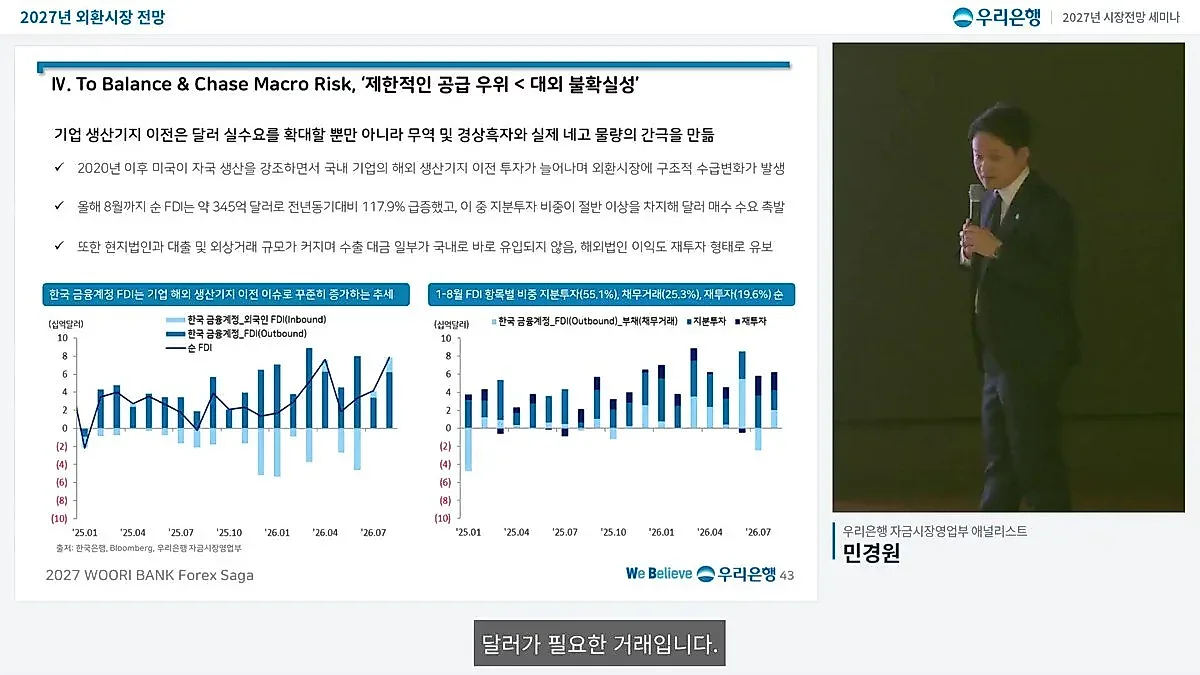
While the won-dollar exchange rate saw a downward trend in the second half of this year due to a "supply and demand effect"—where dollar selling from heavy industry companies flowed into the market alongside semiconductor exports—this temporary effect is expected to vanish next year. Analysts forecast that political uncertainty originating from Europe could increase volatility in global financial markets and drive the exchange rate higher.
During the "2027 Market Outlook Seminar" held on the 9th, Woori Bank analyst Min Gyeong-won analyzed the foreign exchange market trends for 2027, projecting that the exchange rate will hit a low in the first quarter of next year before rising through the end of the year. Regarding the sharp drop in the exchange rate this past July, Min diagnosed that "rather than an inflow of volume from semiconductor companies, unexpected dollar selling from heavy industry companies flowed into the market, causing the exchange rate to slide into the mid-1,300 won range." He explained that while semiconductor demand has been steady since the beginning of this year, the exchange rate plummeted in July before the market could respond as heavy industry order demand flowed into forward selling. He added that as heavy industry volume is converging back to average levels in August and September, it will be difficult to expect the massive dollar inflows from current account surpluses seen previously, noting that while supply may still lead, it will only be by a "slight margin."
French presidential election and 'Marine Le Pen' risk... Euro weakness leads to strong dollar
Min identified political uncertainty in Europe as a key variable for the foreign exchange market next year, specifically warning of the French presidential election starting in February and the possibility of the far-right candidate Marine Le Pen being elected. Marine Le Pen is also the individual who coined the term "Frexit." Currently, anti-government protests against the center-right led by President Macron are intensifying in France, with Marine Le Pen's approval ratings holding the top position.
Min specifically pointed to the instability of the political situation in France. "President Macron made a decisive move by dissolving the assembly in June 2024, but it resulted in failure as three political parties split the seats without a majority party," he said. He predicted that "if Marine Le Pen is elected, there is a high possibility that the assembly will be dissolved again since seats are already fragmented, and presidential political uncertainty will rise as a main theme for the market."
He cited the case of the populist Five Star Movement party taking a single-party dominance in Italy in 2018. Just as the spread between Italian and Germany government bond yields surged at that time, causing sentiment toward Euro assets to deteriorate, a similar pattern could emerge in France. "When political uncertainty in Europe increases, people sell the Euro, leading to a collapse in its value," Min projected. "As the Euro accounts for 57% of the DXY, the weakness of the Euro will trigger a global strong dollar phenomenon."
Fiscal deficits and interest burdens... concerns of spreading to global credit risk
Political uncertainty may not stop at currency values but could extend to national fiscal health issues. France's fiscal deficit ratio relative to GDP has already exceeded the 3% threshold set by the EU's fiscal rules. Min explained, "If government bond yields rise, there is a burden to refinance maturing bonds at higher rates. If yields rise further due to political risk when rates are already elevated, interest expense expenditures based on effective interest rates could surge, falling into a vicious cycle where the debt ratio worsens further."
This phenomenon is also applicable to Italy. Min warned, "The reason Italy's debt ratio declined since 2021 was thanks to the rise in nominal growth rates caused by inflation, but as inflation is caught, the debt ratio is rising again. Once refinancing begins at market rates, Italy's interest expense outflows will also increase at a very rapid pace."
The issue is that these risks could spread to credit risk across developed nations. In the United States and Europe, large-scale High Yield bonds scheduled to mature in 2028 will face market tests starting next year. Typically, High Yield bonds begin the review process for refinancing or loan extensions one year before maturity. Min emphasized, "In a situation where base rates are high, if corporate credit spreads also widen, companies may fail to secure funding as they cannot withstand the elevated interest rates. Uncertainty from France will become a key keyword increasing volatility in global financial markets." He concluded that the won is also one of the vulnerable currencies amidst such volatility, with a high possibility of the exchange rate rising due to speculative demand.
Source: original video (YouTube)



0Comments
Comments are currently disabled.