
KOSPI and Samsung Electronics face technical rebound hopes amid trend deviation
Professor Kim Young-ik suggests a technical rebound is possible for the KOSPI and Samsung Electronics as they have deviated significantly from their trends, though he warns of a continued range-bound market due to slowing economic indicators.
The KOSPI and Samsung Electronics have deviated from their trends by approximately 26% and 27% respectively, potentially triggering a technical rebound. However, Kim Young-ik warned that a full-scale trend reversal may be limited as the OECD leading index has fallen for three consecutive months since peaking in July.
With the KOSPI and Samsung Electronics stock prices plunging and deviating significantly from their trends, the possibility of a technical rebound has been raised. However, analysis suggests there are limits to a full-scale trend reversal as the leading economic index continues its downward trend.
According to the market outlook provided by Professor Kim Young-ik, the KOSPI is currently deviating downward from its trend by approximately 26%. This represents the largest deviation since the 1997 foreign exchange crisis, and Samsung Electronics is also hovering at a level about 27% lower than its trend. "Because it has fallen so far below the trend, a technical rebound is possible at any time, and now could be that time," Kim diagnosed.
U.S. Inflation and Interest Rate Outlook: "Possible Slowdown After February Next Year"
U.S. inflation indicators, key metrics for judging market conditions, appeared higher than expected. The U.S. Consumer Price Index (CPI) for October rose 0.4% from the previous month, exceeding the market expectation of 0.3%. Headline inflation also recorded 0.3%, higher than the expected 0.2%. As inflation came in higher than expected, stock prices fell, while Treasury yields and the dollar index rose. However, a year-on-year comparison for this month was impossible because data was not released for the same month last year due to the U.S. government shutdown.
Kim predicted that U.S. inflation will maintain high levels around 4% until January next year. However, he analyzed that the upward trend is highly likely to slow down after February next year due to shrinking demand. He explained that while a surge in oil prices this year acted as a major cause for the November inflation rise, the stabilization of oil prices in November could act as a factor for future inflation decreases. He noted that while rising oil prices push up inflation in the short term, they become a factor that reduces GDP growth after a time lag of five quarters.
Regarding the monetary policy of the Federal Reserve, Kim forecasted a very high possibility of an interest rate hike at the December FOMC, as both inflation and employment indicators exceed target levels. Most investment banks (IBs) expect an interest rate hike in December, with the market anticipating a hike by 85% and a 0.50 percentage point hike by 15.5%. While some IBs expect one more hike in March next year and will monitor through June and September, Citi forecasted a single hike in December followed by a hold, and then an interest rate cut between June and September next year.
Kim observed that if the Taylor rule is applied theoretically, interest rates would rise in the fourth quarter. However, he analyzed that if next year's economic growth slows due to consumption, causing the GDP gap to turn negative, the possibility of an interest rate cut would increase. Furthermore, stating that "consumer prices precede Treasury yields," he predicted that the 10-year Treasury yield would remain around 5% until January next year, but if the inflation rate slows after February, Treasury yields could also fall significantly.
Concerns Over Slowing Semiconductor-Led Export Growth and Undervalued KOSPI
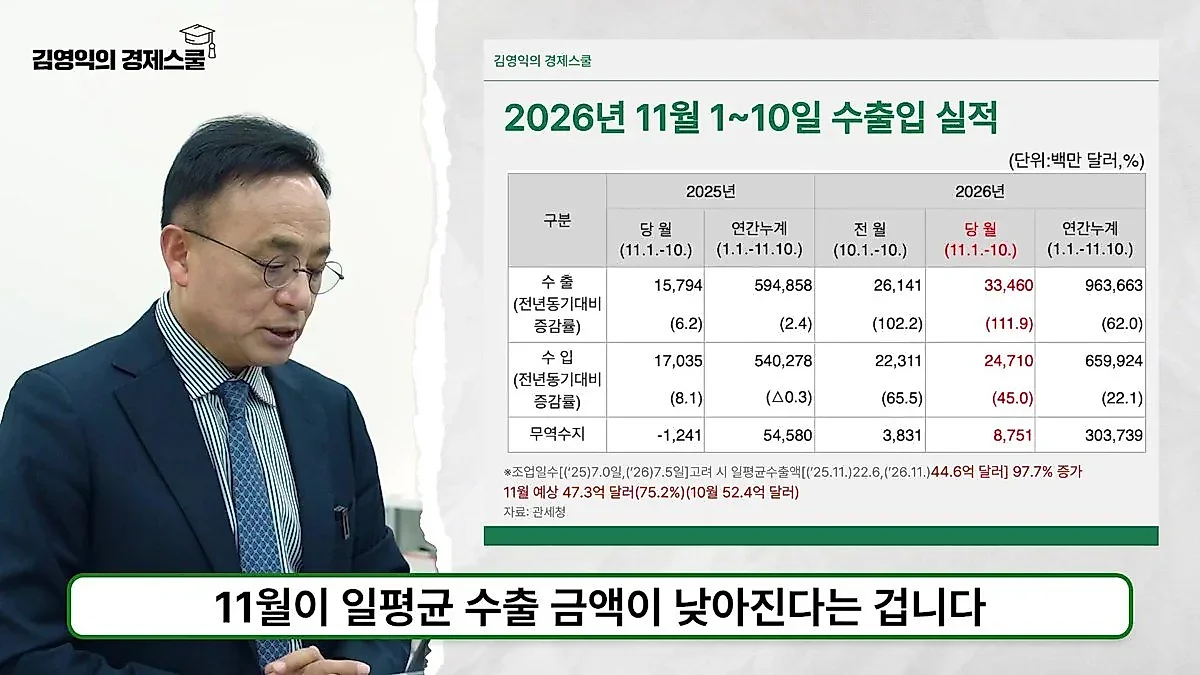
Domestic economic indicators, such as export trends, still show robust figures, but a cautious approach is required when examining detailed metrics. According to the import and export trends released by the Korea Customs Service for the period from November 1 to November 10, the export growth rate recorded a high figure, increasing 112% compared to the same period last year. However, Kim cautioned that this figure might be an illusion caused by the number of working days, noting that working days increased by 0.5 days compared to last year.
The situation differs when looking at the average daily export amount, a more practical indicator. While the average daily export amount in early November was $4.46 billion, a 97.7% increase compared to the same period last year, this is a decrease compared to the $5.24 billion recorded in October. In particular, the semiconductor sector, a core component of Korean exports, has also seen its early November average daily export amount fall below the October figure of $2.57 billion. The semiconductor export share accounts for 49.7%, representing half of all exports, but the average daily amount has decreased from October to $2.22 billion. Kim predicted that "as the OECD leading index has been falling for three consecutive months since peaking in July, the monthly export growth rate for November will likely be lower than that of October."
Reasons for the sluggish semiconductor stock prices include concerns over reduced AI investment in the United States, the pursuit of DRAM technology by China's CXMT, and the possibility of the Democratic Party regulating AI data centers. These factors are compounded by the 'Jensen scandal,' in which NVIDIA's stock price fell approximately 10% in just two days. Kim analyzed that while these factors must improve for the KOSPI to begin a full-scale ascent, improvement will be quite difficult.
Regarding the direction of the KOSPI, Kim mentioned that the appropriate KOSPI level, calculated based on the average daily export amount, is approximately 5,318 points, diagnosing that current prices are in an undervalued zone. However, he predicted that the stock prices may continue to undergo adjustments at a certain level for about a year in a 'range-bound KOSPI' pattern, stating, "It looks very difficult for the average daily export amount to exceed the levels of this past September even next year."
Recommendation to Increase 'Cash-like Assets' Through the First Half of Next Year
In conclusion, Kim predicted that while the KOSPI has entered an undervalued zone and the possibility of a sharp plunge is low, it will move within a 'range' as the economic contraction phase continues. Regarding the U.S. S&P 500 index, he noted that while it rises much more than the inflation rate in the long term, there was a case during the 2000 IT bubble burst where it took 10 years for nominal prices to return to their place and 13 years for real prices to recover. He warned that current U.S. stock prices may have a larger bubble than in 2000, and future 10-year returns could be lower than in the past or real returns could become negative.
As a resulting investment strategy, Kim recommended adjusting weightings rather than aggressive buying. "A short-term rebound can be expected, but it is not a trend ascent," he advised, adding, "If your stock weight is high, it is good to reduce it and increase the weight of cash-like assets or short-term bonds to hold until the first half of next year." He further added, "If you wait until the first half of next year, a good opportunity to buy stocks cheaply will come."
Source: original video (YouTube)


0Comments
Comments are currently disabled.